
Anthropic, the company behind Claude, is not owned by any one company. Its owners are a mix of its seven co-founders, its employees, venture and growth investors, and two tech giants, Amazon and Google, that have put billions of dollars into it. Control is a separate question: a trust and a founders' company hold special shares that decide who sits on the board.
This guide explains who owns what, using Anthropic's own Form S-1 registration statement, the document it filed with the US Securities and Exchange Commission on October 26, 2026, to prepare for an initial public offering. Unless we say otherwise, every figure below comes from that filing and is dated as the filing dates it (most ownership data is as of September 30, 2026; investment figures run through June 30, 2026). The filing leaves most ownership percentages blank until the share price is set, and the numbers will change once the company lists, so treat this as a snapshot.
The short answer
- Co-founders: Dario Amodei, Daniela Amodei, Tom Brown, Jack Clark, Jared Kaplan, Sam McCandlish and Christopher Olah each beneficially own between 231,809,780 (Sam McCandlish) and 244,173,040 (Tom Brown) Class A shares, according to the S-1's ownership table. Dario Amodei's total rises to 245,259,100 with shares he votes by proxy.
- Amazon and Google: both "will each hold greater than five percent" of Anthropic's outstanding capital stock after their preferred shares and notes convert, the S-1 says. Their shares are non-voting.
- Other investors: venture and growth funds that bought preferred stock in rounds such as Series E, G and H. The S-1 names Spark Capital, whose partner Yasmin Razavi sits on Anthropic's board, among buyers in the latest round.
- Employees: hold stock options and restricted stock units, and will also get a special non-economic share class (Class E) with limited voting rights.
- A public benefit fund: Anthropic gave its own Anthropic Public Benefit Fund 5% of its fully diluted shares as of June 30, 2026, assuming full conversion of the Amazon Notes.
- Control: the Long-Term Benefit Trust elects a majority of the board, and a founders' LLC will hold 50.1% of the votes on most other shareholder matters.
Why "who owns it" and "who controls it" have different answers
At most companies, owning more shares means more votes. Anthropic split those apart on purpose. It is a public benefit corporation (PBC), which means its board must balance shareholder returns with a stated public purpose: in the S-1's words, "the responsible development and maintenance of advanced AI for the long-term benefit of humanity."
To protect that purpose, Anthropic created several share classes. The S-1 describes them this way:
- Class A: ordinary shares with one vote each. This is what the public will buy in the IPO, and what founders, employees and most investors will hold.
- Class N: the same economic rights as Class A, but no votes (except where the law requires). The S-1 says holders "are primarily strategic business partners." Class N shares generally become Class A if sold or transferred to an unaffiliated third party.
- Class T: one share, held by the Long-Term Benefit Trust. It lets the trust elect and remove the "Class T directors," who will make up a majority of the board. It has no economic rights.
- Class F: one share, to be held by a company the co-founders set up (the Founder LLC). It carries 50.1% of the total voting power on most shareholder votes, including electing the directors the trust does not pick. It has no economic rights.
- Class E: issued to employees other than the co-founders. It votes "only on certain limited matters" and has no economic rights.
So a company could own a large slice of Anthropic's value and still have no say in who runs it. That is exactly the position of Amazon and Google.
Amazon's stake
Amazon is Anthropic's primary cloud provider and training partner, as Anthropic described it in November 2025. The S-1 details how Amazon's money came in:
- 2023 notes: a deal for up to $4.0 billion of convertible notes, issued in two tranches in September 2023 and March 2024. Anthropic received $4.0 billion in proceeds ($1.2 billion plus $2.8 billion); the second tranche carried a higher face value of $3.4 billion.
- 2024 notes: another $4.0 billion, issued in three tranches of $1.3 billion (November 2024), $1.3 billion (May 2025) and $1.4 billion (November 2025).
- Series H: $5.0 billion of preferred stock in May 2026.
- 2026 agreement: a deal signed in April 2026. Under it, Amazon bought 19.3 million shares of non-voting Series G-2 preferred stock for about $5.0 billion, and Anthropic may issue up to $20.0 billion of non-voting stock or notes to Amazon later. The $5.0 billion Series H purchase reduced the amount left to $15.0 billion.
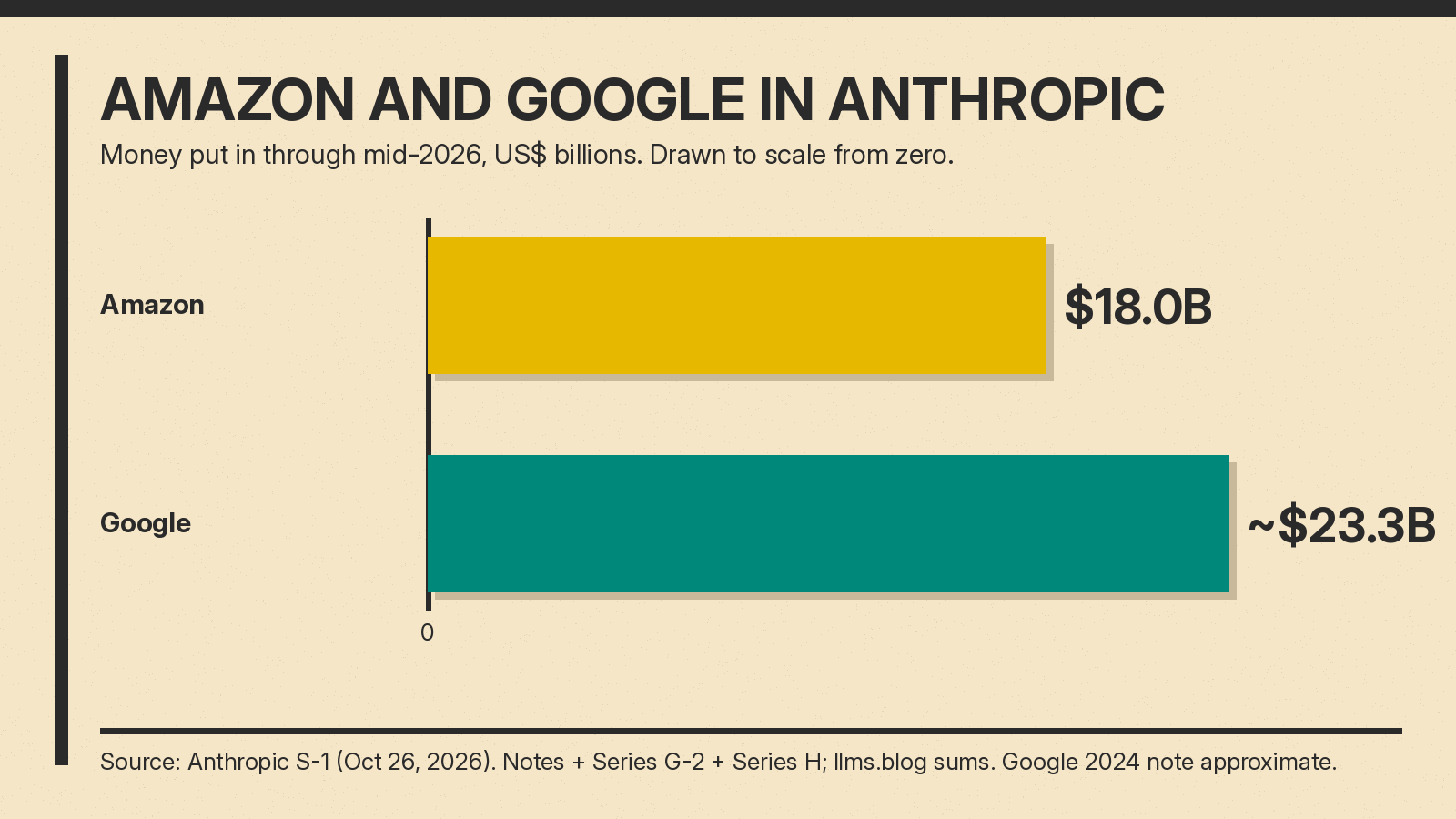
Adding the 2023 notes, the 2024 notes, the Series G-2 purchase and the Series H purchase gives about $18.0 billion of money in through mid-2026. That is our arithmetic from the S-1's figures, not a total Anthropic states.
The notes are designed to turn into shares. Part of the 2023 notes already converted into non-voting Series E-2 preferred stock in 2025, and the S-1 says about $6.2 billion of note principal remains outstanding. At the IPO, the S-1 says, "the Amazon Notes will convert into Class N common stock," subject to an ownership cap. That cap stops a conversion if Amazon would end up with more than 12% of Anthropic's capitalization (counted to include equity awards and other convertible securities), unless Amazon chooses to waive it. Any amount that cannot convert stays as a note and converts at the end of later quarters, as room under the cap allows.
Google's stake
Google's path is similar, per the S-1:
- 2023 notes: up to $2.0 billion, issued as $500 million (September 2023), $750 million (September 2024) and $750 million (September 2025). All of it has since converted into non-voting preferred stock.
- 2024 note: about $1.3 billion, also converted into non-voting preferred stock in 2025.
- Series H: $10.0 billion of preferred stock in May 2026.
- 2026 agreement: signed in March 2026. Under it, Google bought 38.6 million shares of non-voting Series G-2 preferred stock for about $10.0 billion, and Anthropic may issue up to $30.0 billion of notes or non-voting stock through December 31, 2030. The Series H purchase reduced the remaining amount to $20.0 billion.
That is about $23.3 billion in through mid-2026, again by our arithmetic. Google's 2026 agreement has its own cap: it limits share issuances that would push Google's ownership above 14.99% of Anthropic's capitalization on a post-money, as-converted basis, unless Google waives it. The S-1 also says Anthropic granted Google "an option to purchase up to $10.0 billion" of Class N stock in a private placement alongside the IPO, at the IPO price.
Amazon and Google are also large suppliers. The S-1 says Anthropic committed in March 2026 to spend at least about $114.5 billion with Google between April 2026 and July 2033. Both companies sell Claude to their own cloud customers.
Microsoft and Nvidia
Microsoft and Nvidia came in later. In November 2025, Anthropic announced that "NVIDIA and Microsoft are committing to invest up to $10 billion and up to $5 billion respectively in Anthropic." The S-1 does not list either company as a holder of more than 5% of a voting class, so their stakes, whatever their final size, sit below that reporting line or in non-voting shares.
Microsoft is also a supplier: the S-1 says Anthropic committed to spend at least $44.9 billion with Microsoft between November 2026 and May 2033.
The founders
The S-1's ownership table lists seven co-founders. Each beneficially owns between 231,809,780 and 244,173,040 Class A shares (245,259,100 for Dario Amodei, counting shares he votes by proxy), figures that include options and stock units vesting within 60 days of September 30, 2026. Because the percentages are blank in this version of the filing, we do not convert those share counts into ownership percentages.
Two details matter:
- Charity pledges. The S-1 says the co-founders "have each pledged to dedicate 80% of their personal equity in Anthropic to philanthropic causes." Dario Amodei also holds voting proxies over about 4.6 million shares owned by donor-advised funds.
- Selling in the IPO. Several co-founders are listed as "selling stockholders," meaning they may sell some shares in the offering. The number of shares has not been filled in.
Control is where the founders' position is strongest. Through the Founder LLC's single Class F share, the "Continuing Founders" will control 50.1% of shareholder votes on most matters. That share stays in place until a 450-day transition period ends, which starts once there have been fewer than three Continuing Founders for 90 days in a row. It can end sooner if a supermajority of the Continuing Founders agrees or the LLC dissolves. For more on this, see our S-1 explainer, including who controls the company.
Venture and growth investors
Most of Anthropic's outside money came through preferred stock rounds. The S-1 gives the sizes of the two most recent:
- Series G-1 (January to February 2026): about $23.5 billion at $259.1364 per share.
- Series H-1 (May to June 2026): about $45.7 billion at $589.0095 per share.
Google's $10.0 billion and Amazon's $5.0 billion also went into the Series H financing, but the S-1 reports them separately from the Series H-1 total, so we do not add them together.
The filing names only "related persons" among the buyers, such as Spark Capital (about $440 million in Series H-1) and a company owned by director Vas Narasimhan. Other funds that took part are not listed in this section. All preferred stock converts into common stock at the IPO, the S-1 says.
Employees
Employees hold stock options and restricted stock units, though the S-1's ownership table does not break out an employee total. After the IPO, employees other than the co-founders will also hold Class E stock. It has no economic value. One of the few matters it votes on, per the S-1, is a board seat: if the board's nominating committee does not agree with the trust's choice for one specific trust-appointed board seat, the question can go to a vote of Class E holders.
The S-1 also describes a donation matching program: employees can pledge part of their equity to charity, and Anthropic matches with Class N shares.
The Anthropic Public Benefit Fund
Anthropic contributed 846,840,960 Class N shares, "representing 5% of our fully diluted shares as of June 30, 2026," assuming full conversion of the Amazon Notes, to the Anthropic Public Benefit Fund, a wholly owned subsidiary. The board may issue up to another 2% each time the share price rises 50% above the previous milestone, starting from the IPO price. We covered the original commitment in Anthropic commits 5% initial equity to its public benefit fund.
The Long-Term Benefit Trust
The trust owns no economic stake at all: its one Class T share has no economic rights. Its power comes from electing the Class T directors, who will be a majority of the board. The S-1 describes it as "an independent body of financially disinterested trustees with expertise in AI safety, national security, public policy, and social enterprise." Our explainer on the Long-Term Benefit Trust covers its powers and trustees.
Who could own more later
Several deals could add new Class N holders or grow existing ones after the IPO:
- Amazon's remaining $15.0 billion and Google's remaining $20.0 billion under their 2026 agreements.
- Google's option to buy up to $10.0 billion alongside the IPO. If used, the S-1 says it would reduce Google's remaining 2026 agreement amount by up to that sum.
- A Broadcom agreement for up to $42.0 billion of notes that can convert into Class N stock. Broadcom may assign it to a financing partner with Anthropic's consent. We explained that deal in Broadcom's $63B Anthropic chip deal.
Those three agreements total $77.0 billion of possible future issuance, according to the S-1's summary table, though Google's option, if exercised, reduces it by up to $10.0 billion.
What to check after the IPO
Once the offering prices, Anthropic will file an amended S-1 or a final prospectus with the blank percentages filled in. Large holders such as Amazon and Google also have to report their stakes. Those filings, not this snapshot, will give exact ownership percentages.
