
Anthropic is adding its invisible text watermark to older Claude models. The Claude Platform release notes for November 3, 2026 say text from Claude Mythos 5, Claude Opus 4.7 and Claude Sonnet 4.6 now carries the watermark, and a second group of models is due on November 16, according to The Decoder. For developers and teams that need to tell Claude text from human text, the details of which models, which settings and which checks work matter more than the headline.
What changed on November 3
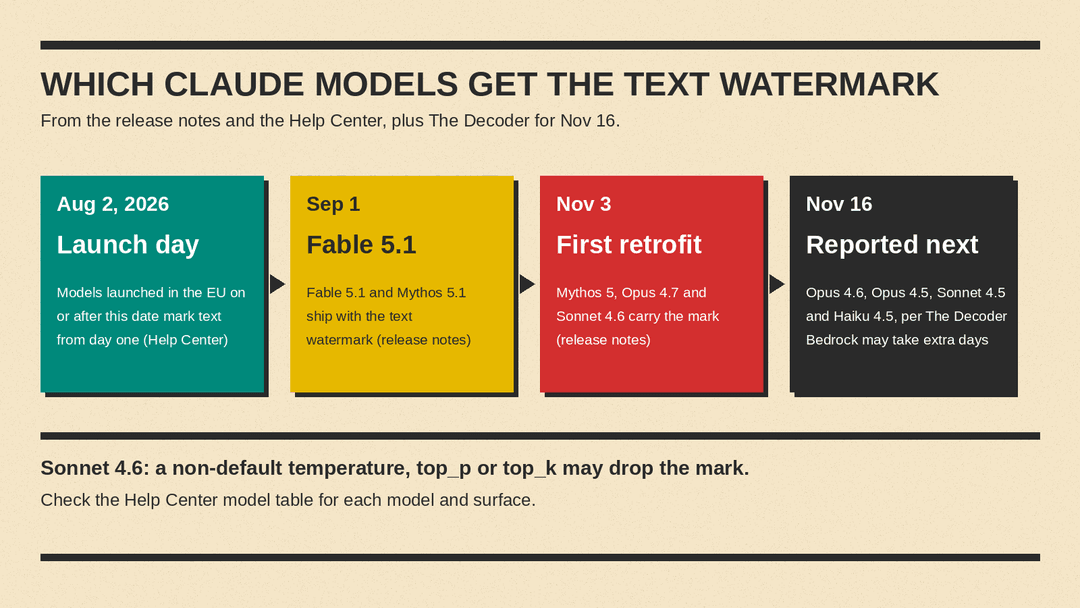
The release notes say text generated by Claude Mythos 5, Claude Opus 4.7 and Claude Sonnet 4.6 carries Anthropic's text watermark on the platforms listed in the Claude Help Center article on how Claude marks AI-generated content. Earlier, the September 1 release notes said Claude Fable 5.1 and Claude Mythos 5.1 shipped with the watermark. Marking needs no changes to API requests or response handling.
There is one caveat on Sonnet 4.6. The release notes say text generated for a request that sets temperature, top_p or top_k to a non-default value might not carry the watermark. The text watermark documentation tells developers who rely on the mark to "omit all three parameters from your requests, including any that a framework or client library sets for you."
The second wave, as reported
The Decoder reports that Anthropic emailed API customers about a second round. Per that report, from November 16, 2026, Claude Opus 4.6, Claude Opus 4.5, Claude Sonnet 4.5 and Claude Haiku 4.5 will get text watermarking, and the rollout on Amazon Bedrock may take a few extra days. The Decoder also reports that Opus 4.6 was originally in the first group for November 3, and that the email confirms the delay without giving a reason.
The Decoder says all four models in the second wave share the same sampling limit: the watermark applies only when the three sampling settings stay at their defaults. Anthropic's own pages are narrower. The documentation names only Sonnet 4.6, and the Help Center's limits list names Opus 4.6 and Sonnet 4.6. The Decoder quotes the email as saying, "If you rely on the watermark for your own compliance, keep these settings at their defaults." We could not see the email, so check the current Anthropic pages before relying on any one model.
The Help Center article lists 16 Claude models in its watermark table, from Fable 5.1 to Haiku 4.5. When we checked on November 4, the table showed no text watermark mark for Claude Opus 4.6, Opus 4.5, Sonnet 4.5 or Haiku 4.5. Those are the four models The Decoder lists for November 16. The page itself is the place to check each model and surface. A footnote on the page says the rollout on Amazon Bedrock will complete by November 10.
Why Anthropic is doing this
Anthropic says it signed the EU AI Act's Article 50(2) Code of Practice on Transparency of AI-Generated Content. In its August 14 explainer, the company said it signed the code in July 2026 along with around 190 signatories. Claude models launched in the EU on or after August 2, 2026 mark their output from the first day. Older models fall under a transition period, and Anthropic said it would roll out marking for them over the coming months. The Decoder says Anthropic points to the EU AI Act's December deadline as the reason for watermarking older models now. The European Commission's FAQ on Article 50 puts that date at December 2, 2026, for generative AI systems placed on the market before August 2, 2026.
Anthropic applies the watermark globally, because, in its words, it does not yet have a durable way to scope it by region. For the August rollout, see our post on how Anthropic implements text watermarks and C2PA provenance under the EU AI Act.
How the watermark works
Claude's watermark is a version of the SynthID-Text method that Google DeepMind published in a 2024 Nature paper. If you want the background on that method, see our explainer on what SynthID is and how to check content.
A language model picks each word from a list of likely candidates, and often several candidates are about equally good. Normally a random number settles the choice. With watermarking, a secret key and the few words before settle it instead. The choices still look random to a reader, but someone with the key can check whether a passage matches the pattern and get a probability that Claude wrote part of it. Anthropic says nothing is added to the text, no hidden characters are inserted, no extra tokens are used, and the price is unchanged. It also says the mark carries no information about the user, the organization or the chat.
Where the mark is weak
Anthropic is open about the limits, and they decide how far anyone can trust a check.
- Short passages give too little signal. Confidence grows with length.
- Exact answers leave no room for the mark. Anthropic's examples are a sum or a fixed fact. Code generally has less watermarking than some other text, though comments can carry it.
- Proofreading leaves little to mark, because nearly all the words are the person's.
- Light editing probably will not remove the mark. A complete rewrite of every word will.
- A translation by Claude carries the mark, because Claude chooses every word.
- A detected mark means Claude was likely involved. It cannot separate "Claude wrote this" from "Claude heavily edited this."
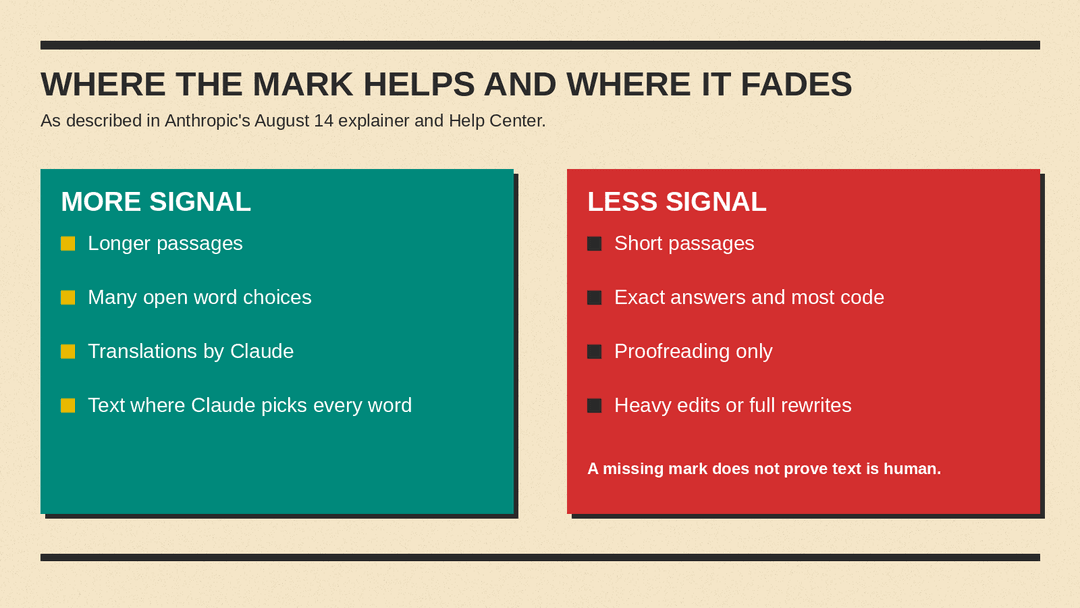
The Help Center adds that a missing mark proves nothing. Text from a model before marking was supported, text that was heavily edited or paraphrased, and text from Opus 4.6 or Sonnet 4.6 with non-default sampling settings can all lack a detectable mark. For how developers have tried to strip it, see our post on open-source workarounds for Claude's text watermark.
Who can check for it
Detection is not public. Anthropic's detection API is in private preview for eligible organizations, such as regulators, law enforcement, media, fact-checkers, independent researchers, educational organizations and EU civil society groups. Enterprises that must verify marks on their own Claude output to meet obligations under the Act can also use it. Anthropic plans to expand access over time, and there is a request form linked from its pages. Files are different: the Help Center says generated images and other supported files get Content Credentials (C2PA), which users can check with the free Claude Content Checker.
The Decoder also reports criticism. Blogger John Gruber argues that no two synonyms mean exactly the same thing, so choosing words by a watermark key instead of by fit must cost some precision. The legal outlet Artificial Lawyer raises a concern for law firms whose clients ban AI use, and for documents that carry several watermarks. Anthropic's own testing found no effect on content, creativity or readability, and it points to Google DeepMind's earlier test of the same method on Gemini traffic, which showed no statistically significant difference in user ratings.
What to do about it
Teams that build on Claude and plan to rely on the watermark should leave temperature, top_p and top_k unset on Sonnet 4.6 and, per Anthropic's Help Center, on Opus 4.6. They should also read the Help Center list for the models they use, since the schedule is still moving. Anthropic's Help Center says builders should independently assess what Article 50 requires of their products. Anyone planning to detect Claude text should expect weak results on short or heavily edited passages. For another change in the same week, see our post on Claude message threads.
Sources
- Claude Platform release notes, September 1 and November 3, 2026 entries
- Text watermark, Claude API documentation
- How Claude marks AI-generated content, Claude Help Center
- How Claude's text watermark works, Anthropic, August 14, 2026
- Anthropic's text watermark is easy to bypass on several older Claude models, The Decoder, November 4, 2026
- Transparency obligations under Article 50 of the AI Act, European Commission
