
This is an opinion piece. The facts come from the linked studies. The argument is mine.
A context window is a limit on how much text a model can take in at once. It is not a promise that the model will use all of that text well. Those are two different properties. My view is that readers should treat a big window as room to hold material, and treat the question "does the model still find and use the right part?" as something to test on their own task.
If you want the basics first, our explainer What Is a Context Window? How Much an AI Model Can Read at Once covers what the window is and how it is measured. This piece is about what the research says happens inside it.
Fitting is not the same as using
Three separate research efforts point the same way.
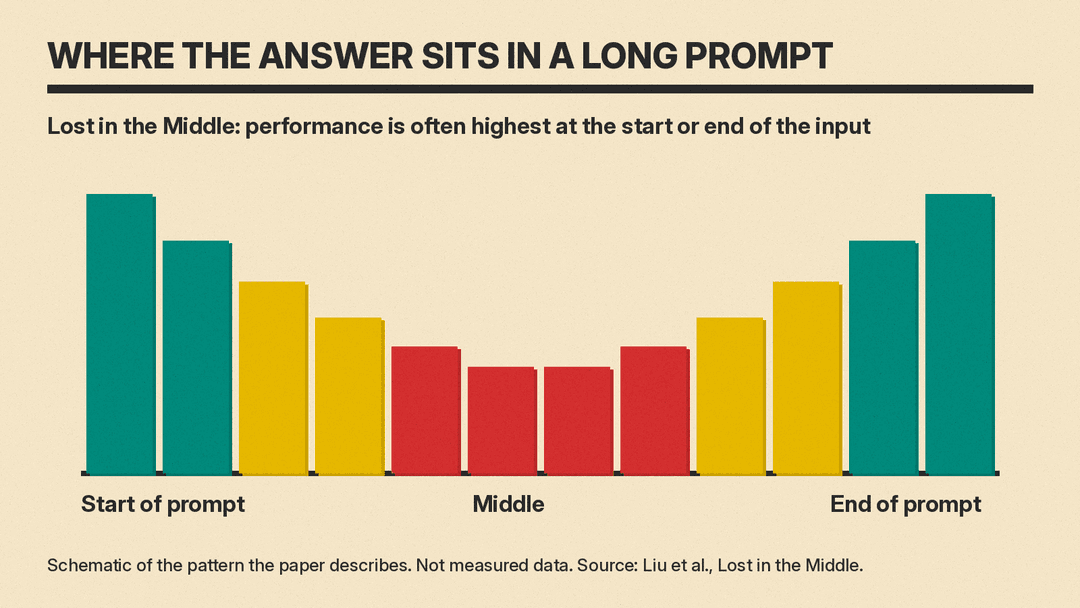
The first is Lost in the Middle, by Nelson F. Liu and colleagues, accepted for publication in the Transactions of the Association for Computational Linguistics. The authors tested language models on two tasks, multi-document question answering and key-value retrieval. They report that "performance can degrade significantly when changing the position of relevant information". They add that performance "is often highest when relevant information occurs at the beginning or end of the input context, and significantly degrades when models must access relevant information in the middle of long contexts, even for explicitly long-context models."
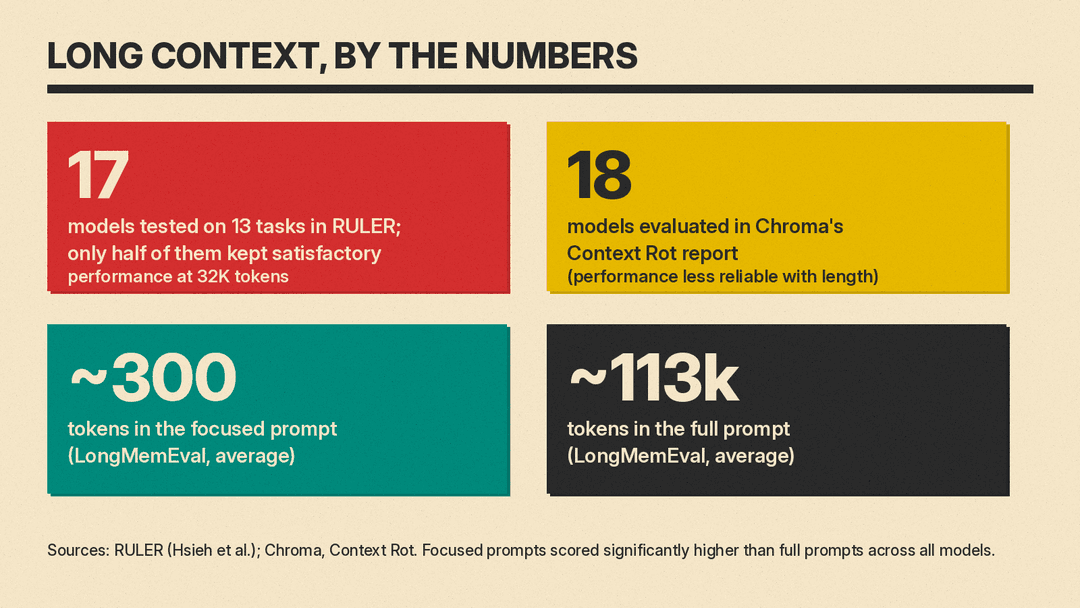
The second is RULER, by Cheng-Ping Hsieh and colleagues. It starts from the needle-in-a-haystack test, where a model must pull one planted sentence out of a long pile of unrelated text. The authors write that this test "is indicative of only a superficial form of long-context understanding". RULER adds more varied tasks, including multi-hop tracing and aggregation. The team evaluated 17 long-context models on 13 tasks. Their finding: "Despite achieving nearly perfect accuracy in the vanilla NIAH test, almost all models exhibit large performance drops as the context length increases." They also write that "While these models all claim context sizes of 32K tokens or greater, only half of them can maintain satisfactory performance at the length of 32K."
The third is Context Rot, a technical report from Chroma. It evaluated 18 models and concludes that "models do not use their context uniformly; instead, their performance grows increasingly unreliable as input length grows." The report notes that it is "often assumed that their performance is uniform across long-context tasks", and then sets out to test that assumption with tasks that keep the difficulty fixed while the input gets longer.
None of these papers says long context is useless. Each says that a model can accept a long input and still be unreliable on it, and that the usual headline test does not show this.
The result that matters most for everyday use
The most practical result in the Chroma report is about chat memory. The authors used LongMemEval, a benchmark of questions about earlier conversations. They compared two versions of each question. The focused version held only the relevant parts of the conversation, about 300 tokens on average. The full version held the whole history, about 113,000 tokens on average, most of it irrelevant to the question.
The authors write: "Across all models, we see significantly higher performance on focused prompts compared to full prompts." Their reading is that the full version adds a second job, because the model has to find the relevant parts and then reason about them in the same call.
That is a direct warning for a common design: keep every past message in the prompt and let a large window handle it. The Chroma result suggests that the same facts, handed over as a short and relevant excerpt, can do better than the same facts buried in a long history. Our post on the Memory Tax study covers a related question: a study of 11 agent memory systems found many score below plain RAG over the raw chat history. RAG, short for retrieval-augmented generation, means fetching the relevant passages before the model answers. If the term is new, our AI Glossary explains it in plain words.
What I would do with this
First, treat the advertised window as a ceiling, not a target. If a task needs two pages of source material, sending two hundred pages "just in case" has a cost in reliability, and the studies above are the evidence for that cost. This is my reading of the research, not a rule any of the papers states.
Second, put the material that matters at the start or the end of the prompt. The Lost in the Middle authors found that performance is often highest there. That finding does not guarantee any particular model will behave the same way, so check it on yours.
Third, test your own task at your own length. A needle test tells you a model can find a planted sentence. It does not tell you whether the model can compare two contracts, track a thread through a long email chain, or answer a question that depends on a detail in the middle of a report. RULER's authors built their benchmark because the simple test was not enough.
Fourth, prefer retrieval and trimming when the source material is mostly irrelevant. Sending only what bears on the question is cheaper in tokens, and the Chroma result suggests it can also be more accurate.
Where the evidence stops
These studies have limits, and the authors say so. The models they tested are a snapshot. Newer models may behave differently, and a model you use today may not have been tested at all. Chroma's report states: "We also do not explain the mechanisms behind this performance degradation." So the research shows that the drop happens on these tests, not why it happens.
The Chroma report also says its tasks are deliberately simple and that real applications are more complex. The authors write that they "would expect performance degradation to be even more severe" in those cases. That is their expectation, not a measured result. Chroma's site also lists a database among its products, which is worth knowing when you read a report that favors giving a model less, better-chosen context.
I would not read any of this as a reason to avoid long-context models. Long windows are useful for tasks where you really do need the whole document in view. My point is narrower. The number on the product page describes capacity, and the reliability inside that capacity has to be checked, task by task.
Sources
- Lost in the Middle: How Language Models Use Long Contexts, Liu et al., Transactions of the Association for Computational Linguistics
- RULER: What's the Real Context Size of Your Long-Context Language Models?, Hsieh et al., COLM
- Context Rot: How Increasing Input Tokens Impacts LLM Performance, Hong, Troynikov and Huber, Chroma technical report
- llms.blog: What Is a Context Window?, Memory Tax, AI Glossary
