
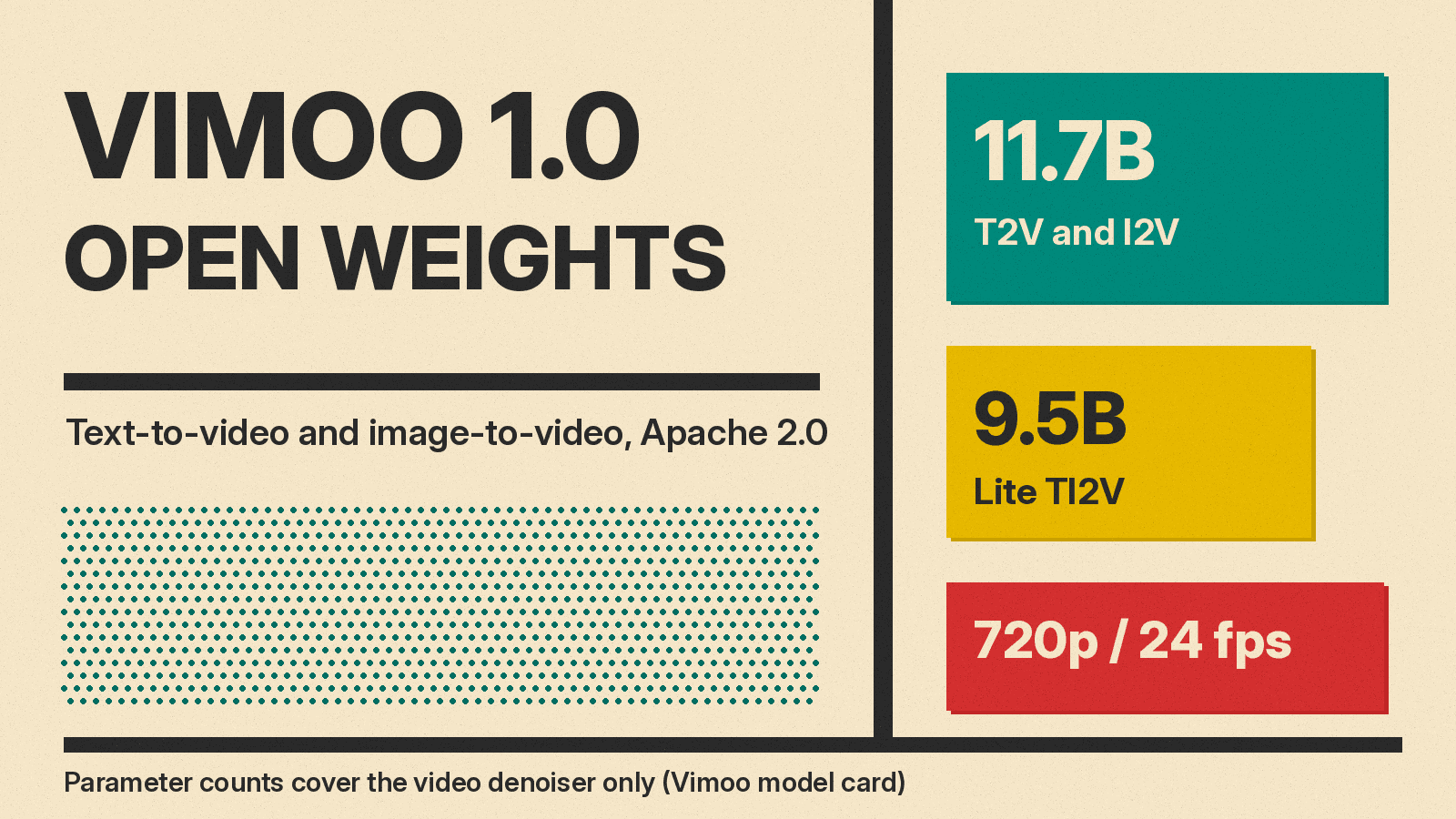
Vimoo, a video AI company, has published open weights for Vimoo 1.0, a text-to-video (T2V) and image-to-video (I2V) model family. The main model has about 11.7 billion parameters per task, and a smaller Lite version has about 9.5 billion. The code and weights use the Apache License 2.0, which permits commercial use. The repositories went up on Hugging Face in late September, the model card lists an October 2026 release, and the model drew wider notice in news coverage on November 8. This post covers what is in the release, how Vimoo says it compares with Wan 2.2, LTX 2.5 and Veo 3.1, what hardware it needs, and the limits to know before you use it.
What Vimoo released
The Vimoo-1.0 model card on Hugging Face lists two models:
- Vimoo 1.0. Separate T2V and I2V transformers, each about 11.7B parameters. Vimoo calls it the highest-quality model in the family.
- Vimoo 1.0 Lite. One model, about 9.5B parameters, that handles both modes (TI2V). Vimoo built it for speed and says its quality is comparable.
Each comes in several packages: a Diffusers version for Vimoo's own Diffusers fork, ComfyUI bundles with distilled LoRA adapters, and an MLX build of Lite Distilled for Apple Silicon. Distilled versions exist only for ComfyUI and MLX. The parameter counts cover the video denoiser only, not the text encoder or the VAE.
The base clip is 720p at 24 fps. The Vimoo model docs give 5 seconds for T2V, I2V and Lite, and the example scripts output 1280 x 720, 121 frames. The technical report says the model is trained to generate 10-second 720p videos, so the released settings are shorter than the training target.
Not everything is open. Vimoo describes a three-part system: Vimoo-PE, a prompt enhancer that rewrites your instructions; Vimoo-Base, the 720p generator; and Vimoo-Enhancer, which regenerates clips at 1080p. Only the base model is open source. The prompt enhancer and the 1080p Enhancer run through Vimoo's API, along with an e-commerce mode that turns 1 to 9 product images into a 20-second, 9:16 clip.
How it is built
Vimoo 1.0 is a 40-block dual-stream MMDiT. Video tokens and conditioning tokens keep separate processing paths and meet through joint attention in every block. Much of the stack is reused open parts:
- Qwen2.5-VL-7B-Instruct reads the prompt.
- Glyph-ByT5-v2, a character-level encoder from research on rendering text in images, adds character features alongside the prompt.
- SigLIP encodes the reference image in I2V mode.
- The Wan 2.2 VAE compresses and decodes the video.
The Wan link is not new on this site. We covered Alibaba's later model in Wan 3.0 explained, and research groups keep building on the open Wan line, as in Wave Forcing, a streaming model on Wan 2.1.
The report says training ran in stages, from 2 billion 256p images up to 720p video at 24 fps, followed by two fine-tuning stages and preference tuning (DPO). Vimoo does not say where the training data came from.
How Vimoo says it compares
Vimoo built its own human evaluation, Vimoo-VBench, with 500 prompts across advertising, social media, storytelling, education and entertainment. On that test, Vimoo reports:
- Text-to-video overall: Vimoo 1.0 35%, Veo 3.1 34%, Lite 32%, LTX 2.5 27%, Wan 2.2 23%.
- Image-to-video overall: Vimoo 1.0 47%, Veo 3.1 44%, Lite 41%, LTX 2.5 35%, Wan 2.2 30%.
- Frame aesthetics (T2V): Vimoo 1.0 91%, Veo 3.1 82%.
- Motion effects (T2V): Vimoo 1.0 53%, Veo 3.1 69%.
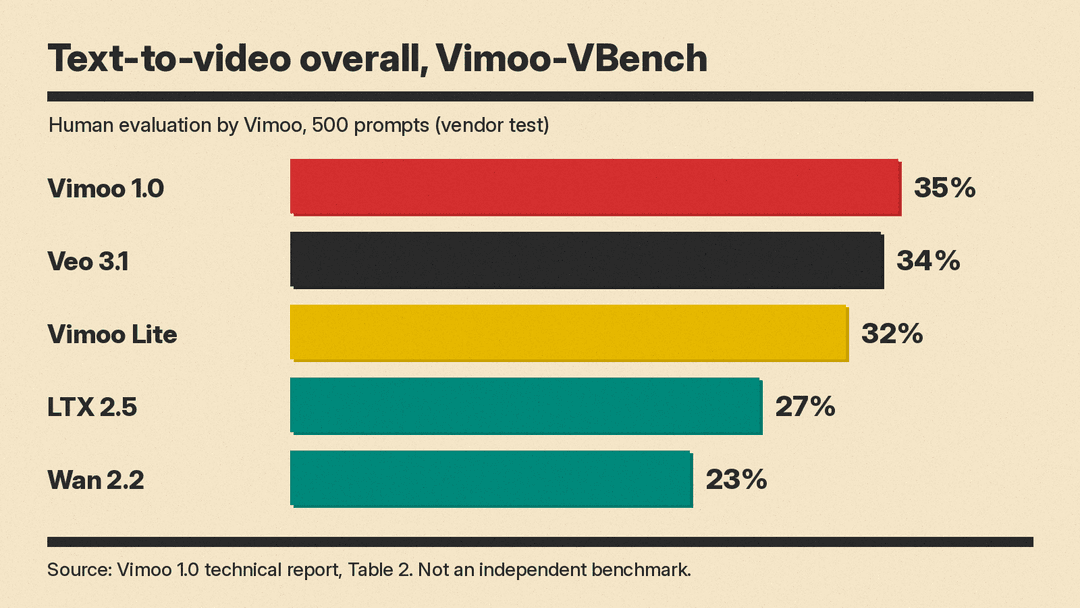
Vimoo's own numbers show a pattern: strong on how frames look, behind Veo 3.1 on motion. Keep in mind that Vimoo built the benchmark and chose its prompts. The report says it uses rating-based evaluation but does not explain how the percentages are calculated. The release does not include independent test results, so treat these as vendor claims.
Speed and hardware
The report gives specific speed figures. At 8 steps without classifier-free guidance, a 121-frame 720p clip took 48.2 seconds for Vimoo 1.0 and 9.7 seconds for Lite, which Vimoo calls a 4.97x speedup. With 50 steps and guidance, Vimoo 1.0 took 480 seconds.
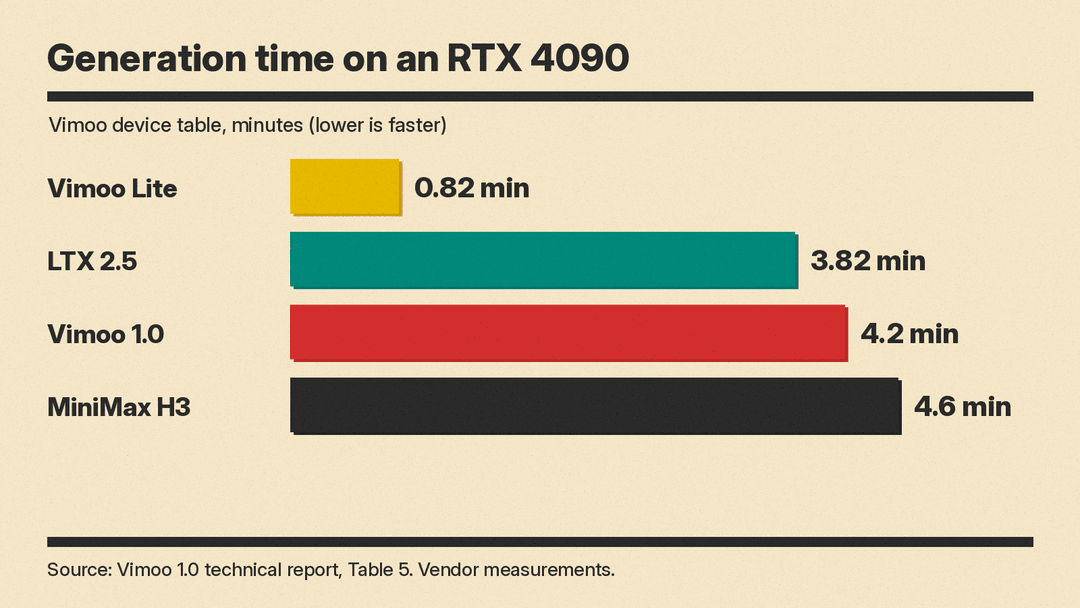
With offloading and VAE tiling turned on, Vimoo says the full T2V or I2V pipeline peaks at approximately 13.6 GB of GPU memory for a 720p, 121-frame clip, which it says allows end-to-end runs on a single consumer GPU such as the RTX 4090. Its device table lists these times on an RTX 4090:
- Vimoo 1.0 Lite: 0.82 minutes
- LTX 2.5: 3.82 minutes
- Vimoo 1.0: 4.2 minutes
- MiniMax H3: 4.6 minutes
On an Apple M4, Lite took 21.3 minutes and the full model took 565 minutes, so Lite is the more practical choice on a Mac. MiniMax H3, which we covered in our TaoMate-HD avatar video post, is a 33B model in the same table.
Limits to know
Vimoo's docs and GitHub README list several limits:
- No audio. Clips are silent. Describing music or dialogue in the prompt does not create sound.
- English prompts only. The open models were validated only with English prompts. Vimoo recommends translating other languages first.
- Cropping. In I2V, reference images are resized and center-cropped to the output ratio, so check that your subject stays in frame.
- First frame drift. The first frame is not guaranteed to match the reference image pixel for pixel.
- No prompt enhancer locally. The hosted service rewrites prompts. Local runs use your prompt as written, so Vimoo points users to its Prompt Guide.
- Setup. The Diffusers path needs Linux, an NVIDIA CUDA GPU, PyTorch 2.9.0 with CUDA 13.0, and Vimoo's Diffusers fork.
Third-party parts such as Qwen2.5-VL, SigLIP and the Wan VAE keep their own licenses, so check the notices file before shipping a product.
Why it matters
Vimoo 1.0 is a new Apache 2.0 option for people who want to run video AI on their own hardware. In its own human evaluation, Vimoo 1.0 scores 1 point above Veo 3.1 overall for text-to-video and 3 points above for image-to-video, with a Lite version that runs in under a minute on a consumer GPU in its tests. If outside tests back that up, it is a practical option for creators and studios that want to self-host. The weak spots are already visible in Vimoo's own data: motion lags Veo 3.1, clips are short and silent, and the 1080p Enhancer and prompt enhancer stay behind Vimoo's API.
