
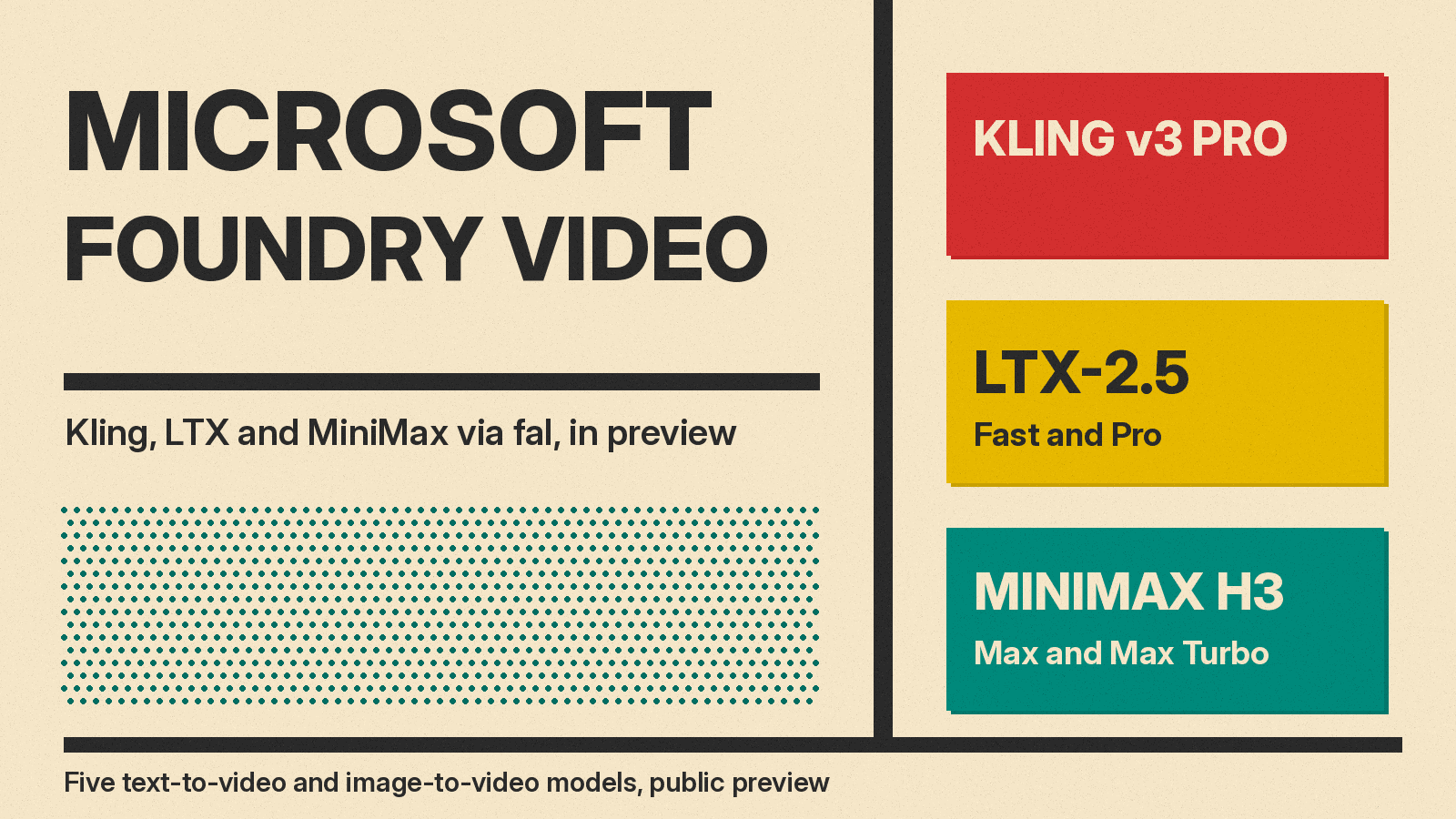
Microsoft says that Kling, LTX and MiniMax video models are rolling out in public preview in Microsoft Foundry through a new partnership with fal. The announcement, published November 5, 2026 by Naomi Moneypenny and updated November 6, describes the models as a first-party Azure service that supports text-to-video and image-to-video generation.
What Microsoft announced
The initial portfolio has five models: Kling v3 Pro, LTX-2.5 Fast, LTX-2.5 Pro, MiniMax H3 Max and MiniMax H3 Max Turbo. Microsoft says more models are planned over time. The models are served by fal and sourced from the companies that build them.
Microsoft says the initial portfolio is hosted in the United States, and that Foundry is the first provider to offer a US-hosted Kling 3 endpoint.
fal describes itself as having APIs for over 1500 models across image, video, audio, 3D and generative worlds. The deal follows news that fal recently raised a combined $1.65B across its Series E and Series F rounds.
"Partnering with Microsoft allows both of us to truly enable the wide creative ecosystem," fal cofounder Burkay Gur said in the announcement.
The five video models
Microsoft's descriptions of each model are as follows.
- Kling v3 Pro. Positioned for cinematic visuals and fluid motion, with native audio generation and custom element support. Its image-to-video mode gives control over how a starting image becomes a moving scene. Note that Foundry currently offers v3 Pro rather than the newer Kling 4.0 Flash.
- LTX-2.5 Fast. Speed-optimized, aimed at rapid iteration and previews.
- LTX-2.5 Pro. Quality-optimized for high-fidelity final output. Both LTX models support text-to-video and image-to-video with synchronized audio.
- MiniMax H3 Max and H3 Max Turbo. Post-trained variants of MiniMax H3 focused on prompt adherence, aesthetics and inference performance. H3 Max also supports reference-to-video, per Microsoft Learn documentation.
"H3 Max brings fal's post-training and inference optimizations to improve quality and speed," Gökay Aydoğan, listed in the announcement as a Creative Engineer, said.
Microsoft lists three example use cases: a creative team exploring several interpretations of a written brief, a retailer turning an approved product image into a short motion concept, and a developer chaining image generation and video generation.
What it costs
Microsoft published pricing in USD per second of generated video. The blog's lead-in sentence says per minute, but its table is headed "Price per video second" and the figures below are per second.
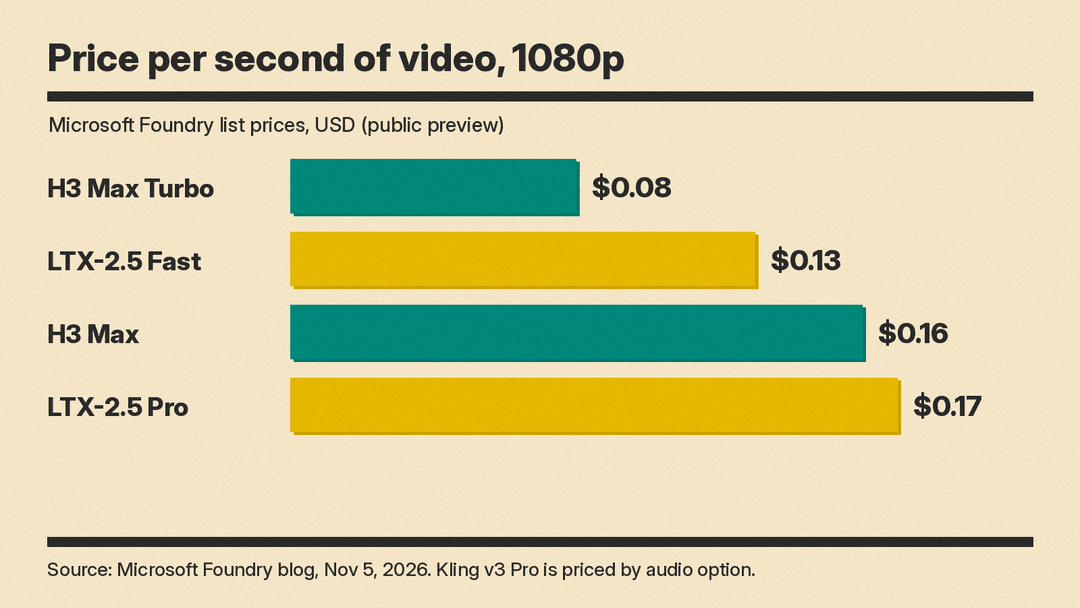
- MiniMax H3 Max (text, image and reference to video): $0.05 at 480p, $0.08 at 768p, $0.16 at 1080p.
- MiniMax H3 Max Turbo: $0.025 at 480p, $0.04 at 768p, $0.08 at 1080p.
- LTX-2.5 Fast: $0.09 at 720p, $0.13 at 1080p, $0.19 at 1440p, $0.30 at 4K.
- LTX-2.5 Pro: $0.12 at 720p, $0.17 at 1080p.
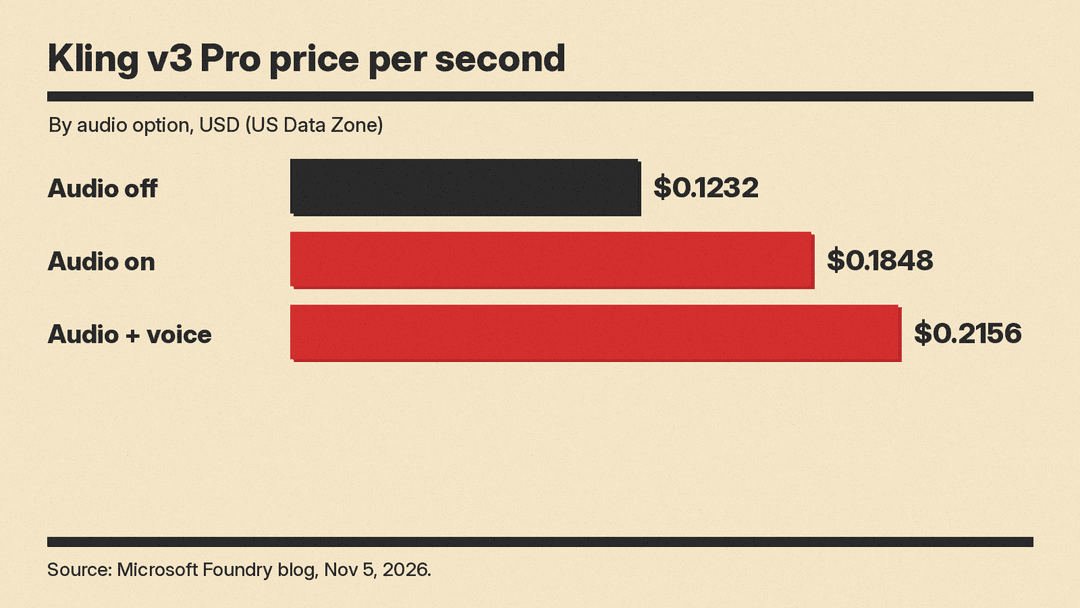
- Kling v3 Pro: $0.1232 with audio off, $0.1848 with audio on, $0.2156 with audio and voice control.
A 10-second clip works out to roughly $0.80 on MiniMax H3 Max Turbo at 1080p, $1.60 on MiniMax H3 Max at 1080p, $1.30 on LTX-2.5 Fast at 1080p, and $1.70 on LTX-2.5 Pro at 1080p. A 10-second Kling v3 Pro clip with audio on costs about $1.85.
Microsoft says pricing will be listed on the Azure pricing page within the coming weeks. No general availability date was given. For broader context on how these rates sit against other video APIs, see our AI video pricing comparison.
Data and privacy terms
The Microsoft Learn documentation for enabling these models sets out terms that differ from a standard Azure AI service.
fal services are operated outside of Microsoft facilities. By deploying them, an organization agrees to the fal Terms of Service, elects to share data with fal, and elects to egress data from Microsoft. Microsoft customer agreements, including the Product Terms, the DPA and certifications, do not apply to the use of fal services on Foundry.
Deployment options also differ by model. Kling v3 Pro uses the US Data Zone. The LTX and MiniMax models use Global Standard pay-as-you-go.
Why it matters
The practical draw is consolidation. Enterprise buyers can reach several video models through one Azure subscription, and, Microsoft says, use the evaluation, governance, security and observability capabilities supported for each offering. Microsoft calls hosting location one factor for teams with data residency requirements and tells them to review each model's data processing and storage terms.
There are limits worth naming. The data terms are fal's, not Microsoft's, so legal and compliance review has to cover a third-party agreement even though the deployment happens inside Azure. The offering is in public preview, with no general availability date. And the Foundry lineup currently lags the newest releases from at least one vendor, offering Kling v3 Pro rather than Kling 4.0 Flash.
How to get access
Access requires two steps.
- An admin with the Subscription Owner or Subscription Contributor role must enable the Fal.EnableDeploy preview feature in the Azure subscription through the Azure Preview features portal. Microsoft says it might take up to 30 minutes to enable.
- After that, a user with the Foundry Owner role on the project deploys the models from the Foundry model catalog. Microsoft says a deployment can take up to 30 minutes.
Microsoft has not given a general availability date, and says the price list will move to the Azure pricing page in the coming weeks.
