
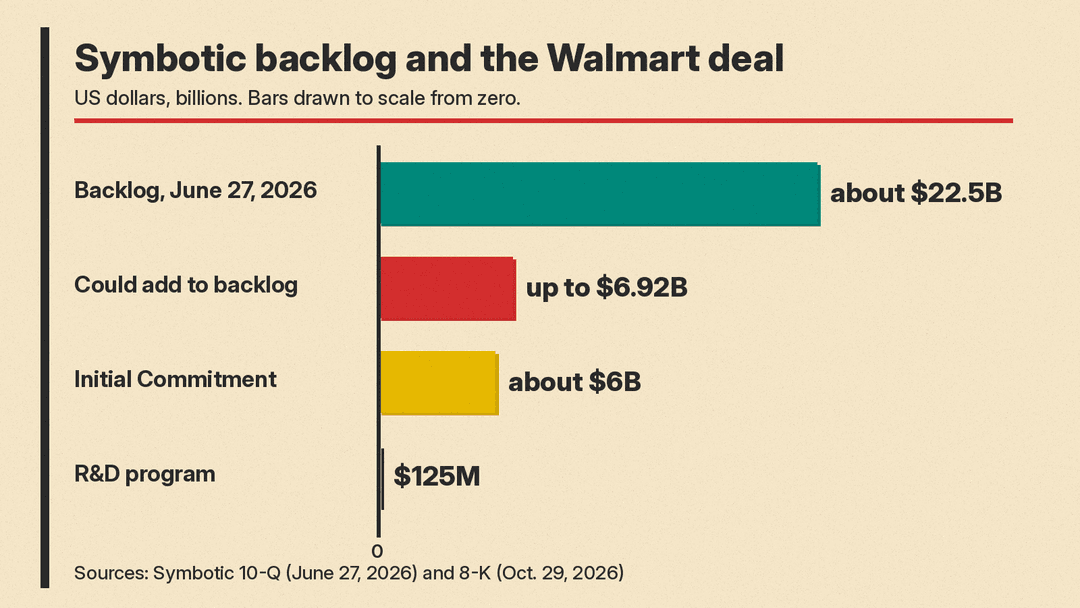
Walmart has committed about $6 billion over several years to buy more automation systems from Symbotic, the two companies said on Thursday. The expanded agreement brings further Symbotic automation to 25 of Walmart's U.S. regional distribution centers and supports other work across Walmart's global supply chain. In its SEC filing, Symbotic said it expects the commitment could increase its future backlog by up to $6.92 billion.
Symbotic describes itself as "a leader in A.I.-enabled robotics technology for the supply chain." Its August earnings release lists "disruption to the business due to Symbotic's dependency on Walmart" among its forward-looking risks.
What Walmart agreed to
The two companies signed what the 8-K calls an "Enterprise Master Automation Agreement." It covers Walmart and its affiliates on a global basis. Key terms:
- Initial Commitment: an "initial aggregate additional spend of approximately $6,000,000,000" over a number of years across multiple locations. It covers system purchases and funded development programs.
- Where the systems go: market program addenda cover Symbotic's automated material handling systems for ambient areas of distribution or fulfillment centers in the United States and select international markets in the Americas.
- Research money: a development program addendum in which Walmart committed $125,000,000 to fund research and development of next-generation racking technology and related picking, process flow and inventory management capabilities.
- Fees on top: for each system bought, Walmart also pays fees for licenses, support, operations and maintenance, and spare parts.
- No quiet cuts: the Initial Commitment "may not be reduced without the mutual written consent of Walmart and Symbotic," subject to each side's termination rights. The agreement also sets a calculation for amounts due to Symbotic if Walmart buys fewer systems than it committed to.
The 8-K says the new commitment is in addition to purchase commitments under the existing 2022 and 2025 agreements between the companies, which stay in force.
Why it matters for Symbotic
The numbers in Symbotic's latest quarterly report show how large this is for the company. Symbotic said it had "approximately $22.5 billion of backlog as of June 27, 2026, of which our agreements with Walmart and Exol comprise the vast majority." If the full $6.92 billion is added, that would equal about 31% of the June backlog figure.
The same 10-Q shows that one customer, labeled "Customer A," accounted for 90.5% of Symbotic's total revenue in the quarter ended June 27, 2026, up from 83.8% a year earlier. The filing does not name Customer A in that table. It also warns that "the concentration in the volume of business transacted with this customer may lead to a material impact" on results if the relationship were lost.
The new agreement gives Walmart some governance rights tied to that position. According to the 8-K, while Walmart owns more than 5% of Symbotic's fully diluted equity and is not in material breach, it may confidentially recommend one independent director for nomination to Symbotic's board. In any year in which Walmart represents more than 50% of Symbotic's consolidated revenue over a trailing four-quarter period, it may also designate two non-voting board observers, subject to exceptions. The agreement also limits Symbotic's ability to sell or license products and services to "a specified company" that the filing does not name.
A decade of Walmart work
Symbotic has helped Walmart automate its supply chain since 2017, Reuters reported. In January 2025, Symbotic agreed to acquire Walmart's Advanced Systems and Robotics business for $200 million in cash at close, plus up to $350 million in contingent consideration. Under that deal, Symbotic said Walmart committed to buy systems for 400 Accelerated Pickup and Delivery centers at stores if performance criteria are achieved, and to pay Symbotic $520 million for a development program. Symbotic said then that the transaction could add more than $5 billion to its backlog.
"Our work with Symbotic over the years, including this expanded agreement, helps us improve service, grow capacity, simplify work for our associates and lower costs," said Rob Montgomery, Executive Vice President for Walmart U.S. Supply Chain Operations, in the release. Symbotic CEO Rick Cohen said the partnership "started with a single product over a decade ago."
According to the release, Walmart plans to use the added capabilities to support e-commerce upstream inventory management, increase storage capacity and improve how products move through its supply chain. Symbotic says its systems run on proprietary software "which harnesses AI to orchestrate and optimize the movement of millions of cases, every day."
On the shopper side, Walmart announced an Agent Gateway for AI shopping agents earlier this month.
What to watch
Symbotic's next report will be its fiscal fourth quarter. In August it guided to revenue of $760 million to $780 million for that quarter, after third-quarter revenue of $721 million, up 22% from a year earlier, and net income of $55 million. CFO Izzy Martins pointed to "77 systems in deployment."
Key open questions are how much of the up to $6.92 billion Symbotic books as backlog, and how quickly the 25 distribution center projects start. Both companies use "several years" or "a number of years" for the timeline and give no per-year split.
For more on AI robotics funding and models, see our posts on Machenta's $40M raise for one-try robot learning and Gemini Robotics ER 2 on Google Cloud.
Sources
- Symbotic: Walmart and Symbotic Expand Commercial Agreement to Support Supply Chain Transformation (Oct. 29, 2026)
- Symbotic Form 8-K, filed Oct. 29, 2026 (SEC)
- Symbotic Form 10-Q for the quarter ended June 27, 2026 (SEC)
- Symbotic Reports Third Quarter Fiscal Year 2026 Results (Aug. 5, 2026)
- Symbotic to Acquire Walmart's Advanced Systems and Robotics Business (Jan. 16, 2025)
- Reuters via Investing.com: Walmart commits $6 billion to expand Symbotic deal
