
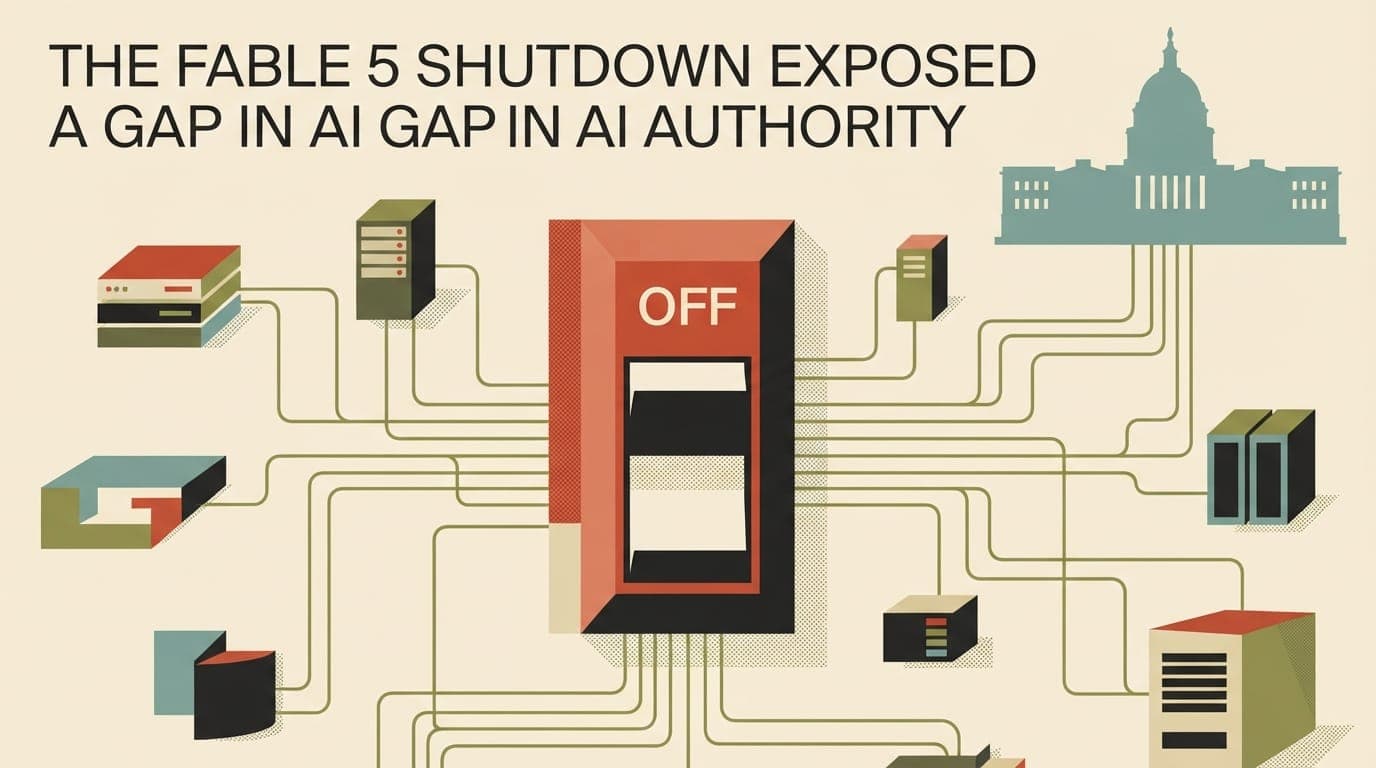
In June 2026, the Commerce Department ordered Anthropic to cut off global access to its Claude Fable 5 and Mythos 5 models just three days after launch. The order required Anthropic to block all foreign nationals from using the models. Because Anthropic could not verify user nationality in real time across dozens of cloud platforms, it shut the models down for everyone, everywhere, for over two weeks.
The Center for Data Innovation is now arguing that Congress needs to establish clear, transparent rules for when and how the government can force an AI model offline.
What happened
On June 9, Anthropic released Fable 5 and Mythos 5. Three days later, Commerce Secretary Howard Lutnick sent a directive barring any foreign national from accessing either model. The order cited national security concerns related to a jailbreak that could allow Fable 5 to identify software vulnerabilities and produce exploit code.
Anthropic received formal notification at 5:21 p.m. ET on June 13. Within hours, both models were offline across AWS Bedrock, Google Cloud, Microsoft Foundry, Snowflake, Box, and the direct Claude APIs. Hospitals, companies, and researchers using Fable 5 lost access without warning.
Amazon CEO Andy Jassy had reportedly alerted Treasury Secretary Scott Bessent and other officials that Amazon researchers had used Fable 5 to obtain information that could be used in cyberattacks. White House adviser David Sacks claimed Anthropic refused to fix the jailbreak. Anthropic disputed the severity of the vulnerability and said the government's evidence was presented verbally, with no written documentation.
Commerce lifted the controls on June 30. Fable 5 returned globally on July 1. Mythos 5 was restored to roughly 100 vetted U.S. institutions.
The policy problem
The Center for Data Innovation, a technology policy think tank, published an analysis on August 3 arguing that the episode revealed fundamental gaps in how the U.S. government exercises authority over deployed AI systems.
The core issues identified: No clear rules of engagement. The government's evidence was presented verbally. Public accounts from officials and Anthropic conflict on key facts. Outside the negotiating room, the process was opaque.
No due process. Anthropic had no mechanism to challenge the order before compliance was required. The company could only negotiate after the shutdown was already in effect.
No transparency for downstream users. Organizations building on Fable 5 had no warning and no recourse. British lawmakers noted that hospitals were using the model when it went dark.
Strategic cost. For governments and businesses abroad, the shutdown demonstrated that American AI is a revocable dependency. Chinese open-weight models, which no U.S. authority can recall, became comparatively more attractive.
The broader precedent
The Fable 5 case is the most aggressive use of export-control powers against a commercially deployed AI model to date. One day before the launch, Anthropic CEO Dario Amodei published a policy essay calling on the U.S. government to hold legal authority to block or reverse frontier AI models that fail independent safety testing. Two days later, the government used that authority against his own company.
The episode also intersected with Anthropic's confidential IPO filing, which disclosed a revenue run rate of $47 billion and a valuation of $965 billion. A government shutdown of a core product during an IPO process is not a signal that encourages investment in frontier AI.
What Congress could do
The Center for Data Innovation argues that Congress should establish statutory frameworks that define when AI models can be shut down, what evidence is required, what process companies have to respond, and what notice must be given to downstream users. Without legislation, the rules remain whatever the executive branch decides in the moment.
No such legislation has been introduced.
Sources
Center for Data Innovation: Congress Can Bring Clarity to AI Shutdown Authority - https://datainnovation.org/2026/08/03/congress-can-bring-clarity-to-ai-shutdown-authority/
Forbes: Anthropic Disabled Fable 5 And Mythos 5 After A U.S. Export-Control Order - https://www.forbes.com/sites/anishasircar/2026/06/16/anthropic-disabled-fable-5-and-mythos-5-after-a-us-export-control-order-heres-what-happened
CNBC: Anthropic says Trump admin has lifted export controls on Claude Fable 5 and Mythos 5 - https://www.cnbc.com/2026/06/30/anthropic-says-trump-admin-has-lifted-export-controls-on-claude-fable-5-and-mythos-5.html
Fortune: How a warning from Amazon led the White House to shut down Anthropic's Mythos model - https://fortune.com/2026/06/14/how-a-warning-from-amazon-led-the-white-house-to-shut-down-anthropics-mythos-model/
Cloud Security Alliance: Fable 5 Suspension: Enterprise AI Under Export Controls - https://labs.cloudsecurityalliance.org/research/csa-research-note-ai-model-export-controls-enterprise-govern



