
New York's frontier AI safety law now has a front door. On November 10, 2026, the state's new AI oversight office opened the RAISE Portal, an online system where the largest frontier AI developers must register with the state by January 1, 2027. The same portal will take critical safety incident reports and quarterly risk summaries once the law's duties begin.
The portal is run by the Office of Digital Innovation, Governance, Integrity, and Trust (DIGIT) inside the New York State Department of Financial Services (DFS). The announcement came in a Governor's release published by DFS, alongside a new state AI safety research center. DIGIT also published a requirements page for frontier developers that spells out who is covered and what they must file.
Who has to register
The RAISE Act (Responsible AI Safety and Education Act) uses three terms, summarized on the DFS page:
- Frontier model: a foundation model trained with more than 10^26 integer or floating-point operations. The count includes the original training run plus any later fine-tuning, reinforcement learning or other material modifications.
- Frontier developer: a person who has trained or initiated the training of a frontier model using, or intending to use, the computing power specified under the RAISE Act.
- Large frontier developer: a frontier developer that, together with its affiliates, had annual gross revenues of more than $500 million in the preceding calendar year.
Only large frontier developers must register. TechCrunch reported that large frontier AI developers "like Anthropic and OpenAI" will be required to register by January 1, 2027. DFS says smaller frontier developers are "strongly encouraged" to create an account early, in case they need to report a critical safety incident quickly.
What the portal asks for
Registration starts with an NY.gov ID. A company first sets up an account with its legal name, country, street address, and the name, job title and contact details of the person filing. DIGIT may ask for more information before it authorizes the account.
After that, the company files what the law calls a "Disclosure Statement." Per DFS, it lists:
- the principal place of business
- each office in New York, if any
- beneficial ownership information, as applicable under the RAISE Act
- primary, secondary and tertiary points of contact
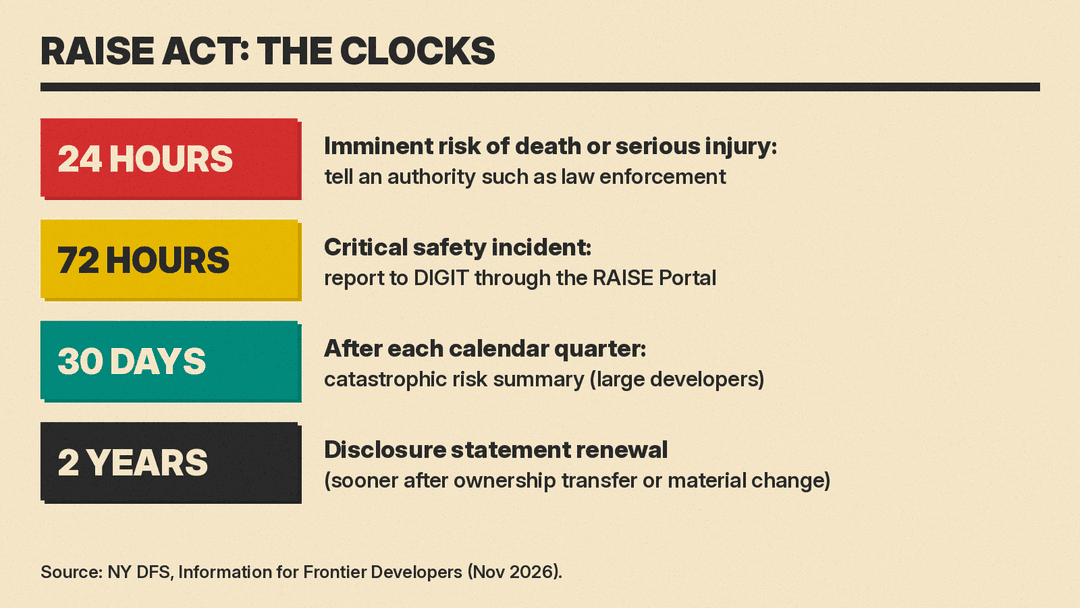
The disclosure statement must be renewed every two years, after a transfer of frontier model ownership, or after a material change to the reported information, whichever comes first. Large frontier developers must also pay applicable assessments through the portal.
The reporting clocks
The DFS page sets out these duties:
- All frontier developers must report a critical safety incident to DIGIT through the RAISE Portal within 72 hours of determining that one occurred, or of learning facts sufficient to establish a reasonable belief that one occurred.
- If an incident poses an imminent risk of death or serious physical injury, the developer must disclose it within 24 hours to an appropriate authority, "such as a law enforcement or public safety agency with jurisdiction."
- All frontier developers must publish a model transparency report before, or at the same time as, deploying a new or substantially modified frontier model. Among other items, it lists the release date, supported languages and output modalities, intended uses, and restrictions on use.
- Large frontier developers must publish a frontier AI safety framework that describes how they assess and mitigate catastrophic risks, respond to incidents, secure unreleased model weights and govern these processes. They must review it, and update it as appropriate, at least once a year.
- Large frontier developers must send DIGIT a summary of their catastrophic risk assessment for internal use of their models every quarter, within 30 days of the end of each calendar quarter.
DFS also says that once the law is in effect, members of the public can report critical safety incidents related to frontier AI models.
Penalties
The dollar caps are in the compiled statute, not on the DFS page. Under General Business Law section 1427, as added by chapter 96 of the laws of 2026 and marked effective January 1, 2027, the attorney general may bring a civil action to recover a civil penalty "in an amount not to exceed one million dollars for a first violation and in an amount not to exceed three million dollars per subsequent violation, determined based on the severity of the violation." Those caps apply when a large frontier developer fails to publish or transmit a required document, makes a prohibited statement, fails to report an incident as required, or fails to comply with its own frontier AI framework. We read that text in a compilation of the Senate's General Business Law page, last updated April 3, 2026. TechCrunch reported the same dollar figures as "as high as $1 million for one violation and $3 million for subsequent violations."
S.10731, introduced in October 2026, would amend those caps so they apply per day and would broaden the conduct they cover. In that bill, the current per-violation wording appears in brackets; the bill's legend says matter in brackets is old law to be omitted. S.10731 is a proposal, not law. We covered it in our post on the RAISE Act 2.0 bill and AI compute limits.
The research center's role
The same release launched the New York Center for AI Responsibility and Research at SUNY's Binghamton University. Greg Morrisett of Cornell Tech and Jeannette Wing of Columbia University will serve as interim co-directors. The release says they will bring together more than 80 scientists from across the state, who will keep working at their home institutions, with computing from the state's Empire AI initiative.
The release also describes a broader mission of independent testing and research. Reviewing published safety frameworks is one task the center will take on with DIGIT, at the state's request. The release says the center "will coordinate with DIGIT to begin reviewing AI Developers' published safety frameworks and providing recommendations on ways to strengthen requirements."
"The stakes are too high to simply take AI companies at their word," Governor Kathy Hochul said in the release.
Why it matters
The portal is where the RAISE Act's filings will happen. Per DFS, registration, incident reports, quarterly risk summaries and assessment payments all go through it, and the release says DIGIT was set up to implement the law and oversee large frontier AI developers. Companies that meet the large frontier developer test now have about seven weeks to file before January 1, 2027.
New York is not the only state on this path. California's frontier AI law, SB 53, took effect on January 1, 2026, and on October 27 state lawmakers asked whether it covers some AI agent incidents, as we reported in our post on the SB 53 hearing on AI incident rules. The release says the Governor "will continue exploring ways to build on the RAISE Act" in the coming months.
Sources
- Information for Frontier Developers (NY DFS / DIGIT)
- Governor Hochul launches New York Center for AI Responsibility and Research, RAISE Portal (NY DFS, Nov 10, 2026)
- AI Safety: Governor Hochul Announces Next Steps to Regulate Major AI Developers (NY DFS, Sep 21, 2026)
- OpenAI, Anthropic face new oversight as New York's AI safety law takes effect (TechCrunch, Nov 10, 2026)
- S.10731 bill text (NY Senate)
- N.Y. General Business Law section 1427 (New York Public Law compilation, citing nysenate.gov, updated Apr 3, 2026)
