

For roughly three years, every picture you saw from a generative model passed through the same 2015-era neural network designed to trace neurons in electron microscope scans. The U-Net, an architecture built for biomedical image segmentation, became the working backbone of Stable Diffusion and its open-source ecosystem. Starting in 2023, it was displaced at the frontier by transformer-based designs. Its rise and replacement is one of the clearest case studies in how architecture choices get made in modern AI: inductive bias versus raw scalability.
What the U-Net actually is
The U-Net was introduced in 2015 by Olaf Ronneberger, Philipp Fischer, and Thomas Brox at the University of Freiburg's Pattern Recognition and Learning Algorithms group. The paper, "U-Net: Convolutional Networks for Biomedical Image Segmentation," was aimed at a narrow problem: given a microscopy image, label which pixels belong to the structure of interest and which do not, a task called semantic segmentation (arXiv:1505.04597).
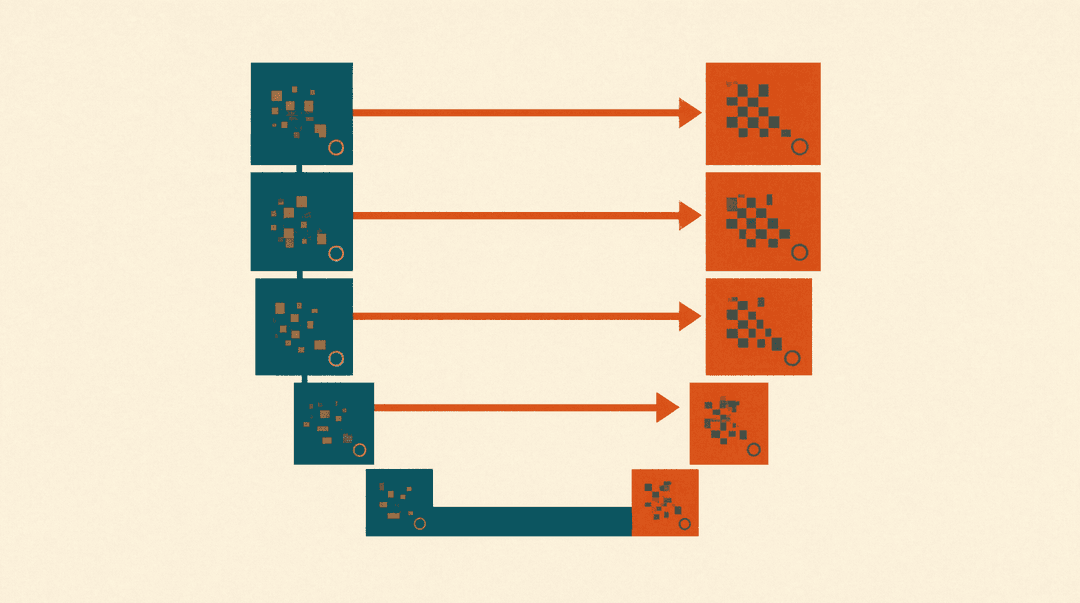
The name comes from the shape of the diagram in the paper, which resembles a U. The left arm is a contracting path: stacked convolutional blocks that repeatedly downsample the image, each halving the spatial resolution while doubling the number of feature channels. This path learns context: what is in the image and roughly where. The right arm is a symmetric expanding path that upsamples back to the original resolution, restoring spatial detail. Connecting the two arms are skip connections: at every resolution level, the encoder's feature maps are copied and concatenated onto the decoder's, so the up-sampling path never has to reconstruct fine positional detail from the compressed bottleneck alone (Freiburg project page).
The original network has 23 convolutional layers. The paper's two headline claims at the time were that the architecture could be trained end-to-end on very few labeled images (30, using aggressive data augmentation) while beating the prior best method on the ISBI 2015 challenge for segmenting neuronal structures, and that it was fast: segmenting a 512x512 image took under a second on a single 2015 GPU. The same network also won the ISBI 2015 cell tracking challenge in its transmitted-light microscopy categories by a large margin (arXiv:1505.04597).
Why it worked on small data
Two design properties explain the U-Net's success in medical imaging, where labeled data is scarce and pixel-level accuracy matters.
First, convolution. Each filter slides over the image with shared weights, so the network encodes a strong prior: nearby pixels are related and local features (edges, textures, cell membranes) are translation-invariant. That prior does a lot of the learning for free when you only have dozens of annotated images.
Second, the skip connections. A pure encoder-decoder compresses a 512x512 input down to a tiny bottleneck, and the decoder must guess where boundaries lie. The copies that bypass the bottleneck deliver exact spatial information from the encoder to the matching resolution level in the decoder. This is the difference between classifying an image and outlining one.
The combination proved durable. nnU-Net, a self-configuring framework that adapts a U-Net pipeline automatically to whatever dataset it is handed, became a standard baseline in biomedical segmentation and remains competitive years later (arXiv:1904.08128).
From segmenting neurons to generating images
The U-Net's second career began with diffusion models. A diffusion generative model learns to reverse a noise process: it is trained to predict and remove noise from a corrupted image, step by step, until a picture emerges. The network that performs this denoising needs to take an image in and produce an image of the same size out, with fine spatial fidelity. That is, structurally, a segmentation problem. Early pixel-space diffusion models, including Google's Imagen, used U-Net backbones, as did the original DDPM work that reignited the field (arXiv:2006.11239).
Stable Diffusion industrialized the setup. The 2022 Latent Diffusion Models paper by Robin Rombach and colleagues moved the diffusion process into the compressed latent space of a pretrained autoencoder, and ran the U-Net there, adding cross-attention layers inside the U-Net so the denoising steps could read text prompts (arXiv:2112.10752). Stable Diffusion 1.x and 2.x, and then SDXL in 2023, kept the same skeleton: SDXL scaled the U-Net backbone roughly threefold, adding more attention blocks and a second text encoder (arXiv:2307.01952). Through the mid-2020s, the dominant open-weight image models that ran on consumer GPUs were, at their core, 2015 medical imaging hardware wearing attention layers.

The transformer takeover
The architecture's fall started with a simple question, posed in William Peebles and Saining Xie's 2023 paper "Scalable Diffusion Models with Transformers": if transformers had taken over language and vision classification, was there anything special about the U-Net, or was it just a default? Their answer, the Diffusion Transformer (DiT), replaced the U-Net entirely with a Vision-Transformer-style stack operating on patches of the latent image. Findings that shaped the field: quality tracked forward-pass compute, measured in Gflops, whether from a bigger transformer or more input tokens, and their DiT-XL/2 model beat all prior diffusion models on the class-conditional ImageNet 256x256 and 512x512 benchmarks, reaching a then state-of-art FID of 2.27 (arXiv:2212.09748).
A caveat: DiT did not delete the U-Net's ideas. It absorbed them. The downsampling behavior that made U-Net efficient is mimicked by patchification, and the skip connections were independently shown to be the transferable part. Fan Bao and colleagues' U-ViT paper, also released in late 2022, replaced the convolutional backbone with a plain ViT but kept long skip connections between early and late blocks, and argued that the skips, not the convolutions, were doing much of the U-Net's work (arXiv:2209.12152).
Commercial models followed the research. Stable Diffusion 3, released in 2024, moved from U-Net to an MMDiT: a multimodal diffusion transformer with double-stream blocks that process image and text tokens with separate weights, trained on rectified flow (arXiv:2403.03206). Black Forest Labs' FLUX.1, released the same year, extended the recipe to a 12-billion-parameter hybrid transformer design (ICLR Blogposts 2026, From U-Nets to DiTs). A 2026 survey of the 2021-2025 generation of text-to-image models puts the score plainly: PixArt, Lumina, SD3, CogView3, and FLUX all abandoned the convolutional backbone, and current frontier image and video generators are transformers.
Why labs switched anyway
The U-Net is, on paper, still the more efficient design at fixed quality. Convolutions cost linear time in pixels; self-attention costs quadratic time in tokens, and diffusion models run the backbone dozens of times per image. What the transformer gave labs was not efficiency but scalability in the sense that mattered commercially: the same architecture that scales with data and compute in language models scaled predictably in generation, with quality improving monotonically with Gflops, as DiT showed (arXiv:2212.09748). Hand-tuned structural priors like the U-Net's lost to general-purpose blocks plus data, the same trade the field had already made everywhere else.
The U-Net survives where its original assumptions still hold: labeled data is small, the task is dense prediction, and compute is constrained. Medical segmentation still runs on U-Net descendants (arXiv:1904.08128), and the enormous installed base of SD1.5 and SDXL checkpoints keeps the architecture generating pictures across the open-weights ecosystem (ICLR Blogposts 2026, From U-Nets to DiTs).
Takeaways
- The U-Net (2015) is a convolutional encoder-decoder with skip connections, built for pixel-level labeling in medical imaging, not for generation (arXiv:1505.04597).
- Stable Diffusion 1.x through SDXL used U-Net as the denoising backbone, adding cross-attention for text conditioning (arXiv:2112.10752, arXiv:2307.01952).
- DiT (2023) and U-ViT (2022) showed transformers could replace it, and that its most valuable idea, the skip connection, transfers (arXiv:2212.09748, arXiv:2209.12152).
- SD3 and FLUX.1 made the switch commercially in 2024; frontier image generation is now transformer-native (arXiv:2403.03206, ICLR Blogposts 2026).
Sources
- Ronneberger, Fischer, Brox, "U-Net: Convolutional Networks for Biomedical Image Segmentation," MICCAI 2015 - https://arxiv.org/abs/1505.04597
- U-Net project page, University of Freiburg - https://lmb.informatik.uni-freiburg.de/people/ronneber/u-net
- Isensee et al., "Automated Design of Deep Learning Methods for Biomedical Image Segmentation" (nnU-Net), Nature Methods 2021 - https://arxiv.org/abs/1904.08128
- Ho et al., "Denoising Diffusion Probabilistic Models," NeurIPS 2020 - https://arxiv.org/abs/2006.11239
- Rombach et al., "High-Resolution Image Synthesis with Latent Diffusion Models," CVPR 2022 - https://arxiv.org/abs/2112.10752
- Podell et al., "SDXL: Improving Latent Diffusion Models for High-Resolution Image Synthesis" - https://arxiv.org/abs/2307.01952
- Peebles and Xie, "Scalable Diffusion Models with Transformers," ICCV 2023 - https://arxiv.org/abs/2212.09748
- Bao et al., "All are Worth Words: A ViT Backbone for Diffusion Models" (U-ViT), CVPR 2023 - https://arxiv.org/abs/2209.12152
- Esser et al., "Scaling Rectified Flow Transformers for High-Resolution Image Synthesis" (Stable Diffusion 3), ICML 2024 - https://arxiv.org/abs/2403.03206
- ICLR Blogposts 2026, "From U-Nets to DiTs: The Architectural Evolution of Text-to-Image Diffusion Models (2021-2025)" - https://iclr-blogposts.github.io/2026/blog/2026/diffusion-architecture-evolution
