
Ai2 (Allen Institute for AI) published RoboTrack on Monday, a benchmark and synthetic training suite for point tracking in robotic manipulation, and the headline finding is unflattering to the field's best tools. Every leading tracker Ai2 evaluated scores 3.0 to 6.6 points lower on RoboTrack-Bench than on RoboTAP, the only other real-video robotics benchmark. Even CoWTracker, the strongest off-the-shelf model, falls from 70.5 to 63.9 Average Jaccard.
Point tracking sounds narrow: given a pixel location in one video frame, estimate where that same point appears in later frames, through occlusions and viewpoint changes. But manipulation robots depend on it. A robot following a single demonstration needs to keep track of a gripper, a vial, a pipette tip, across cluttered scenes where the gripper hides the object it holds. Robotics systems already use off-the-shelf trackers to annotate demonstrations and provide feedback during execution, and those trackers score well on established benchmarks. RoboTrack's premise is that the established benchmarks are the problem.
What the benchmark contains
RoboTrack-Bench holds 307 human-annotated videos drawn from DROID, Ego-Exo4D, MolmoAct 2 and EgoVerse, with 2,522 verified point tracks total. The footage mixes robots and human hands, first- and third-person viewpoints, and cluttered scenes. Annotators were told to prioritize moving and occluded points rather than static background, label each track's category (robot or human body, manipulated object, static object), and a second group re-checked every track frame by frame. A 33-pair subset records the same interaction from two synchronized cameras, with the same physical points annotated in both views.
The evaluation exposed three awkward patterns. First, the difficulty drop versus RoboTAP holds across all four architectures tested, suggesting a shared weakness rather than one model's quirk. Second, training on 15 million real videos (BootsTAPNext versus its TAPNext base) adds 5.1 AJ on RoboTrack-Bench but loses 9.5 AJ on RGB-Stacking, a simulated block-stacking benchmark, meaning the synthetic benchmark ranks the models in the opposite order from real manipulation video. Third, leads on older benchmarks shrink: CoWTracker's 4.7-point advantage over CoTracker3 on RoboTAP narrows to 2.1 on RoboTrack-Bench.
The fix is more simulation, but the right simulation
Ai2's hypothesis was that trackers fail because most train on Kubric, a pipeline that generates videos of objects tossed into scenes, with few examples of robot arms grasping and carrying things. So the team extended MolmoSpaces, Ai2's simulation ecosystem, rendering pick-and-place episodes in MuJoCo: 3,000 videos from 300 simulated homes, 5,000 tracks each, 15 million tracks in total, with positions and visibility computed from simulator geometry rather than human labels.
The first attempt produced no gain. The diagnostic was distributional: Ai2 compared histograms of how far tracked points move in each training set versus real manipulation video. Version one sampled points on walls and floors, so most third-person points never moved. Restricting points to the robot and manipulated objects fixed the wrist view. Moving points from the robot's fixed base onto the moving arm fixed the third-person view, lifting the ablation score to 63.0 AJ, 1.5 above the Kubric-only control. The team notes Kubric has the same wrist-view mismatch, which likely explains why it alone underperforms.
Fine-tuning on the corrected data yields two released models: RoboTracker (built on the 17-million-parameter AllTracker) and RoboTracker-Warp (built on the roughly 1-billion-parameter CoWTracker). On RoboTrack-Bench, RoboTracker gains 0.8 AJ and RoboTracker-Warp gains 2.1 AJ (63.9 to 66.0), with up to 1.2 AJ averaged across three robotics benchmarks and no loss on general video. RoboTracker-Warp is now the best of the evaluated models on four of five benchmarks; its gains extend even to human-hand footage despite training only on robot arms. RoboTracker-Warp weights are released for noncommercial use.
Does it matter on a real robot?
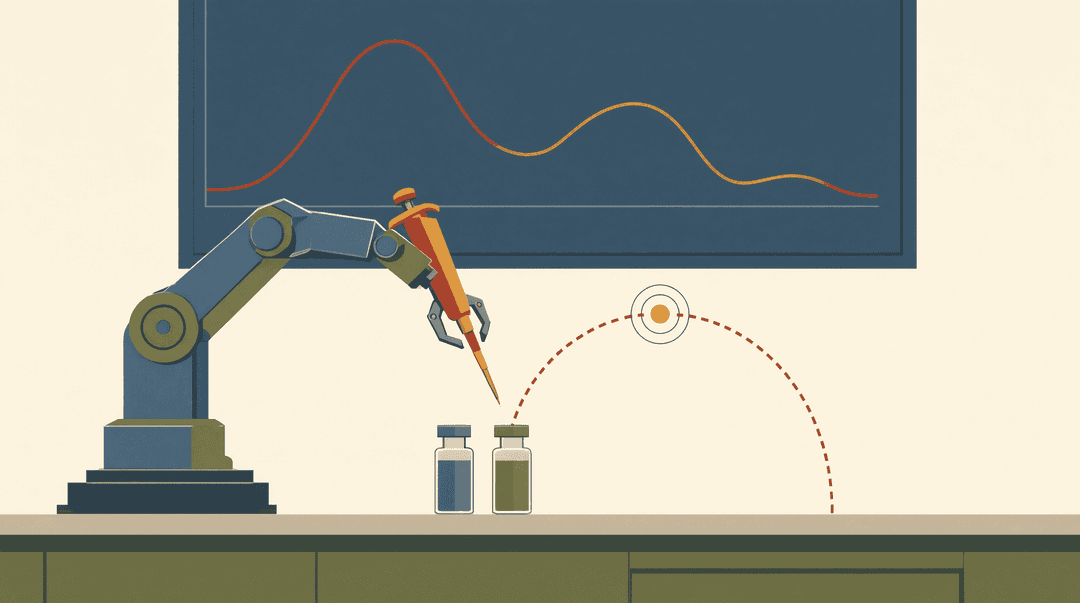
Ai2 tested deployment on a wet-lab task: pick up an electronic pipette, draw liquid from one vial, dispense into another, return the pipette, learning from a single teleoperated demonstration and aligning to layouts that change every trial. Over 20 layouts (10 clear, 10 partially occluded), point tracking completed 17 of 20 transfers. Object masks managed 8; optical flow managed 5. In clear views point tracking went 10 for 10; under occlusion it went 7 for 10, where the mask method succeeded once.
Remaining failures, stated plainly in the post: long occlusions, reacquiring points after they disappear, and small objects against busy backgrounds. The simulations also cover everyday pick-and-place, not the precise motions pipetting demands. Still, the practical claim lands: a tracker good enough to move a pipette tip within millimeters, guided only by one demonstration, is a different class of tool for lab automation than the field had evidence for a week ago. The benchmarks, dataset, pipeline and checkpoints are on Hugging Face.
