
Reson8, a speech recognition startup in Amsterdam, has published the weights of Rumble-2-Flash, a 0.5B-parameter speech-to-text model for 40+ languages, under the Apache 2.0 license. The Hugging Face announcement, dated November 18, 2026, says it "competes with models 3-60x its size." The model debuted in Reson8's paid API on November 3, according to Reson8's launch post and SiliconANGLE.
Here is what the sources say it does, how to run it, and what they leave out.
What Reson8 released
The weights sit on the Hub at Reson8/Rumble-2-Flash. The Hugging Face blog lists these features:
- Native support in Transformers and vLLM, "no custom code"
- 40+ languages with automatic language detection
- Output control: "numbers as digits or words, fillers, verbatim repeats, forced language"
- Over 7,000 RTFx on full batches, which the blog describes as "an hour of audio in about half a second"
The model uses the Qwen3-ASR architecture, which is why it runs in existing Transformers and vLLM installs "with no forked runtime or trust_remote_code," per the blog. Reson8 built it by distilling Rumble-2, its larger production model, with on-policy distillation. The student model transcribes the audio itself and the teacher grades that transcript token by token. Because the two models use different tokenizers, Reson8 used a method called GOLD to compare them over the same text.
SiliconANGLE describes the model as "designed for fast transcription of prerecorded audio" and says Reson8 is aiming it at developers and researchers who need speech recognition for languages other than English.
What it is good for
Reson8's launch post names "calls, lectures, voice notes, podcasts" as the recordings it handles, and gives examples such as a student getting a two-hour lecture back as text and a podcaster getting Welsh episode notes. The post says the model "handles voice notes, interviews, and one-on-one calls well, and even in a busy meeting or a noisy room it gets around 9 in 10 words right."
SiliconANGLE reports that Reson8's models "are said to be trained for noisy settings, including phone-line audio." Reson8's own phone-call test is covered in the benchmarks section below.
If you are comparing transcription apps rather than models, our roundup of AI transcription tools covers hosted options.
How to run it
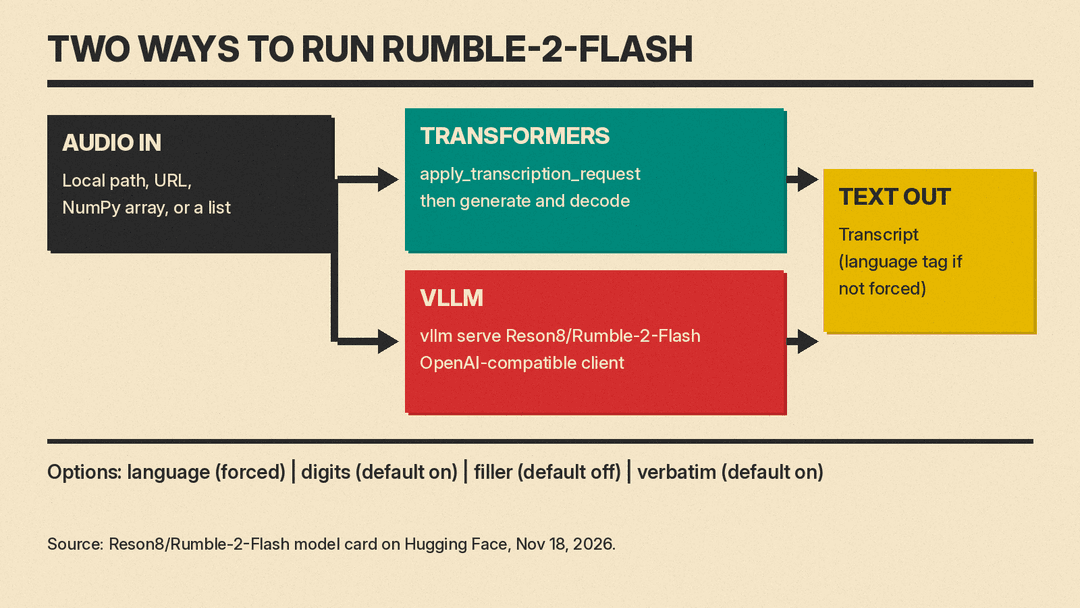
The model card gives two paths. With Transformers, install the packages with uv pip install torch transformers accelerate, then load the model:
from transformers import AutoProcessor, AutoModelForMultimodalLM

model_id = "Reson8/Rumble-2-Flash"
processor = AutoProcessor.from_pretrained(model_id)
model = AutoModelForMultimodalLM.from_pretrained(model_id, device_map="auto")
The card then calls processor.apply_transcription_request with an audio file and an optional language, and decodes the output. The audio input "accepts a local path, a URL, a NumPy array, or a list of these."
With vLLM, the card starts a server and sends audio through an OpenAI-compatible client:
uv pip install "vllm[audio]" openai
vllm serve Reson8/Rumble-2-Flash --max-model-len 4096
Four transcription options can be passed through vLLM's chat_template_kwargs or to processor.apply_chat_template in Transformers:
language: forces a language by its English name, such as "Dutch". If unset, the output starts with the detected language.digits: on by default; off writes numbers as words.filler: off by default; on keeps fillers such as "um" and "uh".verbatim: on by default; off collapses repeated words.
Reson8 also sells access through its API, starting at €0.01 per hour of audio, pay as you go, according to its launch post. By that rate, the post says, a thousand hours of audio costs €10.
Benchmarks, as reported by Reson8
All numbers below come from Reson8's blog posts and model card. The Open ASR Leaderboard changelog, checked on November 18, 2026, shows release 18-11-2026 (v1.16.1) adding Reson8/Rumble-2-Flash to its English, private and multilingual tracks.
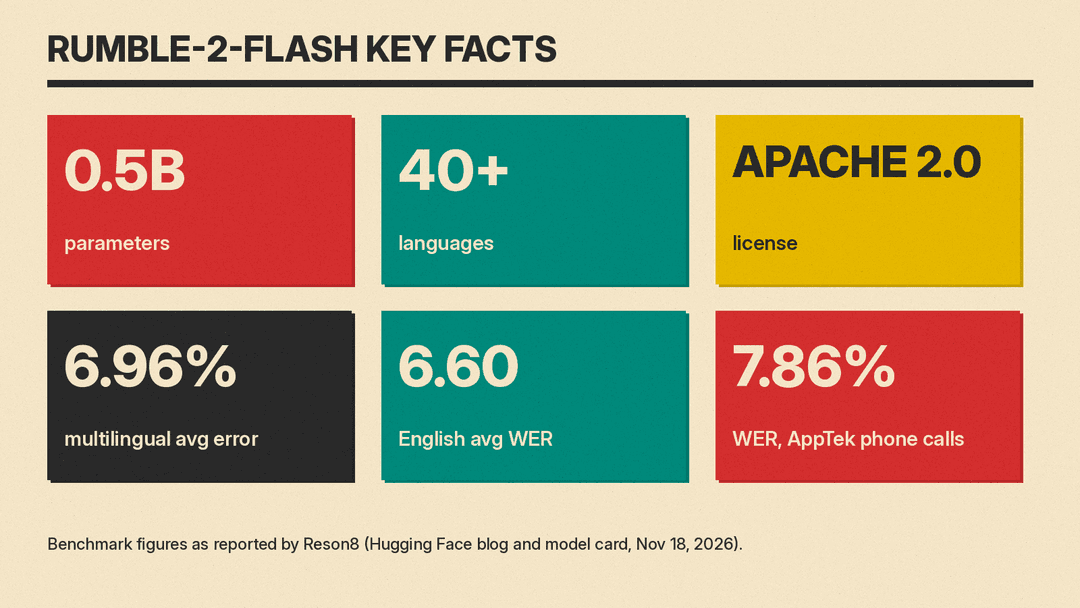
- Multilingual: the Hugging Face blog reports a 6.96% average error rate on the leaderboard's multilingual track, across Chinese, German, French, Italian, Spanish, Portuguese, Hindi, Dutch and English, and calls that "better than Meta's omniASR-LLM 7B, a model 15x larger, and ahead of Whisper large-v3." Reson8's own launch post words the omniASR comparison as "on par" across seven languages, and SiliconANGLE reports 7.09% across seven languages.
- English: the model card lists an average WER of 6.60 (RTFx 6338) over seven public splits plus two private ones. Reson8's launch post says it "lands at about 5% WER" across the leaderboard's English datasets. Per-split numbers on the card range from 2.43% on VoxPopuli to 13.14% on the private conversational set.
- Phone calls: on AppTek's call-centre benchmark (302 hours of helpline calls, 14 English accents), the Hugging Face blog reports 7.86% WER, against 7.78% for NVIDIA's Nemotron 3.5 Transcribe (30B), 8.7% for Qwen3-ASR 0.6B and 7.4% for Qwen3-ASR 1.7B. Reson8's chart notes that some bars were "reported by others, with different setups."
- Lower-resource languages: Reson8 reports 17.6% average WER on ten languages against 39.8% for Whisper Large V3, including Maltese (13% vs 72%), Basque (13% vs 42%) and Bangla (26% vs 74%).
For context on the NVIDIA model in that comparison, see our post on Nemotron 3.5 Transcribe.
Reson8 adds its own caveat. Its launch post says human reference transcripts contain mistakes, that fixing them in one test cut its misses "from about 6% to under 3%," and advises: "If you are evaluating ASR for your own product, test on your own audio."
License
The model card says the model is "Licensed under the Apache License 2.0," the repo metadata lists apache-2.0, and the repo includes a LICENSE file with the standard Apache License, Version 2.0 text. That license grants a "perpetual, worldwide, non-exclusive, no-charge, royalty-free, irrevocable copyright license to reproduce, prepare Derivative Works of, publicly display, publicly perform, sublicense, and distribute" the work, subject to its notice and attribution conditions.
Limits and what is not stated
Reson8 says it "kept Rumble-2-Flash lean on purpose": telling speakers apart and transcribing live conversations "will be part of a bigger model." The larger Rumble-2 adds speaker diarization and end-of-turn detection, per the launch post, and SiliconANGLE reports that custom vocabulary support "remains exclusive to Rumble-2."
On the pages we read, these points are not stated:
- Minimum GPU or memory requirements. The card says its leaderboard runs used an H200 with vLLM.
- Maximum audio length per request.
- The training data used for Rumble-2-Flash or Rumble-2.
- What the
ctcfolder in the repo is for. The Files tab shows a 1.02 GB model.safetensors file plus a separate ctc_head.safetensors of about 357 MB, which the card does not describe.
The repo metadata lists 45 language codes. The card's multilingual table covers eight languages, with averages from 3.73% (Spanish) to 14.11% (Hindi).
Why it matters for voice and audio work
Open weights let you run transcription on hardware you control rather than through a hosted API. Rumble-2-Flash adds a small, permissively licensed option that loads in standard Transformers and vLLM setups, with controls that matter for editing transcripts, such as keeping or dropping fillers. For podcasters and interviewers, the filler and verbatim switches decide whether you get a clean read or a word-for-word record.
The trade-offs are clear from Reson8's own description: no speaker labels and no live transcription in this model. If you need on-device speech features on a phone instead, see our post on Google AI Edge Gallery's on-device speech and TTS.
