
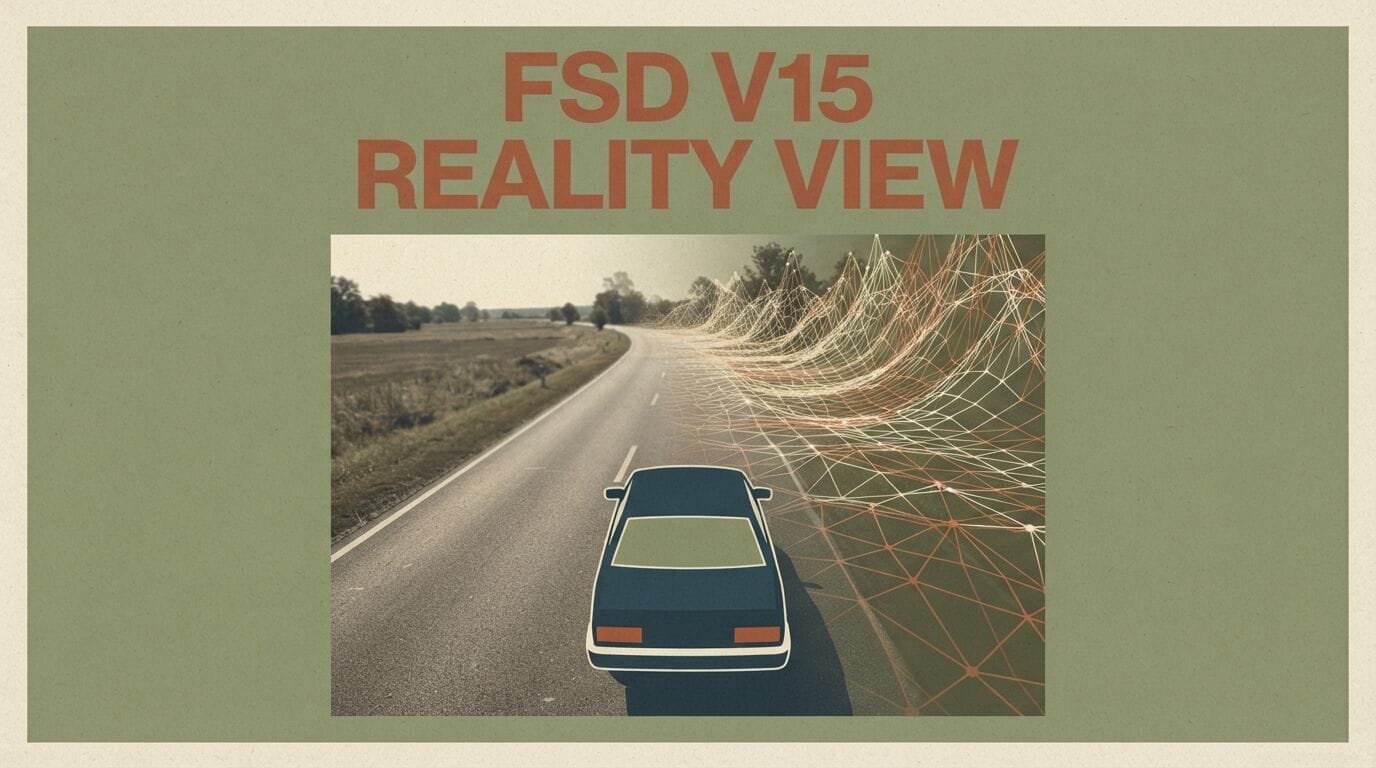
Tesla began rolling out Full Self-Driving (Supervised) v15 to Early Access Program members on Saturday, November 21, with a wide release expected in December for the 2026 Holiday Update. This version introduces "Tesla Reality View," a real-time generative driving visualization created by the end-to-end driving model itself rather than a game engine. The update also features an upgraded vision encoder shared with Robotaxi and Optimus, supporting claims of 25x better handling of safety-critical cases.
Tesla began rolling out Full Self-Driving (Supervised) v15 to Early Access Program members on Saturday, November 21, with a wide release slated for December as part of the 2026 Holiday Update (Teslarati). The version number is less interesting than what is inside it: a generative video model now sits in the driver's display path, and a shared vision encoder now serves three of Tesla's products at once.
The visualization is generated, not modeled
The headline feature is Tesla Reality View. The release notes describe a "real-time generative driving visualization that continuously streams a view from an arbitrary virtual camera situated above your vehicle." Previous FSD visualizations were diagrams, a stylized car on an otherwise empty gray road. This one renders the actual street around the car, photorealistically, from a camera that does not exist.
Tesla's head of AI Ashok Elluswamy said the display is produced by the driving stack itself: "the same end-to-end driving model also renders a realistic view of the world around the vehicle" (Eletric-Vehicles). Musk's description, that the feature is real-time AI video generation without a game engine, drew speculation after Tesla's teaser video that Unreal Engine was involved (Teslarati). Musk says otherwise, and the naming wobble suggests Tesla was not fully settled on what to call it: the Tesla Super Intelligence account first posted the release notes with the feature named "Tesla Augmented Reality," then republished them roughly 25 minutes later as "Tesla Reality View."
A neural renderer running in a moving car is an inference-budget story, not just a cosmetic one. Producing a continuous photorealistic third-person view while the same network drives is a far heavier real-time generation task than the clipped, offline video demos the generative-model crowd has been showing this year. Musk called it "like GTA" on X, piggybacking on GTA VI's launch week. Gizmodo's Mike Pearl noted the Lakitu-camera perspective and asked the obvious question about drivers who stop telling the rendered world from the real one.
One encoder, three robots, and a 25x
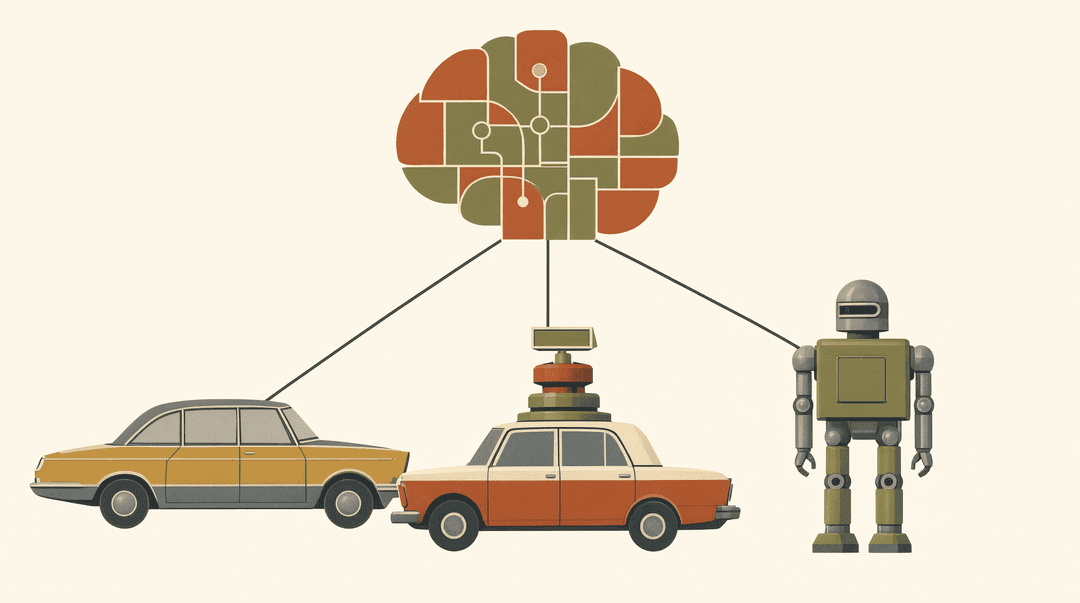
The release notes attribute v15's safety claim, "25x better handling of safety critical cases," to an upgraded vision encoder shared between FSD, Robotaxi and Optimus, trained on "millions of internet videos" for generalization and data efficiency (Electrek). Tesla's driving car, its robotaxi fleet and its humanoid now run perception through the same model, and the training corpus is no longer only fleet driving footage.
The number itself follows Tesla's house style: a multiplier with no base. Electrek's Fred Lambert supplied the arithmetic from this year's crowdsourced data, which put FSD v14 at roughly a couple thousand miles between critical interventions. A true 25x would land v15 near 50,000 miles between critical interventions, well past the threshold of about 10,000 miles Electrek has said a limited unsupervised service would need. The track record argues for caution. v14 launched in October 2025 with hallucinations, brake stabbings and speeding complaints, and early crowdsourced numbers showed about 732 miles between critical disengagements. In April Musk wrote that v15 "will far exceed human levels of safety, even in completely unsupervised and complex situations," a claim Lambert noted he had made about v12 and v14 as well. In August Tesla briefed JPMorgan that v15 is a "step-change" built on seven core technologies, with about 40 percent already running in the Austin robotaxi fleet, where v15 has been logging miles for months (Eletric-Vehicles).
The fix list reads like the complaint file
The rest of the notes target FSD's most visible weaknesses: detection of road signs, small animals, debris and chains; potholes and deep standing water; speed handling in school zones and bad weather; parking-spot selection from personal history; navigation behavior learned end-to-end from fleet route preferences, starting with trip ends and beginnings. FSD will now slow for speed cameras, and remembers a camera's location if the driver cancels the slowdown twice. A Bike Rack Mode permits FSD with hitch accessories attached, at the cost of no reversing and no Autopark or Summon at the destination.
Two entries cut against the safety framing. Driver monitoring gains support for hats and sunglasses, but Tesla is also "decreasing strictness in higher speed driver profiles," at a moment when sleeping drivers on FSD remain a regular news item. And slowing only for cameras implies the speed limit itself is a different kind of object than the thing that photographs you breaking it.
Regulators hold the same complaint file. NHTSA is reviewing a petition that Tesla's Robotaxis speed through active school zones, on top of an investigation into FSD traffic-law violations opened in October 2025. A September test by Brussels nonprofit Johanna.be found FSD exceeded the limit in 55 percent of the 30 km/h zones it drove through, and Electrek notes Tesla has promised pothole avoidance since 2019.
If v15 delivers, it is the biggest FSD release since the end-to-end rewrite. Whether it did is currently uncheckable: Tesla publishes the multiplier, never the base, and still declines to publish disengagement data. The pretty dashboard may end up being the least important thing in the update, and the 25x the most important number nobody outside Tesla can verify.
Sources
- Mike Pearl / Gizmodo: Tesla rolls out FSD v15 with "it's like GTA" Reality View - https://gizmodo.com/its-like-gta-musk-touts-video-game-like-update-to-tesla-fsd-2000843584
- Fred Lambert / Electrek: Tesla launches FSD v15, targets its biggest weaknesses - https://electrek.co/2026-11-21/tesla-fsd-v15-rollout-25x-safety-reality-view
- Teslarati: Tesla Full Self-Driving v15 rollout begins, full release notes - https://www.teslarati.com/tesla-full-self-driving-v15-rollout-begins-full-release-notes-improvements
- Eletric-Vehicles: Tesla Starts FSD V15 Rollout, Adding Reality View and Speed-Camera Slowdown - https://eletric-vehicles.com/tesla/tesla-starts-fsd-v15-rollout-adding-reality-view-and-speed-camera-slowdown
- Techmeme cluster: https://www.techmeme.com/261122/p4
Frequently asked questions
When was Tesla FSD v15 released?
Early Access Program members received FSD v15 starting Saturday, November 21, with a wide release slated for December as part of the 2026 Holiday Update.
What is Tesla Reality View in FSD v15?
Tesla Reality View is a real-time generative driving visualization that streams a photorealistic view from an arbitrary virtual camera situated above the vehicle, produced directly by the end-to-end driving model without a game engine.
How does FSD v15 improve safety compared to previous versions?
Tesla claims v15 offers 25x better handling of safety-critical cases, attributed to an upgraded vision encoder shared between FSD, Robotaxi, and Optimus, which is trained on millions of internet videos for generalization.
Does Tesla FSD v15 slow down for speed cameras?
Yes, FSD v15 will now slow for speed cameras and remembers a camera's location if the driver cancels the slowdown twice; however, critics argue this treats cameras differently than actual speed limit objects.
