
Four days after Anthropic began trading on Nasdaq, the company's research arm published its most consequential economic document yet: a qualitative study of what its own enterprise customers have done with AI. The headline finding cuts against both the mass-layoff narrative and the job-creation narrative. In 66 interviews across 58 US companies, the authors found "very few examples of domestic layoffs that were driven by AI automation." They also found that roughly two-thirds of the companies reported hiring less because of AI.
"We may not be firing, but we're not hiring," one interviewee told the researchers.
The report, titled Working with AI, was written by three Anthropic economists, Nathan Wilmers, Maxim Massenkoff and Peter McCrory, and is credited to The Anthropic Institute. It joins a small shelf of primary-source evidence on AI labor effects, next to the company's September Economic Index releases and its October internal report on how heavy Claude use has reshaped hiring at Anthropic itself.
What the study is, and what it is not
The method is interviews, not econometrics. Each conversation was a face-to-face video call of 25 to 40 minutes with executives, managers or individual contributors. The sample runs from AI-native startups to century-old firms and includes dentists, structural engineers, hedge funds, law firms, a trucking company and a publisher. The companies are all Anthropic customers, and the authors state plainly that the sample is not random or systematically representative. Value assessments are interviewees' self-reports, mostly not backed by A/B tests.
That caveat matters because Anthropic sells the tools under study. Still, the report is worth reading for the granularity: nearly 300 distinct AI applications coded by value and by the depth of organizational change they required, and 100 pieces of software that employees wrote with AI in enough detail to categorize.
The jobs numbers that are actually changing
Layoffs directly attributed to AI automation were rare. Only two of the 58 companies said AI had fully eliminated a position and cost someone their job. Five companies described pushing out employees who refused to adopt AI tools. Ten reported hiring more because of AI, mostly into implementation and IT support roles.
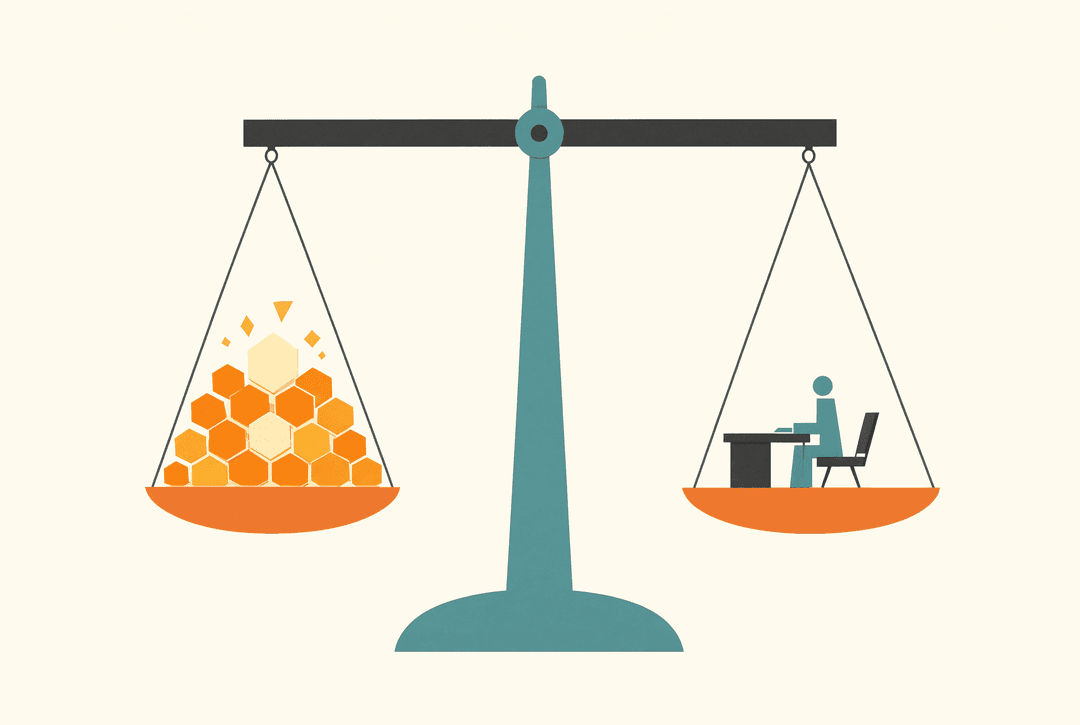
The cuts are landing elsewhere. Nine companies described ending contracts with outside software developers, customer service teams, legal counsel and back-office providers, many already offshored. A finance company downsized well over 100 offshore data and developer contractors. An operations leader at a software company said AI-driven contract reviews made their "legal bill just completely disappear." One company deployed an agent that reads submissions against approval policies and, as a result, cut the number of human reviewers it had planned to hire next year by more than 90%.
The authors flag offshore contract work as the leading indicator: modular, self-contained tasks handed across time zones at moderate quality expectations are exactly what agents absorb first, and they call the reported cuts "an early warning of job disruption in the international business services industry."
Inside the firms themselves, the replacement metric is the compute budget. An engineering leader at a health management company said the firm "added a lot of capacity by buying tokens instead of hiring people." One chief operating officer told the researchers that 90% of his operations budget now goes to AI tokens and 10% to headcount. Six AI-native startups gave estimates of their labor counterfactual: on average, they said they would need roughly four times as many employees if they did not have AI.
Where the value shows up
Most applications, according to the interviews, add value by increasing output rather than cutting costs. About half of those output gains come from accelerating existing work; the other half come from new products, better service quality or both. The categorized AI-written software follows the same logic in reverse: 80% automated previously manual work, and 20% replaced software the firm had bought from outside vendors.
In about one-tenth of use cases, the value was captured by employees directly, as easier or shorter work. A food-industry executive said employees had thanked him because AI let them take a vacation. Another executive complained that staff hide their gains: "They don't want you to know, because they want to use those 10 hours a week to go walk their dog." A private equity manager suspected portfolio-company employees were "working basically half days."
Three ways to deploy, and who resists
The report sorts companies into three adoption strategies, each with a characteristic failure mode.
Top-down automation buys or builds workflow-specific systems. It cuts the fastest, and it generates the most fear. Employees quoted in the report describe being told to design the systems that could replace them: "If I'm open to this, I'm essentially building my own coffin." Some firms went further and used AI to score workers' output; one executive called the result a "panopticon effect." These deployments are also brittle, because the underlying model improves underneath them. "It'll be obsolete in three months," one employee said of a vendor system. Another executive described building fixed workflows around fast-improving models as "throwing darts at a spinning dart board." One firm considered gift cards to incentivize reviewers to double their throughput with an agent.
Bottom-up experimentation hands Claude to domain experts and waits. It produces genuinely strange wins: an accountant who vibe-coded an app that audits 401(k) payment routing, a job that used to take 80 hours, saying "I told Claude what I needed to do"; a former airport operations manager who "wielded AI like Excalibur" on a vehicle-tracking app. It also produces pockets. Success is concentrated in power users, savings are small next to maintenance costs, and unswept AI prose floods the organization. Power users lob what one firm called "Claude grenades"; skeptics answer "Guys, I'm not reading your AI email."
Reorganizing around AI, the report's favored path, merges roles so one person owns a whole workflow, moves people toward bottleneck tasks that agents cannot do, and builds shared data infrastructure so non-engineers can query the business directly. "Every single employee now is a developer... creating additional attack surface every day," one security executive said, which is the argument for giving them sanctioned rails rather than banning the practice. Companies that did this, the authors write, got AI's gains while not cutting jobs.
The bottleneck is the rest of the company

The report's most durable observation is that coding stopped being the constraint. As agents accelerate software work, review, sales, approvals and strategic decisions become the limit. "The closer you are to the money, the harder it is for models to excel in that job," one executive said. An engineer put the new job description plainly: "Code's no longer the problem. Let's put time in user experience testing. Let's put time in requirements gathering."
The authors end where the hype cycle cannot: the reorganization path "is not a guarantee against AI-induced job loss," they write, and it will not replace a policy response if disruption arrives at scale. But the variance across three law firms doing completely different things with identical tools is their core evidence that employers, for now, choose how AI changes work rather than simply absorbing it.
