
Railway published a full incident report on November 10, 2026, at 6:00 a.m. PT, last updated at 10:02 a.m. PT that day (November 10, 18:02 UTC). It follows a preliminary report from October 22, 2026, at 4:31 p.m. PT. The Hacker News reported the same figures on November 11, 2026.
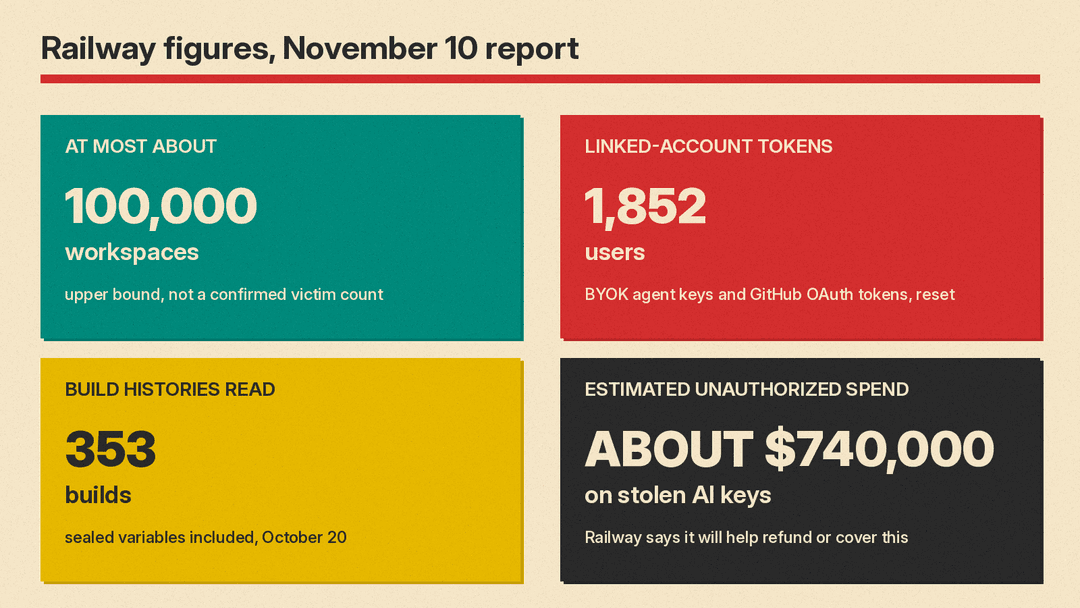
Railway says unauthorized spend on stolen AI keys was estimated to reach about $740,000. It says a threat actor obtained and decrypted a subset of customer environment variables, and that at most 1.85% of workspaces, about 100,000, could have had any of those variables decrypted, a figure the company calls an upper bound. Railway says it is working with providers to refund that spend and will cover it from its own balances when a provider will not.
What Railway says happened
Railway says its engineers became aware at 13:58 UTC on October 20 (6:58 a.m. PT) of a threat actor with unauthorized access, and dates the initial exploit to 07:28 UTC that day (12:28 a.m. PT). A previously unknown vulnerability in its multi-tenant build infrastructure, the report says, let the attacker partially escape filesystem isolation and obtain a build-server credential. An internal Temporal system used for builds accepted that credential as a trusted client. Through it, the attacker read a limited subset of stored build histories and retrieved a copy of Railway's internal monorepo. Railway writes: "Up until this point, we have no indication that the attacker targeted anything but Railway itself. We have no indication that the attacker downloaded snapshots or repositories of Railway customers."
The report says the attacker then used "an erroneously defined OIDC binding configuration" to obtain a short-lived cloud credential at 03:26 UTC on October 21 (8:26 p.m. PT on October 20), and then retrieved a longer-lived credential that allowed decryption of encrypted variables and reached the database that stores envelope-encrypted environment variables. Railway says database logs show the attacker was "specifically prioritizing AI provider keys" and "specifically targeting customers with large numbers of variables in their environment." Decryption of per-environment keys, it says, began at 04:42 UTC on October 21 (9:42 p.m. PT on October 20) and ran until Railway disabled the credential at 07:14 UTC (12:14 a.m. PT on October 21). Railway says the attacker was fully evicted at 09:24 UTC on October 21 (2:24 a.m. PT) and "had no access to any customer data beyond 09:25 UTC on October 21st." It also says the attacker's first signups began on October 18, and that early probing with dummy accounts was unsuccessful.
What Railway says about customer secrets
From logging available to it, Railway says it can validate that "at most 1.85% of workspaces, about 100,000, could have had any of their environment variables decrypted." It adds: "The logs identify a subset of environments, not individual variables, so that figure is an upper bound." Railway says it emailed customers who were at high risk of having their credentials stolen, based on the forensics available to it, and that any further data the attacker might have been able to exfiltrate cannot be decrypted because the credential the attacker was using has been disabled.
Railway says the attacker also read the stored histories of 353 builds between 13:50 and 15:30 UTC on October 20 (6:50 a.m. to 8:30 a.m. PT), "sealed variables included." Starting at 09:25 UTC on October 21, it asked GitHub, GitLab, Anthropic, OpenAI, OpenRouter, SpaceXSI, Google, and Stripe to revoke potentially compromised keys, and says it provided hashes of every key it held. Some vendors "opted to revoke further keys at their discretion." In the preliminary report, Railway said users being notified by vendors about revocation "does not imply that their credentials were impacted by the incident." Railway says the decrypted data also included linked-account tokens (BYOK agent keys and GitHub OAuth tokens) for 1,852 users. It says it reset every one of those tokens, notified each user, and "identified no logins to Railway accounts using credentials taken in this incident."
Railway's "internal forensic investigation suggests AI provider keys were the primary target of the attack." The company says it believes the credentials "were passed on to distributed transfer stations for use for distillation." It also says an additional query matched cloud, database, and payment service credentials, and that "forensics did not indicate customer databases were accessed." Railway writes: "We have not established whether the original attacker operated those services or supplied credentials to other parties."
What to do if you use Railway
These steps come from Railway's November 10 incident report and from the October 22 preliminary report that the later report still links.
- In its October 22 preliminary report, Railway recommends that all customers who signed up prior to October 21 rotate their keys stored on Railway, and that all users "revoke and reapply sensitive environment variables stored on Railway prior to this date," out of an abundance of caution.
- The same report says it is advisable for all customers to remove public network access to databases, rotate any sensitive variables and keys, check GitHub account audit logs and review all app access, and check audit logs within registries such as Dockerhub.
- Railway asks all customers to report charges they did not make through a form linked from the incident report. It says it will do its best to help them get compensated. Customers can also reach Railway at station.railway.com. The preliminary report lists support@railway.com.
Our tip, not Railway's: set spend caps with your AI provider.
Railway lists these provider refund policies "at the time of writing":
- AWS Bedrock: "AWS's existing refund policy covers fraud and their account teams have initiated refunds for customers."
- Google Gemini: "Google's existing refund policy covers fraud and their account teams have initiated refunds for customers."
- OpenAI: "The vendor advises affected customers to open a support request and pass the Case ID to Railway support. We have a shared bridge where they review refunds on a case-by-case basis."
- SpaceXSI: "The vendor advises affected customers to contact Railway support with their claim. We have a shared bridge where they review refunds on a case-by-case basis."
- Anthropic: "As of writing, we are in active discussions with their customer team to get next steps for our joint customers. In the interim, we will be covering Anthropic breached key costs ourselves."
- OpenRouter: "While OpenRouter has decided to enforce their no-refund policy as per their Terms of Service, we will be covering all costs associated with this breach in relation to OpenRouter."
Railway also writes: "As noted, for the providers who will not be covering token-related losses, we will be covering all token losses in lieu of them." An October 26 update on the preliminary report had said, "Railway is unable to refund customers for spend performed with compromised API keys." That was Railway's earlier position, dated October 26. The November 10 report is the current one.
What Railway says it did
Railway says it halted builds twice, at 17:03 UTC on October 20 (10:03 a.m. PT) and at 07:22 UTC on October 21 (12:22 a.m. PT), rotated internal credentials, and "invalidated every user session and token at 20:19 UTC on October 21st" (1:19 p.m. PT). It restored builds for all plans by 22:49 UTC on October 22 (3:49 p.m. PT). "Existing user applications did not encounter downtime, as existing deployments continued to run." The report also says some customers encountered downtime because a user who revoked a credential had no way, at the time, to redeploy with the new credential until builds were back.
Railway says: "Each of the attack vectors used during the incident has been remediated, with every weakness the attacker exploited now closed." New builds, it says, each get a dedicated ephemeral virtual machine. Railway says it sent a formal complaint to the FBI's IC3 "to allow law enforcement to begin their investigation," and is engaging a specialist forensics firm whose investigation is ongoing. It is sharing indicators of compromise privately until it gets sign-off from law enforcement partners. In the report's conclusion, Railway writes that it is "deeply sorry for the impact it has caused for our customers."
Why this matters for AI apps
Railway says the unauthorized usage it has observed "ranges from coding agents to AI training pipelines." It lists OpenCode, Warp, Fireworks AI, and several others as having "disclosed similar thefts" between October 6 and October 23, and assesses this "to be one of a series of attacks on platforms that hold AI keys." We covered the Fireworks AI breach and the OpenCode breach of third-party API keys.
Railway also writes that the situation "became a contest of agent speed, with Railway defending against abliterated models and a harness similar to ARTEX, according to Wiz." Railway attributes the ARTEX comparison to Wiz. We have covered ARTEX in a separate post. Railway says Wiz's "Black October" investigation "documents a similar broader pattern: stolen AI credentials being checked and used by resale operations," and that the research "provides context for our findings; it does not independently attribute the Railway incident or establish that all subsequent use came from the same operator."
Sources
- Incident Report: October 21st Security Attack, Railway, published November 10, 2026, at 6:00 a.m. PT, last updated 10:02 a.m. PT
- Preliminary Report: Oct 21st Security Incident, Railway, published October 22, 2026, at 4:31 p.m. PT
- Railway Says Stolen Customer AI Keys Led to $740,000 in Estimated Unauthorized Usage Charges, The Hacker News, Swati Khandelwal, November 11, 2026
- "Black October" for AI Developer Platforms, Wiz, October 30, 2026, cited by Railway as context
