
Fireworks AI says its October security incident touched more customer data than it first reported, including account and billing details and, for a limited set of accounts, secrets, datasets and incomplete models. That is what the company says in an update to its security bulletin, which the page shows as last updated Nov 9, 2026. Fireworks describes itself as one platform to run, ensemble and train open models, and we have covered Microsoft putting 26 Fireworks open models on Azure. The account below follows Fireworks' own statements, the public research it points to, and SecurityWeek reporting.
What Fireworks found
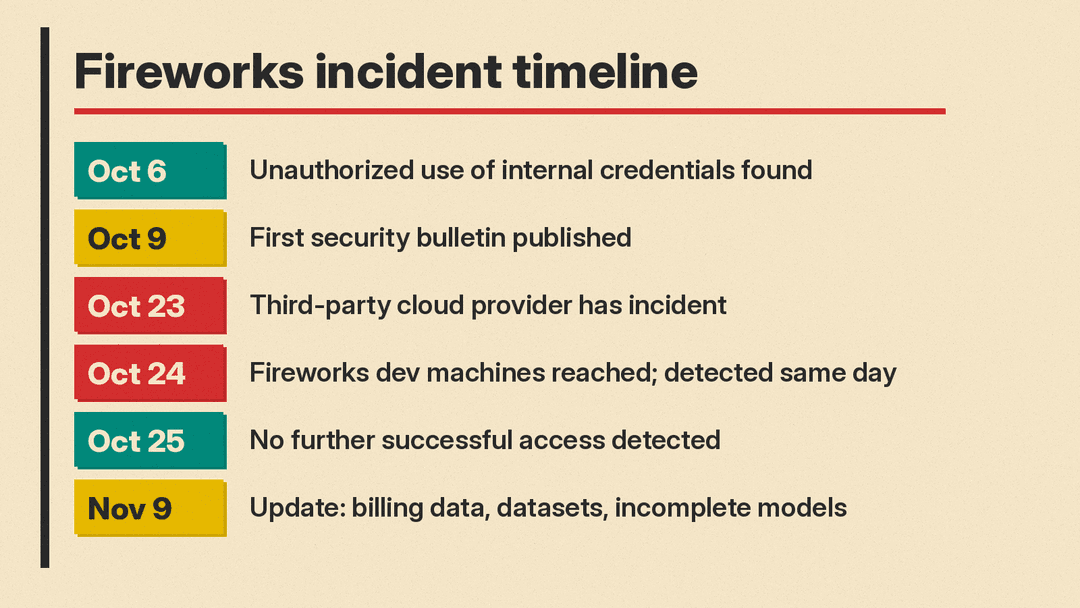
Fireworks published its first bulletin on Oct 9, 2026, and last updated it on Oct 10. It said that on Oct 6 it identified unauthorized use of internal Fireworks credentials. An unauthorized third party accessed environment variables used in evaluation jobs in a limited number of customer accounts. Fireworks believed API keys and tokens stored as secrets were captured in certain affected accounts.
The update says that when the first bulletin was published, only Fireworks stored secrets (for example, those used in evaluation jobs) were known to have been accessed. The update then says: "Since then, we discovered impacts to account and billing information. For a limited set of accounts, we also discovered impact to secrets, datasets, and incomplete models."
Fireworks says it notified law enforcement and received help with forensic analysis from Palo Alto Networks Unit 42. The update also describes further activity. A third-party cloud provider that hosted Fireworks research and development machines had a security incident on Oct 23. On Oct 24, an unauthorized third party used it to reach Fireworks development machines and ran an unauthorized workload that led to additional customer data impact. Fireworks says it detected this the same day. As of Oct 25, Fireworks says it has not detected further evidence of successful unauthorized access by the threat actor on the Fireworks platform that customers use.
The update lists what the affected internal application gave access to. The first category is resource metadata, which includes items such as resource identifiers, display names, descriptions and creation time. The second is billing information, which includes items such as billing and shipping addresses, invoice and payment history, account balance and credit usage. The third is a subset of incomplete model weights and datasets, for certain customers. Fireworks says the investigation is ongoing and may reveal more.
What was not affected
Fireworks says it does not store payment card numbers and that they were not impacted.
Fireworks says it has not detected any impact to Inference, Training SDK and Nexus. Those products are zero data retention (ZDR) by default, the update says. The first bulletin put it this way: "Fireworks does not store prompts or outputs by default, as our platform is ZDR."
What is LLMJacking?
Fireworks does not say it has confirmed a specific attacker. Its update says: "The evidence indicates links to a cybercriminal threat actor group, which is financially motivated and aimed at selling tokens from unauthorized access to Large Language Models (LLMs) to illicit routing gateways, known as 'LLMJacking'." That is Fireworks' characterization of the evidence, not an independent finding stated as fact here.
Fireworks points readers to a Google Threat Intelligence Group and Mandiant post published Nov 2, 2026. That post describes LLMJacking in general. It says Mandiant responded to multiple incidents in 2026 in which threat actors hijacked enterprise access to LLMs. It says fraudulent charges in individual incidents exceeded $100,000 in a single day, and cumulative charges at some organizations reached $1 million before access was revoked. The post does not identify Fireworks as one of those cases.
The post also describes how stolen access is resold. It says "LLM Mixers" are illicit routing gateways that proxy, aggregate and resell unauthorized LLM access to underground subscribers.
The Fireworks update does not name the group behind its incident.
What Fireworks changed
Fireworks says it took these steps:
- Revoked and replaced credentials and service accounts, and removed unnecessary elevated privileges
- Restricted unauthorized network pathways and isolated affected systems
- Tightened access to data storage and analytics systems
- Secured and enhanced logging and monitoring
- Disabled self-serve dataset uploads and downloads used by Batch Inference and dataset-based training while it investigates
Fireworks says it is notifying customers whose data was impacted and giving them details about the impact and recommended response actions.
What customers should do
For customers affected by the credential exposure, Fireworks' first bulletin gives this advice:
- Replace revoked Fireworks API keys if they are still needed.
- Rotate third-party credentials named in the notice with the providers that issued them. Fireworks notes that "Removing a stored secret alone does not invalidate the underlying credential."
- Work with those providers to review access logs and the data the credentials could reach, and rotate the credentials even if nothing suspicious turns up.
- Check the Fireworks account for API keys, users, evaluators, training jobs and datasets that are not recognized.
Why it matters for AI apps
Fireworks' first bulletin says the environment variables captured in certain affected accounts included API keys and tokens stored as secrets, and its advice names third-party credentials that customers must rotate with the providers that issued them. Deleting the copy stored on Fireworks is not enough, by the company's own account. That is why its advice points customers back to those providers and to the logs they keep.
Fireworks is not the only AI developer platform hit recently. SecurityWeek reported that over the past month at least a dozen AI developer platforms were hit, listed Fireworks AI among them, and said the attacks do not appear to be related. We covered a similar case when OpenCode disclosed a breach of third-party API keys.
Update, November 11, 2026: Railway's November 10 incident report lists Fireworks AI among the platforms that "disclosed similar thefts" between October 6 and October 23. Railway says AI keys stolen in its own October incident ran up an estimated $740,000 in unauthorized spend.
Sources
- October 2026 security incident update, Fireworks AI security bulletin, last updated Nov 9, 2026
- October 2026 security incident, Fireworks AI security bulletin, last updated Oct 10, 2026
- The Rise of LLMJacking: How Threat Actors Monetize Compromised Cloud and Model Resources, Google Threat Intelligence Group and Mandiant, Nov 2, 2026
- AI-Linked Breaches Mount as WorkOS, Northflank, Trigger.dev Disclose Hacks, SecurityWeek, Nov 4, 2026
