
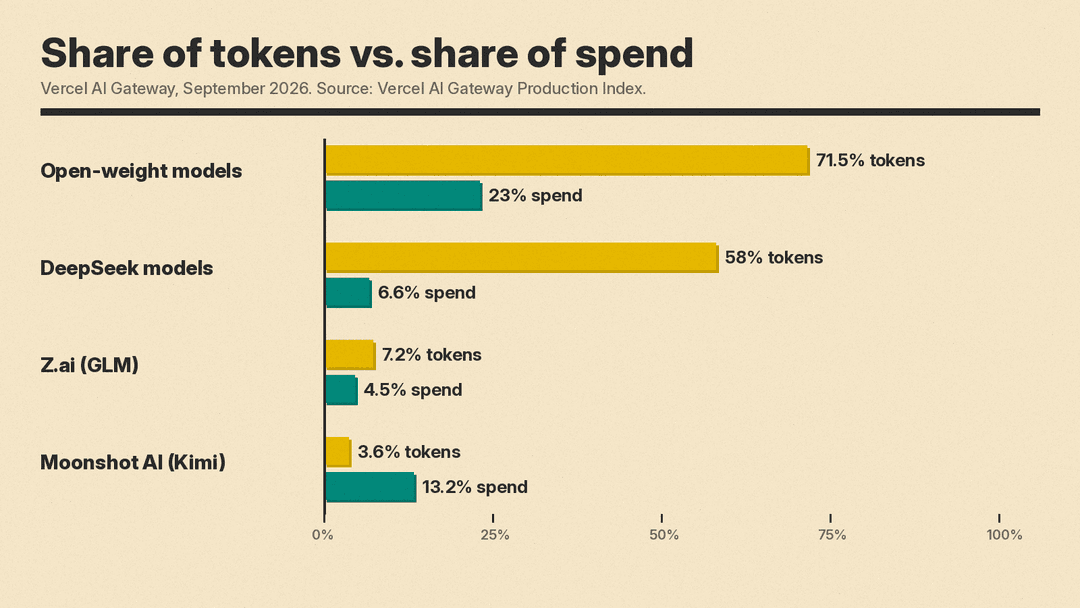
Open-weight models now handle most of the traffic on Vercel's AI Gateway, but they still collect a minority of the money. In its October 2026 AI Gateway Production Index, Vercel reports that open-weight models processed 71.5% of gateway tokens in September and accounted for about 23% of estimated spend. That spend share has more than quadrupled since June, when open weight took roughly one in twenty gateway dollars.
The report is one of the few regular, public views of what production AI traffic looks like across labs. Vercel says the gateway routes tens of trillions of tokens a month between customer applications and model providers. The numbers come with limits, covered below, but the direction is clear: customers are spending far more on AI, paying less per token, and switching models often.
Cheap tokens, expensive dollars
The gap between tokens and dollars is mostly a price story. DeepSeek's models processed 58% of all gateway tokens in September for 6.6% of spend, according to Vercel. DeepSeek V4.1 Flash alone handled nearly half of September's tokens and took 2.6% of spend, at about a fifth of the open-weight average price per token.
The spend growth inside open weight came from the other end of the price range. Vercel says models priced at least four times the open-weight average, led by Moonshot AI's Kimi K3, drove about two thirds of the increase in open-weight spend. Moonshot accounted for 3.6% of tokens but 13.2% of spend. Z.ai, the lab behind GLM, took 7.2% of tokens and 4.5% of spend.
Frontier labs are not losing money in absolute terms. Vercel says spend on frontier models has grown tenfold since December, while spend on open-weight models grew more than seventyfold. In September, 68% of teams that increased open-weight spending also increased closed-model spending. Vercel's reading is that a lab can earn more from a customer while handling a smaller share of that customer's workloads.
A bigger, cheaper, more fickle market
Total gateway spend in September was about 13 times December's level, while the average price per token fell 47%. The median paid customer active in both months more than doubled its spend.
Loyalty is weak. Nearly one in two teams changed their most-used model in September, and almost one in three changed their most-used lab, which Vercel calls an index record. Teams also run many models at once. Since December, teams that processed at least 100 million tokens used an average of 26 different models, and teams above a billion tokens used 42.
Anthropic is the clearest example of the shift. Vercel says Anthropic's share of gateway spend fell below half for the first time, from 63.7% to 43.9%. The Opus family went from about one in two gateway dollars in August to almost one in three in September, even as Claude Opus 5.5 took 11.03% of spend in its first two weeks, the largest share of any September launch.
Chinese models, American revenue
One of the less obvious findings is where money for Chinese models goes. Nearly 70% of September gateway spend on Chinese-origin models went through US-based providers, up from less than 10% in December. Vercel says US providers served nine in ten Moonshot tokens and seven in ten Z.ai tokens. DeepSeek served more than four in five of its own tokens, yet two in five dollars spent on DeepSeek models still went through US providers.
That matters for the policy debate around Chinese AI. A Chinese lab can win usage while much of the inference revenue lands with American hosting companies.
Reach is not revenue
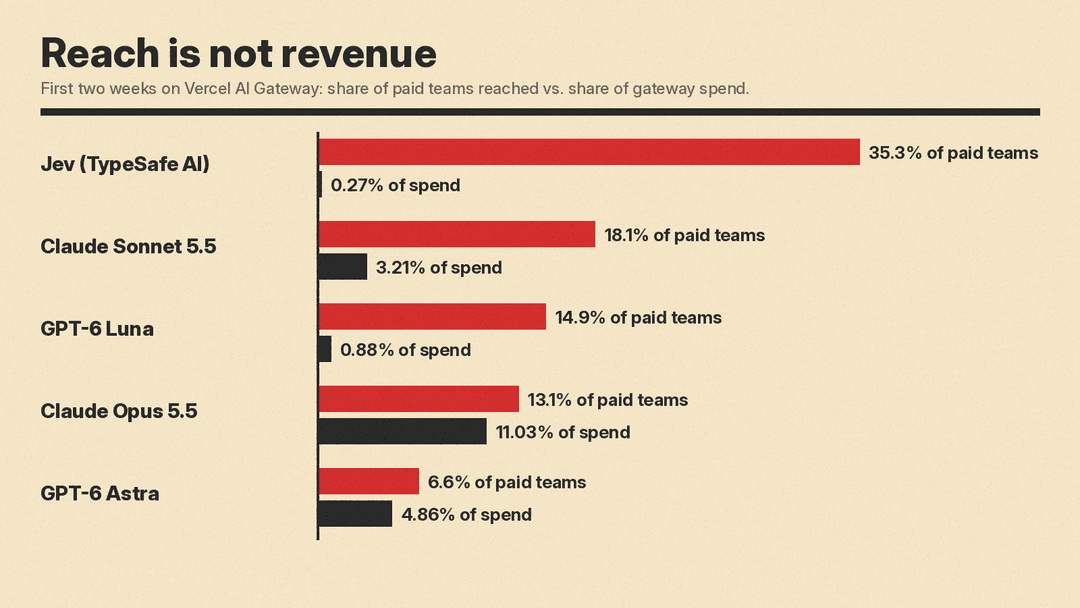
Vercel also ranked September launches by reach, spend share and two-week return rate. Jev, a "decision model" from TypeSafe AI that returns typed choices and probabilities instead of text, reached 35.3% of paid teams in its first two weeks, nearly double Claude Sonnet 5.5's 18.1% and the fastest adoption in gateway history. It took just 0.27% of spend over the same period. Vercel had reported in September that Jev reached nearly 13% of paid teams within 24 hours.
OpenAI's launches split the same way. GPT-6 Luna reached 14.9% of teams and had the best return rate of the month at 64.8%, but under 1% of spend. GPT-6 Astra reached 6.6% of teams and took 4.86% of spend. On Vercel's combined score, Claude Sonnet 5.5 ranked first, followed by Gemini 3.8 Flash and Claude Opus 5.5.
Caveats
This is one gateway's data, not the whole market. Customers who call lab APIs directly do not appear, a gap TechCrunch noted in its coverage. Spend is estimated at published list prices, so negotiated discounts are not reflected. Vercel also says its open-weight definition is now broader than in earlier reports, and prior months may be revised. Treat the figures as a strong signal about developer behavior on one platform, not market share.
Why it matters
The report supports a pattern many teams describe: route high-volume, simple work to cheap open models, keep expensive frontier models for the hardest tasks, and change models when prices or quality move. For labs, usage is easier to win than budget, and budget is easier to lose than it used to be.
