
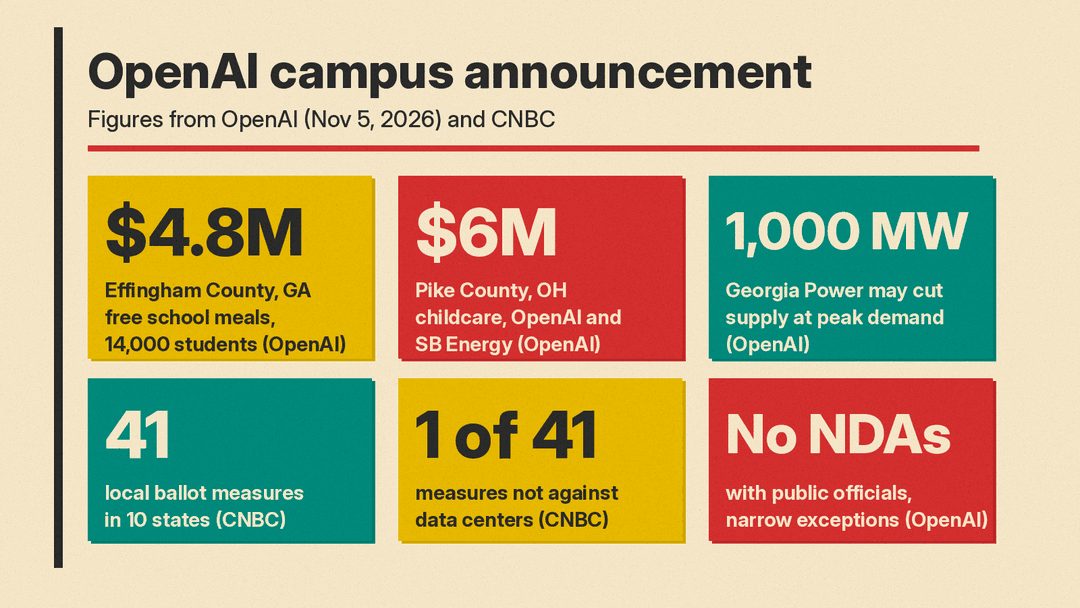
OpenAI published a National Community Compact and a Compute Campus Policy Blueprint on Thursday, November 5. OpenAI's announcement says the compact "sets out what communities can expect from OpenAI at future campuses that we own and operate." The blueprint asks federal, state and local policymakers to write similar rules into law. The release comes two days after an election in which voters backed restrictions or rejected pro-development measures in all but one of 41 local data center ballot measures, according to Ballotpedia and CNBC.
What OpenAI committed to
OpenAI says every future campus it owns and operates will get its own local compact. It says it will engage residents early, name a local point of contact, and report publicly each year. Each compact will carry a common set of commitments.
- Energy. OpenAI says it will "pay the full cost of the electricity we use and the infrastructure needed to serve us." Before major spending begins, it will give financial assurances so other customers are protected if a project is delayed, reduced or canceled.
- Resources and reporting. OpenAI says it will write a water plan for each campus, prioritize closed-loop or low-water cooling, and publish site-level water and electricity use. It will publish construction plans and independent noise studies before operations begin and every year afterward.
- Secrecy. OpenAI says it will not use non-disclosure agreements with public officials. It allows only narrow protections for "legitimate security information, trade secrets, or proprietary or competitively sensitive information."
- Jobs. OpenAI says it will publish the jobs it expects to create, work with unions and training providers, and invest in priorities that residents help select.
OpenAI gives two examples. In Effingham County, Georgia, residents helped shape a $4.8 million grant for free school meals for all 14,000 students in the county. In Pike County, Ohio, families picked childcare, which led to a joint $6 million commitment from OpenAI and SB Energy.
What the blueprint asks lawmakers to do
OpenAI writes that voluntary commitments from companies are "an important starting point." Its requests include:
- State utility commissions should require large electricity customers to cover the costs they add to the grid and protect other customers if a project falls through.
- Utilities should make it easier to connect campuses that can safely cut demand when power is scarce. OpenAI says its agreement with Georgia Power for the planned Effingham County campus lets the utility reduce the power it delivers by up to 1,000 megawatts during periods of high demand.
- Congress should speed up transmission upgrades and restore and expand tax incentives for clean electricity.
What OpenAI executives said
OpenAI's chief global affairs officer, Chris Lehane, briefed reporters on Wednesday. CNBC quotes him: "What we're doing with this blueprint is really laying out the best lessons that we have learned and committing to applying them as they go forward." CNBC reports that Lehane said the blueprint has been in the works since August and that he has met with dozens of lawmakers and candidates since then.
Reuters reports that Lehane put the expected jobs at one OpenAI facility in southern Ohio at 2,500 long-term jobs with an average annual salary of $80,000. Reuters also quotes Lehane: "These projects are not the types of data centers that people have historically thought about, which are some version of a black box in a pasture that did very little in terms of the economic utility for the communities they were in."
Reuters adds that OpenAI President Greg Brockman said at a separate event on Wednesday: "We need to do a better job of really communicating to people, to local communities, about why data centers can be beneficial to them."
The election backdrop
Reuters reports that Democrats flipped governorships in Texas, Georgia and Ohio with candidates who promised to pause new data center permits and tighten construction rules. We covered the local results in Ohio Votes Ban and Limit Data Centers in 14+ Places, the market reaction in Midterms Hit AI Stocks: Hyperscalers Up, Data Centers Down, and an earlier Texas pause in Texas Pause Stalls Bond Sale for Anthropic Data Center.
Limits and open questions
In OpenAI's words, the compact covers campuses OpenAI owns and operates. Reuters notes that partners such as Oracle are building and own much of OpenAI's data center infrastructure, with the capacity dedicated to the startup. Reuters also notes that proprietary information would still be under wraps under the NDA pledge.
Axios reports that Lehane said renaming data centers "compute campuses" was an intentional effort to "provoke that conversation." Axios says some policymakers and consumer advocates view the renaming as a gimmick. Axios also reports that it is "far from clear" whether Democrats set to take control of powerful congressional committees will accept the industry's talking points, and that some new state leaders campaigned on the importance of binding agreements. It cites a report last month from Sen. Elizabeth Warren that found major tech companies are not covering the full infrastructure costs of their data centers.
Sources
- OpenAI: Setting a new standard for responsible AI infrastructure, November 5, 2026
- CNBC: OpenAI to pay for data center power after election shows AI concern
- Reuters via StreetInsider: OpenAI kicks off charm offensive to change voters' view of data centers
- Axios: Big tech scrambles to offer voters a new AI deal
