
A machine learning engineer takes a model from idea to production and keeps it working there. Google Cloud's certification page for the role puts it this way: the ML Engineer "builds, evaluates, productionizes, and optimizes AI solutions using Google Cloud capabilities and knowledge of conventional ML approaches." The same Professional Machine Learning Engineer page adds: "By training, retraining, deploying, scheduling, tuning, monitoring, and improving traditional and generative AI (gen AI) models, the ML Engineer designs and creates scalable, performant solutions."
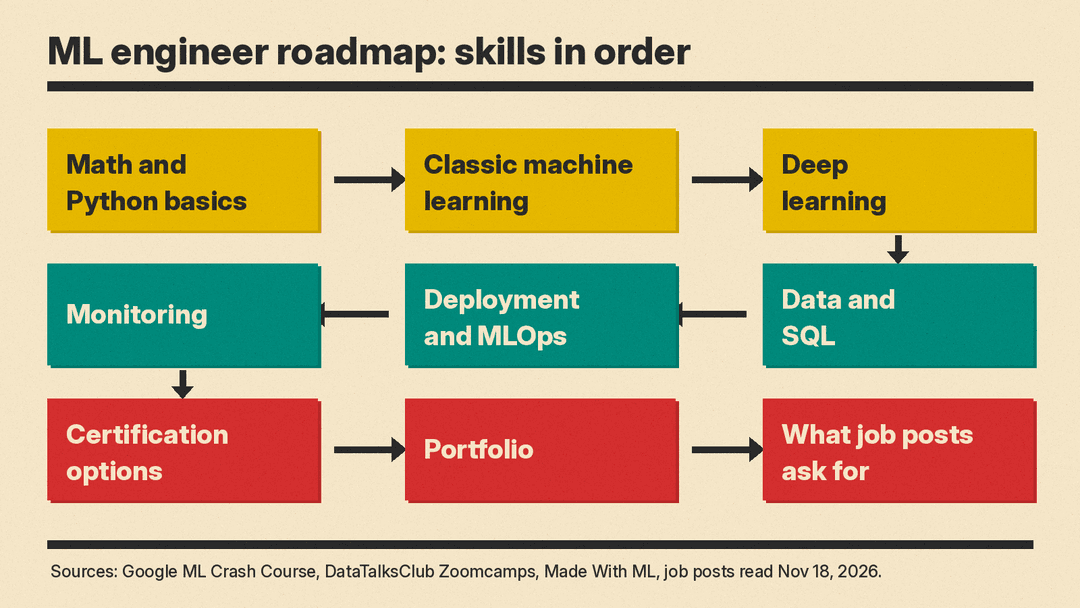
This roadmap lays out the skills in the order we would learn them, with a course, book or job post behind each stage. The order itself is our reading of how the sources build on each other: the courses below list earlier topics as prerequisites for later ones. If you are still deciding between roles, start with our comparison of AI engineer vs ML engineer vs data scientist.
What a machine learning engineer does
The Google Cloud page describes an ML Engineer who "handles large, complex datasets and creates repeatable, reusable code." It says the role "is proficient in the areas of model architecture, data and ML pipeline creation, MLOps, and metrics interpretation." It also says the role "is familiar with the foundational concepts of prompt and context engineering, application development, infrastructure management, data engineering, and data governance."
Job posts describe the same loop of building, shipping and maintaining models. Stripe's Machine Learning Engineer, Radar post asks the hire to "Build, train, evaluate, and deploy models that detect fraud and abuse across Stripe's global network, and own the production systems they run on." Our reading: the job is less about inventing new model types and more about getting models into products and keeping them reliable. For roles that build on top of foundation models, see our AI engineer roadmap.
Math and Python basics
Google's Machine Learning Crash Course prerequisites page is a practical checklist for this stage. It says learners "must be comfortable with variables, linear equations, graphs of functions, histograms, and statistical means." It also says: "You should be a good programmer." The page lists the background topics it expects:
- Algebra: variables, coefficients and functions, linear equations, logarithms, and the sigmoid function.
- Linear algebra: tensor and tensor rank, and matrix multiplication.
- Statistics: mean, median, outliers and standard deviation, and the ability to read a histogram.
- Calculus, marked optional for advanced topics: the concept of a derivative, gradients, partial derivatives, and the chain rule.
- Python: functions, dictionaries, lists, sets, loops, conditionals, string formatting and basic data types, plus list comprehensions for a few exercises.
As prework, the course points beginners to NumPy and pandas tutorials, and its exercises run in the browser on Colaboratory. To run the exercises locally or in a cloud console, it says you should be comfortable working on the command line. For more study material on the math side, see our list of math for machine learning courses and books.
Classic machine learning
Classic machine learning means models such as linear regression, logistic regression and decision trees, along with the habits of preparing data and measuring results. Two sources cover this stage in detail.
The Machine Learning Crash Course starts with an ML Models group. Google describes the Linear Regression module as "An introduction to linear regression, covering linear models, loss, gradient descent, and hyperparameter tuning." The Classification module is "An introduction to binary classification models, covering thresholding, confusion matrices, and metrics like accuracy, precision, recall, and AUC." A Data group follows, with modules on numerical data, categorical data, and datasets, generalization and overfitting. Google says each module is self-contained and recommends the listed order for newcomers.
DataTalksClub's Machine Learning Zoomcamp goes over the same ground with more code. Its README lists modules on regression (including linear regression from scratch and with scikit-learn), classification, evaluation metrics (accuracy, precision, recall, F1 score, confusion matrices, ROC curves and AUC, cross-validation, imbalanced classes), and decision trees and ensemble learning (random forests and gradient boosting with XGBoost).
Deep learning
Neural networks come next in both courses. The Crash Course's Advanced ML models group covers neural networks (perceptrons, hidden layers and activation functions), embeddings, and an introduction to large language models, from tokens to Transformers.
In ML Zoomcamp, the Neural Networks and Deep Learning module lists the main components of a neural network, work with PyTorch, TensorFlow and Keras, convolutional neural networks, and transfer learning. Later modules move straight into serving those models, which leads to the deployment stage below.
Data and SQL
Data skills carry through the whole roadmap, but job posts name them on their own. The Google Cloud certification page notes: "The exam does not directly assess coding skill." It adds that with a minimum proficiency in Python and SQL, you should be able to interpret any questions with code snippets.
Both Pinterest posts we read on November 18, 2026 ask for big data tools. The Machine Learning Engineer, Core Engineering post asks for "End-to-end hands-on experience with building data processing pipelines, large scale machine learning systems, and big data technologies (e.g., Hadoop/Spark)." Stripe's post lists large-scale data and feature pipelines among the systems a candidate may have run.
For the reasoning behind data work, Chip Huyen's book Designing Machine Learning Systems (O'Reilly, 2022) has chapters titled Data Engineering Fundamentals, Training Data, and Feature Engineering, according to its GitHub repo. The repo says: "This is NOT a tutorial book, so it doesn't have a lot of code snippets." Our reading: use it next to a hands-on course, not instead of one, and come back to it during the deployment and monitoring stages.
Deployment and MLOps
The Google Cloud page lists six areas its exam assesses:
- Architect low-code AI solutions
- Collaborate within and across teams to manage data and models
- Scale prototypes into ML models
- Serve and scale models
- Automate and orchestrate ML pipelines
- Monitor AI solutions
In our reading, three of those six (scaling prototypes, serving models, and orchestrating pipelines) belong to this stage, and monitoring gets its own stage below.
ML Zoomcamp's Deploying Machine Learning Models module covers serializing trained models, exposing predictions through a FastAPI service, packaging the service with Docker, and deploying it to a cloud platform. Its later modules cover serverless deployment with AWS Lambda and serving with Kubernetes and TensorFlow Serving.
DataTalksClub's MLOps Zoomcamp picks up from there. Its README calls it a free 9-week course, and its FAQ says: "All videos, materials, and homework are free and open-source." Its modules cover experiment tracking and model management with MLflow and a model registry, workflow orchestration and ML pipelines, model deployment (online web and streaming versus offline batch, Flask, AWS Kinesis and Lambda, batch scoring), monitoring, and best practices (unit and integration testing, pre-commit hooks, CI/CD with GitHub Actions, and Terraform). The README says DataTalksClub does not plan a live cohort in 2026 and that the course is available for self-paced study.
Made With ML, which its site now brands as Made With ML by Anyscale, teaches the same territory as one course. Its site says: "Learn how to combine machine learning with software engineering to design, develop, deploy and iterate on production ML applications." Its lessons run through Design, Data, Model (training, tracking, tuning, evaluation, serving), Developing, Utilities, Testing (code, data, models), Reproducibility, and Production (jobs and services, CI/CD workflows, monitoring, data engineering).
Monitoring
The Google Cloud exam lists monitoring AI solutions as its own area. Stripe's post asks the hire to lead ML projects end to end, through deployment, monitoring and iteration, and to lead incident response for model regressions. The Designing Machine Learning Systems repo describes a reader who has little feedback on how models perform after deployment and wants to quickly detect, debug and address issues in production.
For practice, the MLOps Zoomcamp Model Monitoring module covers web service monitoring with Prometheus, Evidently and Grafana, and batch job monitoring with Prefect, MongoDB and Evidently. On the design side, Designing Machine Learning Systems has chapters titled Data Distribution Shifts and Monitoring, and Continual Learning and Test in Production. Huyen's book page says the book weighs design decisions such as how often to retrain models and what to monitor.
Certification options
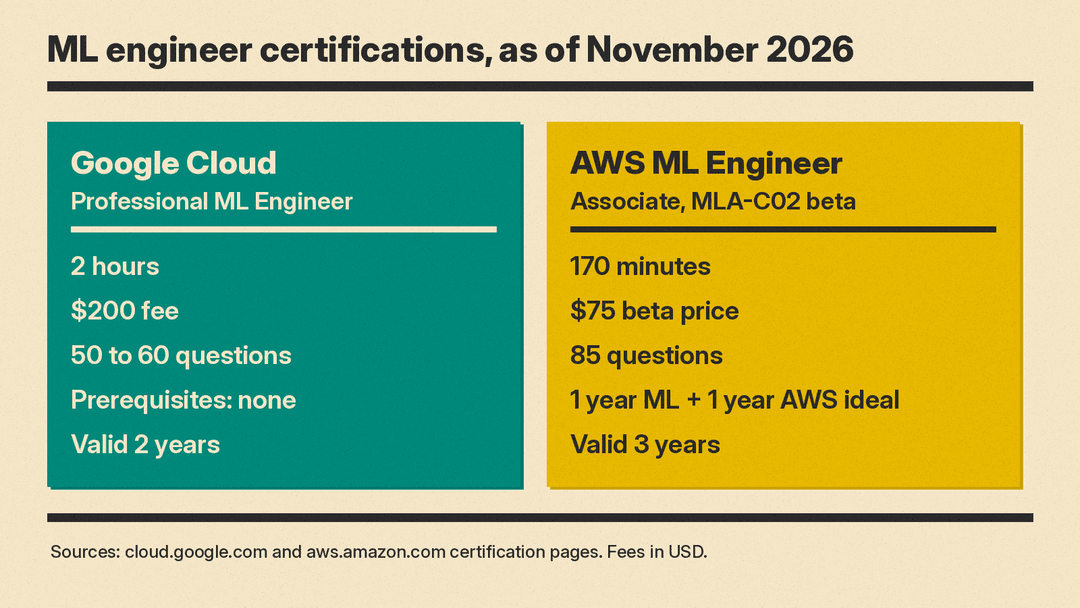
None of the three job posts we read asks for a certification. Exam facts are as of November 2026, from each program's own page.
Google Cloud Professional Machine Learning Engineer:
- Length: 2 hours.
- Registration fee: $200 (plus tax where applicable).
- Format: 50 to 60 multiple choice questions, in English or Japanese.
- Delivery: online proctored, or onsite at a testing center.
- Prerequisites: "None."
- Recommended experience: "3+ years of industry experience including 1 or more years designing and managing solutions using Google Cloud."
- Validity period: 2 years.
- The page says the exam was updated to reflect the transition from Vertex AI to Gemini Enterprise Agent Platform and updates to Google Cloud's data and analytics stack, and that it prioritizes Google Cloud native solutions.
AWS Certified Machine Learning Engineer - Associate:
- AWS says it "validates technical ability in implementing ML workloads in production and operationalizing them."
- The exam is being updated. The new MLA-C02 beta began delivery on September 29, 2026: 170 minutes, 85 multiple choice and multiple response questions, $75 USD beta pricing, English only during the beta.
- The current MLA-C01 exam (130 minutes, 65 questions, $150 USD) was available in English through September 28, 2026, and stays available in Korean, Japanese and Simplified Chinese until MLA-C02 reaches general availability.
- AWS says the ideal candidate "has at least 1 year of experience in machine learning engineering or a related field and 1 year of hands-on experience with AWS services."
- Validity: 3 years.
Our reading: each exam centers on one vendor's cloud, so a certification tells an employer you know that cloud's ML services. It does not replace the portfolio below, and the recommended experience on both pages suggests they are meant for people already doing the work.
Portfolio
The courses above are built around projects. ML Zoomcamp's README says: "You choose a dataset, define the prediction task, develop and evaluate a model, and deploy it as a web service." To earn its certificate, it says, "you must submit two qualifying projects and complete the required peer reviews during a live cohort." The 2026 live cohort started September 14, 2026; the README says modules run September through December and final projects conclude in January. The README says: "Machine Learning Zoomcamp is a free, practical course for people who want to learn machine learning engineering by building and deploying real projects." Its cost line lists both the live cohort and self-paced study as free.
Its listed prerequisites are at least one year of programming experience, comfort using the command line, and a laptop with an internet connection. No prior machine learning experience is needed. MLOps Zoomcamp expects more: Python, Docker, command line basics, machine learning (for example from ML Zoomcamp), and 1+ year of programming experience. Made With ML's FAQ lists Python (basics, NumPy, Pandas) and ML or deep learning basics (logistic regression, PyTorch).
Our reading: one project that is trained, deployed behind an API, tested and monitored shows more of this job than a set of notebooks that stop at a score. That matches what the job posts below ask for: end-to-end work.
What job posts ask for
We read three live machine learning engineer posts from two companies on November 18, 2026. Pay figures are base salary ranges as each post states them.
Pinterest, Machine Learning Engineer, Core Engineering:
- 2+ years of industry experience applying machine learning methods, with examples such as recommender systems, search, ranking and natural language processing.
- Data pipelines, large scale ML systems and big data technologies (Hadoop/Spark).
- "Bachelor's degree in computer science, machine learning, statistics, a related field or equivalent experience."
- Base salary range: $138,905 to $285,982 USD, US based applicants only. The post says the role is also eligible for equity.
Pinterest, Master's University Grad Machine Learning Engineer 2027 (USA):
- "Master's in Computer Science, ML, NLP, Statistics, Information Sciences or related field required."
- "Mastery of at least one systems languages (Java, C++, Python) or one ML framework (Tensorflow, Pytorch, MLFlow)."
- Big data technologies (Hadoop/Spark) and real-time systems that process stream data.
- Base salary range: $146,000 to $196,000 USD, US based applicants only.
Stripe, Machine Learning Engineer, Radar:
- "5+ years of experience developing, evaluating, and deploying machine learning models in a production environment."
- "Strong programming and software-engineering skills, with experience writing tested, maintainable code for production ML applications."
- Experience with several of: large-scale data and feature pipelines, distributed model training, low-latency inference, model deployment, or production monitoring.
- Annual US base salary range: $212,000 to $318,000. Stripe says the range may span several career levels at Stripe and will be narrowed during the interview process.
Both Pinterest posts also ask about AI-assisted engineering. The Core Engineering post lists, as nice to have: "Experience using Cursor, Copilot, Codex, or similar AI coding assistants for development, debugging, testing, and refactoring." The grad post asks for "Proficiency with AI-native engineering, including the design of agent-friendly codebases." Job posts close and change, so check each one before you apply. For a wider look at pay across AI roles, see our post on AI engineer salary data from job posts and BLS.
The roadmap in short
- Math and Python basics: the Crash Course prerequisites, NumPy and pandas.
- Classic machine learning: regression, classification, evaluation metrics and tree models.
- Deep learning: neural networks with PyTorch or TensorFlow.
- Data and SQL: Python and SQL, plus pipelines and big data tools.
- Deployment and MLOps: APIs, Docker, Kubernetes, experiment tracking, orchestration and CI/CD.
- Monitoring: production metrics, data shifts and retraining.
- Certification options: Google Cloud or AWS, both optional.
- Portfolio: end-to-end projects that are deployed, not only trained.
- What job posts ask for: production experience, software engineering, and data pipelines.
Sources
- Google Cloud: Professional Machine Learning Engineer certification
- AWS Certified Machine Learning Engineer - Associate
- Google Machine Learning Crash Course
- Machine Learning Crash Course: Prerequisites and prework
- DataTalksClub Machine Learning Zoomcamp (GitHub)
- DataTalksClub MLOps Zoomcamp (GitHub)
- Made With ML by Anyscale
- Chip Huyen: Books
- Designing Machine Learning Systems repo (GitHub)
- Pinterest: Machine Learning Engineer, Core Engineering
- Pinterest: Master's University Grad Machine Learning Engineer 2027 (USA)
- Stripe: Machine Learning Engineer, Radar
