
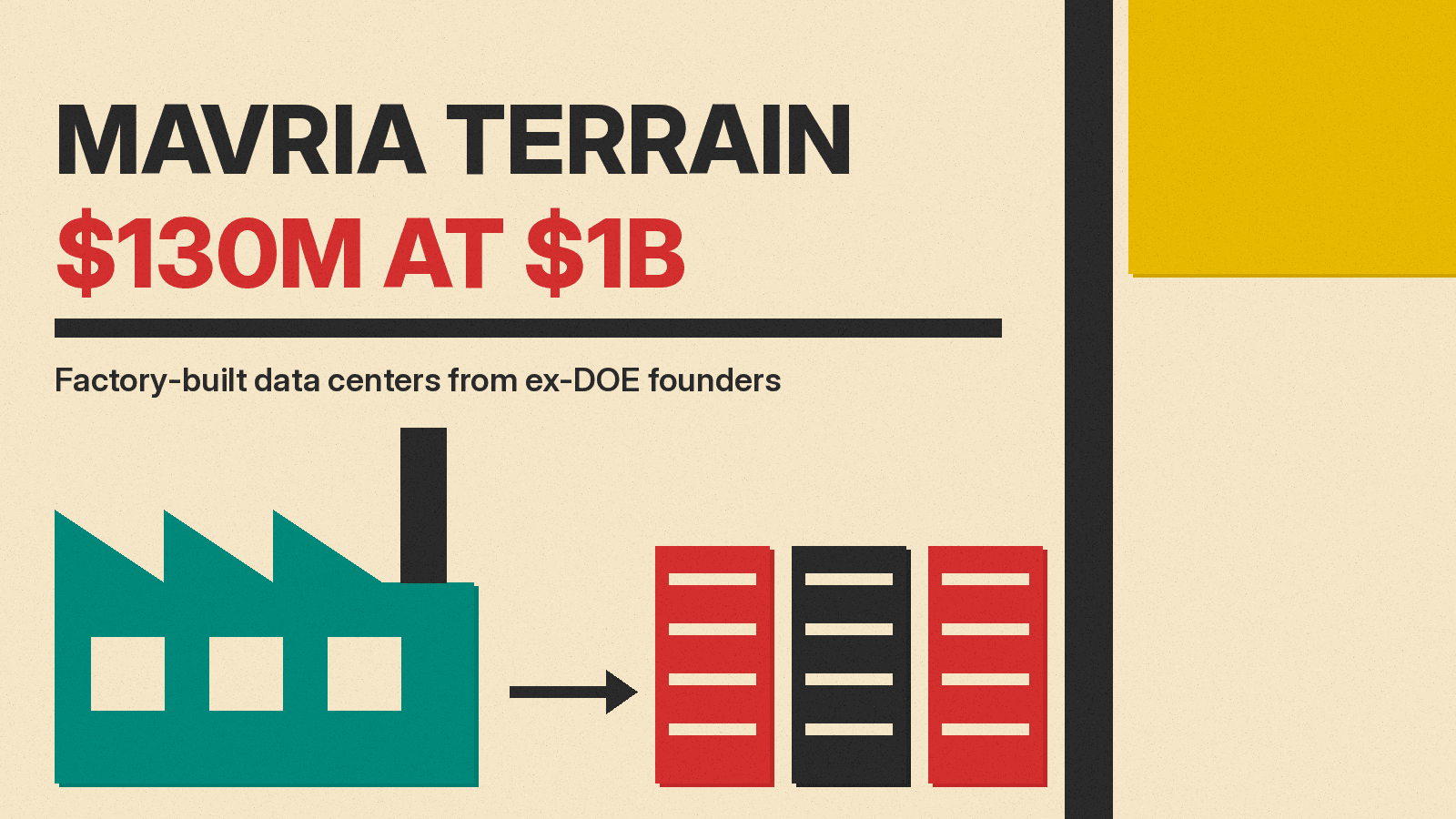
Mavria, a startup founded by former US Department of Energy staff, unveiled itself on Nov 9, 2026 with $130 million raised and a $1 billion valuation. The company plans to build data centers in a factory rather than on site. It is headquartered in The Woodlands, Texas, just north of Houston, according to Data Center Dynamics.
What Mavria announced
"Today we're unveiling Mavria: a company building the industrial platform behind American AI," CEO Adam Blake wrote in the launch post. The co-founders previously worked together at the Department of Energy. "We believe in rapidly deploying infrastructure as a product, rather than custom-building every project," Blake wrote. "We're starting with data centers, but our ambition extends across the physical infrastructure that AI depends on."
The launch post states: "We've raised $130 million to date across pre-seed and seed rounds. Our latest round values Mavria at $1 billion and was led by Paradigm, with participation from AMP PBC, Liquid 2, Critical Frontier, and Dream Ventures." Dealroom described Paradigm as a crypto investor. Kirkland & Ellis said it advised Mavria on the $130 million raise. Mavria said it is putting the capital to work securing critical supply chains, scaling manufacturing and expanding its team, and that it is hiring across engineering, manufacturing and operations.
What Terrain is
Mavria's first product is Terrain, "a factory-built data center platform designed to bring compute online faster, with more predictable delivery and lower costs. It replaces custom field construction with repeatable manufacturing." The launch post says Terrain is built for frontier labs, cloud providers, and data center developers. The Terrain product page says Terrain serves "frontier labs, neoclouds, developers and infrastructure owners" and that "Full product details are coming soon."
In plain terms, Mavria wants to make a data center the way a factory makes equipment: the same design, built again and again, instead of a custom construction project at each site. According to Data Center Dynamics, each Terrain unit is a 5MW system that leaves the factory fully integrated, with power distribution, direct liquid cooling, automation controls and standard IT server racks inside. Dealroom described Terrain as a truck-shippable system meant to be placed near available electricity.
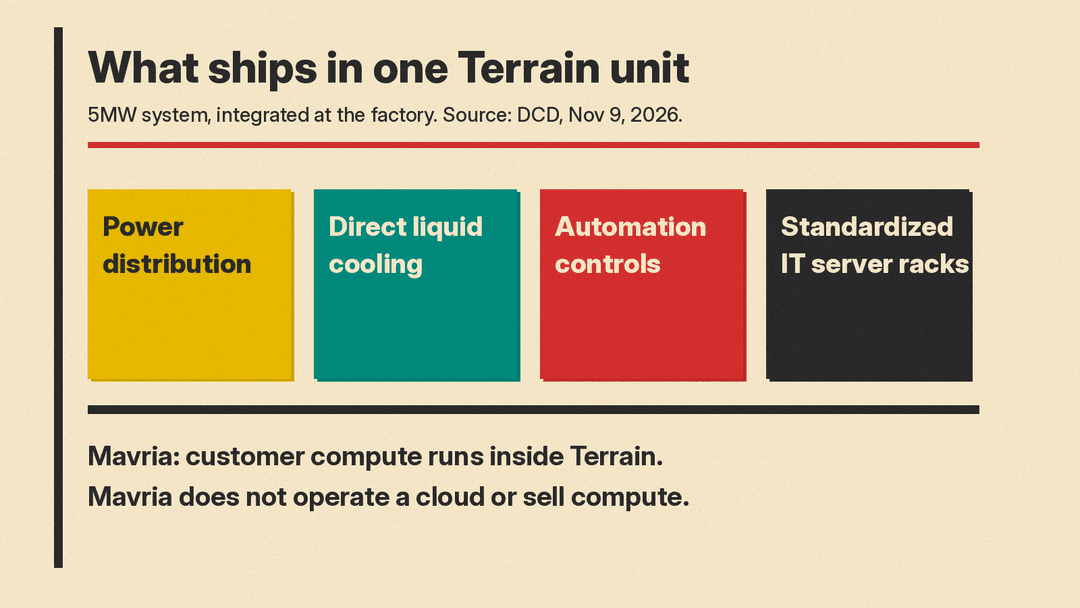
The product page says "Power, cooling, controls and IT pods are designed, integrated and tested as a standardized system before deployment." It also sets out the business model: "Customer compute runs inside Terrain; Mavria provides the physical infrastructure required to operate it. We don't operate a cloud, and we don't sell compute."
Data Center Dynamics also reported Mavria's claim that a unit can avoid grid connection delays by plugging straight into local distribution lines to "soak up" excess capacity.
Who is behind Mavria
Blake wrote that the co-founders worked together at the Department of Energy. The launch post describes them:
- Nick Poradek is an engineer who built complex energy equipment. He sold his last company to Liberty Energy and then helped build Liberty's manufacturing platform.
- Seth Cohen started as a Kirkland lawyer and "ended up at the center of the effort to restart American nuclear power."
- Adam Blake built one of the largest commercial solar companies in the US and sold a software business to Vista Equity Partners.
The rest of the founding team has "run utilities, led a modular LNG manufacturer with more than a thousand employees, developed major energy projects, and rapidly scaled technology companies," Blake wrote. The Mavria home page says the broader team brings experience in "data center engineering at NVIDIA and AWS, large-scale modular LNG manufacturing, and infrastructure project finance."
Timeline
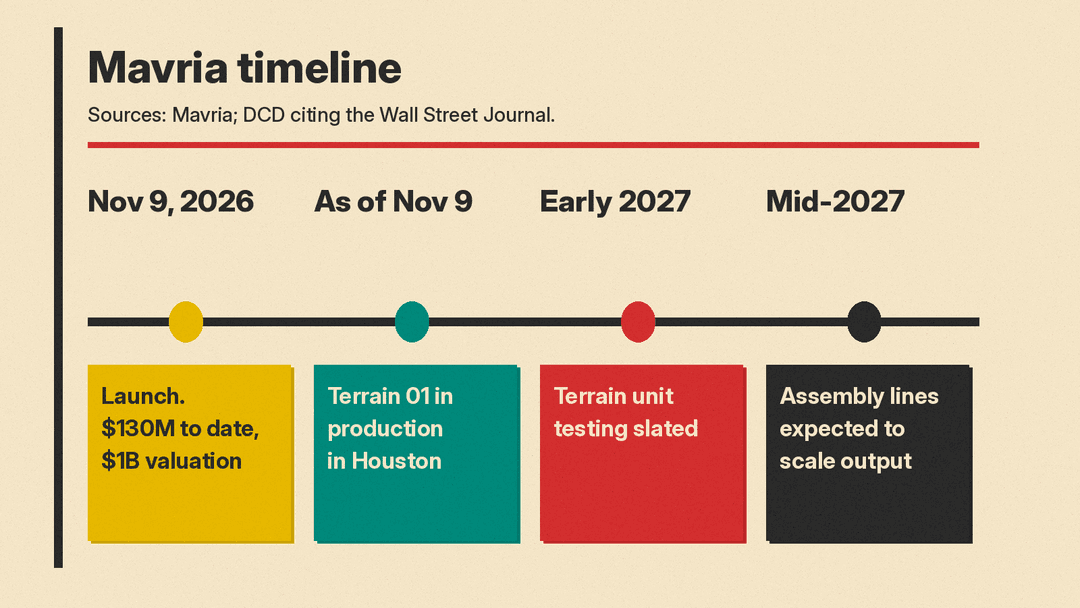
- Nov 9, 2026: Mavria publishes its launch post, announcing the company, its funding and Terrain.
- As of Nov 9: "Terrain 01 is in production in Houston right now," according to the launch post.
- Early 2027: The company told the Wall Street Journal that testing of the Terrain units is slated for early 2027, Data Center Dynamics reported.
- Mid-2027: Assembly lines are expected to scale output by mid-2027, per the same DCD report.
What is not disclosed
Mavria's own post gives only the $130 million total across pre-seed and seed rounds. It does not state the size of the latest round alone. The company has not disclosed customers, prices or where Terrain units will be deployed.
Why it matters
Mavria describes the problem Terrain targets as turning available power into operating compute. That process "still depends on bespoke engineering, fragmented procurement and extensive field construction," the home page says. The company's manifesto adds: "You may have the chips but not the power. Then if you solve for power, you still might wait years for transformers, switchgear, or turbines."
Power and site questions also run through other recent stories on llms.blog, including Anthropic's gas generator deal, a planned 300MW AI data center in South Korea that stalled, and a wind-powered AI campus in China.
Sources
- Mavria: Introducing Mavria (Adam Blake, Nov 9, 2026)
- Mavria: Terrain
- Mavria: home page
- Mavria: Industrializing Intelligence (manifesto)
- Kirkland & Ellis: Kirkland Advises Mavria on Fundraising
- Data Center Dynamics: Former US DOE staffers launch modular data center firm Mavria
- Dealroom: Mavria raises $130M to build data centers in a factory, hits $1B valuation
