
IK Multimedia released ReSing Choir on November 12, 2026. It is a standalone desktop app that takes one recorded vocal line and turns it into a group of up to five AI-modeled singers per song section, with harmonies that follow the chords you set. It runs offline on your own computer and is sold as a one-time purchase, not a subscription.
For home producers and songwriters, the pitch is simple: sing once, get a choir. Here is what the app does, what it costs, what you need to run it, and what IK has not said.
What ReSing Choir does
ReSing Choir builds on ReSing, IK's AI voice-modeling plug-in and standalone app, which IK says captures "the unique timbre, tone, and expression of real artists." Choir puts several of those modeled singers into one workspace so you can build backing vocals, doubles and stacked harmonies from a single take.
According to IK's announcement and product page, the main features are:
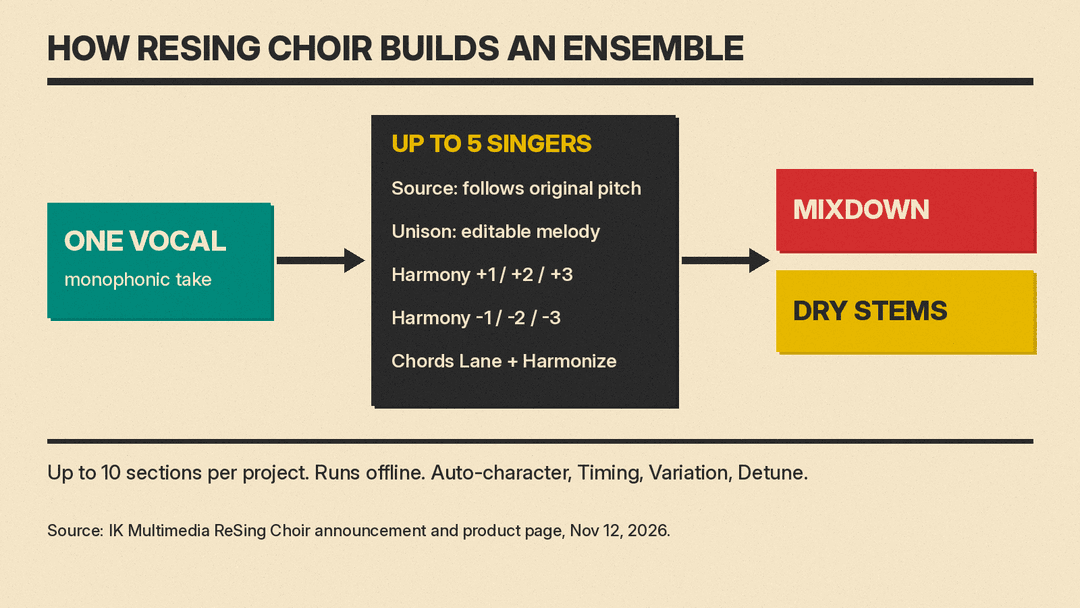
- Up to 5 singers per section. Each singer is a separate ReSing voice model with its own part.
- Chord-aware harmonies. You draw chord regions in a Chords Lane. A Harmonize slider balances how closely each harmony follows your lead melody versus the chord tones.
- Part assignment. Each singer can take the Source part (follows the original pitch curve), a Unison part (follows the melody with scale-quantized notes you can edit), or a harmony 1, 2 or 3 steps above or below the melody.
- Piano roll editing. All voice lines show in one color-coded piano roll. You can split and move notes, change vibrato, and smooth transitions. IK says notes you lock stay in place when you reharmonize.
- Swap singers without losing work. IK says replacing a singer keeps its part assignment, mix settings and manual note edits.
- Up to 10 sections per project. Verses, choruses and bridges can each have their own source vocal, singer lineup, arrangement and instrumental reference.
- Export. Each section exports as a full mixdown, as individual dry vocal stems, or both.
Auto-character: making the group sound less robotic
Copies of one vocal that start and stop at exactly the same moment can sound mechanical; IK says its Variation control is there to avoid "sterile synchronization." The headline feature here is new technology IK calls Auto-character, which the company says varies the chosen vocal character through a performance.
Three controls sit around it, per the product page:
- Timing moves the choir ahead of or behind the original performance across five positions, from Ahead to Behind.
- Variation adds small timing shifts to word and phoneme onsets.
- Detune adds Low, Medium or High pitch spread between singers.
Panning and a built-in reverb then place the voices across the stereo field. Whether this sounds like a real group is something you will need to judge from IK's audio demos; we have not tested the app.
Voices included, and where they come from
ReSing Choir ships with 10 starter voice models: Neil, Jenny, Leyla, Alex, Rika, Aaron, Vixy, Bob, Maya and Amber. It also loads any models already in your ReSing library, including singers bought separately and custom models made with ReSing Modeler, which IK says can include models of your own voice.
The product page says the ReSing library and collections now hold "over 66 voice models" in English, Spanish, Japanese and Portuguese.
On consent, IK states that its professional singer models "are created with the full participation, consent and fair compensation of the original artists." IK does not publish the pay terms. Yamaha takes a similar licensed-voicebank route with VOCALOID7, though that product synthesizes singing from notes and lyrics rather than from your recorded take.
Price and availability
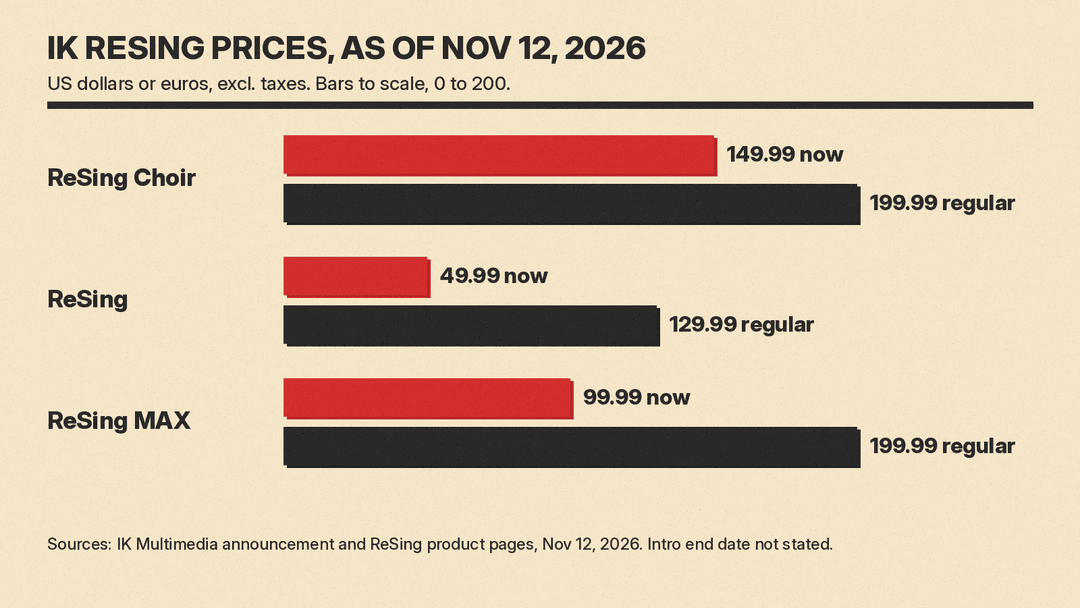
As of November 12, 2026, IK lists:
- ReSing Choir: introductory price of $/€149.99, normally $/€199.99, as a perpetual license. IK says there are no recurring subscription fees. Prices exclude taxes.
- ReSing (plug-in and app): currently $/€49.99, regularly $/€129.99.
- ReSing MAX: currently $/€99.99, regularly $/€199.99.
IK has not given an end date for the introductory price. The product page also offers upgrade pricing to owners of eligible IK products after login; we did not see those prices.
System requirements
From the product page, as read on November 12:
- Mac: Apple M1 or Intel Core i5, 8 GB RAM, macOS 13.7 or newer, 9 GB of disk space, OpenGL 2 graphics.
- Windows: Core i5 or equivalent, 8 GB RAM, Windows 10 (64-bit) or newer, 9 GB of disk space, an ASIO-compatible sound card, OpenGL 2 graphics.
- Internet is required for authorization.
ReSing Choir is a 64-bit standalone application. IK describes processing as "100% local," with no cloud credits or usage quotas. The input is a single monophonic vocal recording.
Why it matters
Song generators such as Suno write a whole track from a prompt. ReSing Choir is a different kind of product: it assumes you already sang the part and handles the tedious work of building harmonies and doubles around it. That puts it next to features arriving inside music software, such as the AI tools in Splice Create, Pro Tools and Logic Pro, and next to research like BARS that tries to control AI vocals more precisely.
Two choices stand out. First, it runs offline with a one-time price; IK stresses "no cloud credits or usage quotas." Second, IK frames its voice library around consented, paid artists, which gives buyers a clearer story about where the voices came from.
What we do not know yet
- How long the $149.99 introductory price lasts.
- How the harmonies and Auto-character sound on difficult material; we only have IK's demos.
- Processing speed on the minimum M1 or Core i5 machines; IK lists requirements but no render times.
- Whether the app is a plugin as well; IK describes it only as a standalone application that runs separately from ReSing.
