
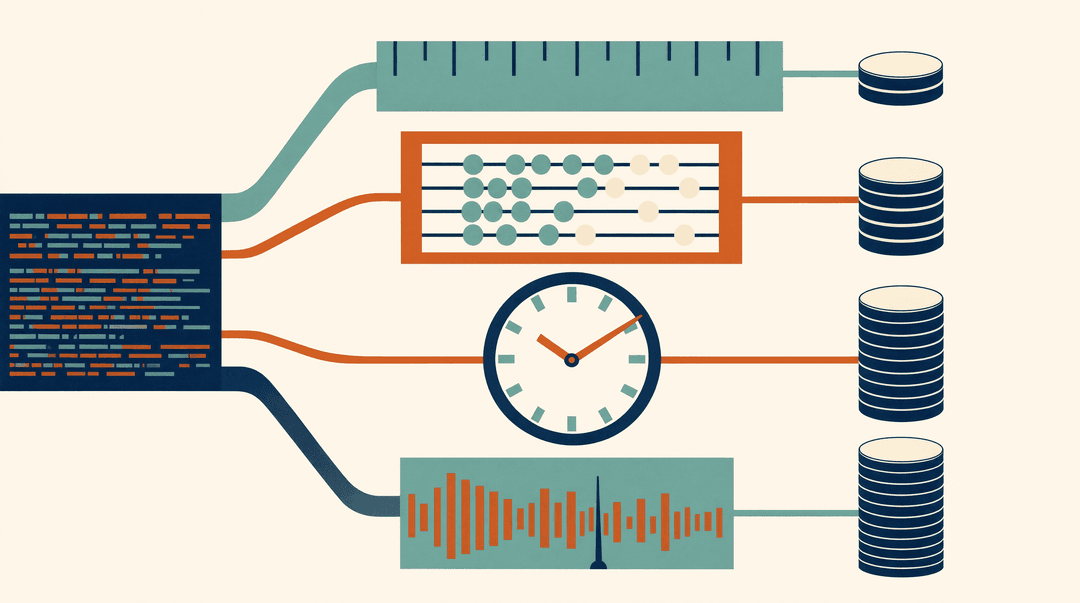
Synthesized speech is the only part of the AI bill with no standard unit. Text models charge per token, images charge per pixel or per generation, and voice charges however each vendor feels. In late 2026 there are four different meters in active use: characters, subscription credits, audio tokens, and minutes. The same sentence of narration can cost 25 times more depending on which one you picked, and the unit choice interacts with your workload in ways the price list does not show.
The character meter
Most vendors bill per million characters of input text, counting spaces and punctuation. It is the simplest meter in the category: you pay for what you send, not for what the voice does.
Amazon Polly runs one text meter across four quality tiers: Standard voices at $4 per million characters, Neural at $16, Generative at $30, and Long-Form at $100. Google Cloud's classic Text-to-Speech has the same shape: WaveNet and Standard voices at $4, Neural2 at $16, the current Chirp 3: HD voices at $30, an instant custom voice at $60, and Studio voices at $160 per million characters. Azure's Neural line sits near $16 per million, and Microsoft cut Neural HD from $30 to $22 per million in March 2026. Deepgram publishes Aura-1 at $0.015 per 1,000 characters, Aura-2 at $0.030, and its newer Flux TTS at $0.045 on pay-as-you-go, with a prepaid Growth tier (from $4,000 a year) taking roughly 10 to 20 percent off.
ElevenLabs lists its API between $0.04 and $0.08 per 1,000 characters depending on model (v4 Turbo and Flash at the low end, Eleven v4 at $0.08), with its top Multilingual v3 line tracking to about $100 per million characters. The ladder is remarkably consistent across vendors: a utility voice for navigation prompts runs $4 to $16 per million characters, an expressive narrator runs $30 to $50, and the flagship tier runs $100 or more.
The character meter has one property worth internalizing: cost is independent of delivery. A voice that reads slowly, pauses dramatically, or stretches syllables bills exactly the same as one that rattles through the text.
The credit meter
ElevenLabs and Cartesia hide the character meter inside a subscription. ElevenLabs charges roughly 1 credit per character for standard text-to-speech, 0.5 to 1 credit per character for its Flash and Turbo models, and the same credit pool pays for transcription, music, dubbing and voice changing on published per-unit rates (330 credits per minute for speech-to-text, 2,000 to 10,000 per minute for dubbing). Plans run from Free at 10,000 credits to Business at $990 for 6 million credits, and unused credits roll over only up to twice the monthly quota.
Cartesia's plan table is more explicit about what the subscription buys: Pro at $5 for 100,000 credits, Startup at $49 for 1.25 million, Scale at $299 for 8 million, with overage billed at $65, $45 and $38 per million credits respectively. Since one credit is one character, the effective rate is $38 to $65 per million depending on plan, with no clean pay-as-you-go rate at all.
The trap in the credit meter is that a bigger plan is not a discount. Bland's pricing review notes that ElevenLabs prices the characters included in each subscription tier at the same per-million rate as the raw API, so upgrading buys capacity and features, not a lower unit price. Comparison sites consistently find that credits make the sticker prices hard to line up against per-character vendors; independent tables put Cartesia's effective rate anywhere from $30 to $50 per million depending on which plan the author assumed.
The token meter
The newest meter bills the audio, not the text. Google's Gemini-TTS line charges per million text tokens in and per million audio tokens out, where a second of output equals 25 tokens. The current Flash TTS preview runs $0.50 in and $9.00 out per million tokens, and Google's own pricing page states the rates double to $1.00 in and $18.00 out on January 1, 2027. OpenAI's realtime audio models work the same way, with the mini tier at $10 per million audio input tokens and $20 per million audio output tokens.
The consequence inverts the character meter: cost now follows the performance. Slower speech, longer pauses and expressive pacing produce more seconds, which produce more tokens, which produce more money. OpenAI's estimate of about $0.015 per minute of generated audio for its token-priced speech model shows up in the company's developer forum with the usual caveats: users report short texts billing roughly double the estimate, and instructing the voice to speak slower raises the output cost directly. The model does not even return usage data on the classic speech endpoint, so teams end up estimating their own bill with third-party calculators.
The minute meter
Per-minute billing never left. OpenAI's current voice rate card leads with GPT-Live at $0.05 per active minute and $0.02 per standby minute, billed per second. ElevenLabs' Business plan advertises low-latency text-to-speech "as low as 5 cents per minute" as a plan feature. Deepgram's Voice Agent API folds speech-to-text, a managed language model and a voice into one per-minute rate from $0.05 to $0.163 depending on tier and what you bring yourself.
The minute meter is built for two-way conversation, where most of the clock is silence or the other party talking, and standby pricing makes that cheap. It is badly shaped for narration, where the clock runs continuously. A ten-hour audiobook on OpenAI's active-minute rate is a very different number than the same text on a character meter.
Converting the meters to one number
To compare, you need a speech rate. Amazon's own pricing examples imply one: 1 million characters synthesizes to about 23 hours and 8 minutes of audio, roughly 720 characters per minute. (Gradium's comparison guide uses 750.) With that, one workload converts cleanly.
Take a 500,000-character audiobook, about 11.5 hours of finished audio:
- Google WaveNet or Polly Standard: $2.00
- Polly Neural or Azure Neural: $8
- Deepgram Aura-2 or Polly Generative: $15
- Gemini Flash TTS on the preview token rate: about $9 now, and about $19 the same script on January 1, 2027
- ElevenLabs Flash class: $25
- OpenAI GPT-Live if the voice never goes idle: about $35
- ElevenLabs top tier or Polly Long-Form: $50
Now flip the workload. A support assistant that speaks 100 million characters a year in short replies costs $400 on the cheapest character meter, about $1,900 on the token meter at preview rates, roughly $6,900 on the active-minute meter, and $10,000 on ElevenLabs' flagship character rate. The same words span a 25-fold range because the meters tax different things: text length, audio length, or clock time.
What actually decides the bill
- Pick the meter to fit the duty cycle. Continuous narration belongs on a character meter. Interactive conversation with real silences belongs on a minute meter with standby pricing. Token meters are priced for neither or both, and their estimates drift.
- Read the tier ladder as the real price. Every vendor's headline number is the utility voice; expressive tiers run 4 to 25 times higher on the identical unit.
- Watch the calendar, not the rate card. Google's speech token prices double on January 1, 2027; Azure's Neural HD dropped a third in March 2026; Deepgram's Flux spend-match credits run out December 31, 2026. Comparison tables go stale in a quarter.
- Treat subscriptions as capacity, not discounts. ElevenLabs and Cartesia plan rates track their API rates; the plan buys concurrency, features and rollover rules.
- The free tiers are real money at small scale: Polly gives 5 million Standard characters a month, Azure 500,000 characters, Google 1 to 4 million depending on voice class.
The unit is the product. Before asking which voice sounds better, ask which thing you are paying for: the script you wrote, the audio it produced, or the time it took to play.
Sources
- Amazon Polly pricing (tier rates and the 1M-characters-to-23-hours example): https://aws.amazon.com/polly/pricing/
- Google Cloud Text-to-Speech pricing (character tiers, Gemini-TTS token rates, January 2027 increase): https://cloud.google.com/text-to-speech/pricing
- Deepgram pricing (Aura and Flux per-1,000-character rates, Growth tier, Voice Agent per-minute table, Flux spend-match promo): https://deepgram.com/pricing
- ElevenLabs pricing (credit costs per product, plan table, rollover rules, Business low-latency note): https://elevenlabs.io/pricing
- Cartesia's ElevenLabs pricing teardown and Cartesia plan table: https://www.cartesia.ai/learn/elevenlabs-pricing
- Bland AI TTS pricing review (ElevenLabs API rates, plan parity, Deepgram tiers): https://www.bland.ai/blog/text-to-speech-api-pricing
- Microsoft blog on Neural HD pricing reduction to $22 per million characters (March 2026): https://techcommunity.microsoft.com/blog/azure-ai-foundry-blog/azure-speech-%E2%80%93-neural-hd-text-to-speech-recent-voice-updates/4505380
- Azure TTS pricing analysis (Neural $16 per million, commitment tiers): https://texttolab.com/blog/azure-text-to-speech-pricing
- OpenAI API pricing docs (GPT-Live per-minute rates, realtime audio token rates): https://developers.openai.com/api/docs/pricing
- OpenAI developer forum threads on token-priced speech estimates and per-minute drift: https://community.openai.com/t/gpt-4o-mini-tts-output-cost-has-exceeded-what-i-calculated/1312195
- nineninesix.ai realtime TTS price table (effective per-million rates across ten vendors): https://www.nineninesix.ai/blog/tts-api-pricing-comparison-2026
- Gradium guide on cross-provider TTS price conversion (speech-rate normalization): https://gradium.ai/content/how-to-compare-tts-pricing-across-providers-2026
