
OpenAI on Tuesday pushed the largest update yet to openai/math, the GitHub repository where it dumps mathematics manuscripts produced by an unnamed internal frontier model. Nine new papers across two result families, merged into the repo at 00:18 UTC on November 25 under the commit message "Add November 24 mathematics manuscripts and Lean formalizations." The headline claim is one that complexity theorists have circled for fifty years: the exponent of square matrix multiplication, the number known as omega, is exactly 9/4, or 2.25, over every field.
That is a stronger statement than the one OpenAI made in October. The October 2 manuscript, released publicly on October 6 alongside more than 700 other results, claimed an upper bound: any two n-by-n complex matrices can be multiplied in roughly n^2.25 arithmetic operations. Upper bounds are the easy direction. You prove one by exhibiting a scheme, and the community checked this one fast. Three independent arXiv papers followed within weeks: Rafael Pass published a constructive, elementary reproof via polynomial packings (arXiv:2610.28627); Alimzhan Amanov, Maxim van den Berg and Jeroen Zuiddam rewrote the argument in the language of spectral points and proved a barrier showing the current framework cannot go below 9/4 (arXiv:2610.30054); a group led by Mustafa Dogan extended the bound to every field using a symmetrized tensor value, with a Lean formalization (arXiv:2611.09716). The upper bound has essentially been cross-validated by outsiders.
The new paper, titled "The matrix multiplication exponent is nine fourths," claims the hard part: a matching lower bound. Per the manuscript's README, the paper proves that at every side length n of at least two, computing square matrix multiplication requires at least ceil(n^9/4 / 2) nonscalar multiplication or division gates in formal arithmetic circuits. It also claims the geometric border rank of the square multiplication tensor is at least n^9/4 and its asymptotic rank over the base field equals n^9/4. If the lower bound holds, no future algorithm, human or machine, can beat 2.25 in this model. The exponent would be pinned, closing a chase that started when Volker Strassen beat n^3 in 1969 and ran through two decades of tensor gymnastics that stalled around 2.37, a margin an AlphaEvolve-assisted optimization shaved down slightly in August (arXiv:2608.16884).
The mechanism is a companion paper, "Euclidean geometry in the asymptotic spectrum of tensors," which assigns costs to tensors by placing their indices in a real Hilbert space. A bit shared between two sites costs their Euclidean distance; a bit shared among a set of sites costs the mean width of their convex hull. This geometry lets the proofs compare a tensor with the networks that produce it, which is where the lower bound comes from.
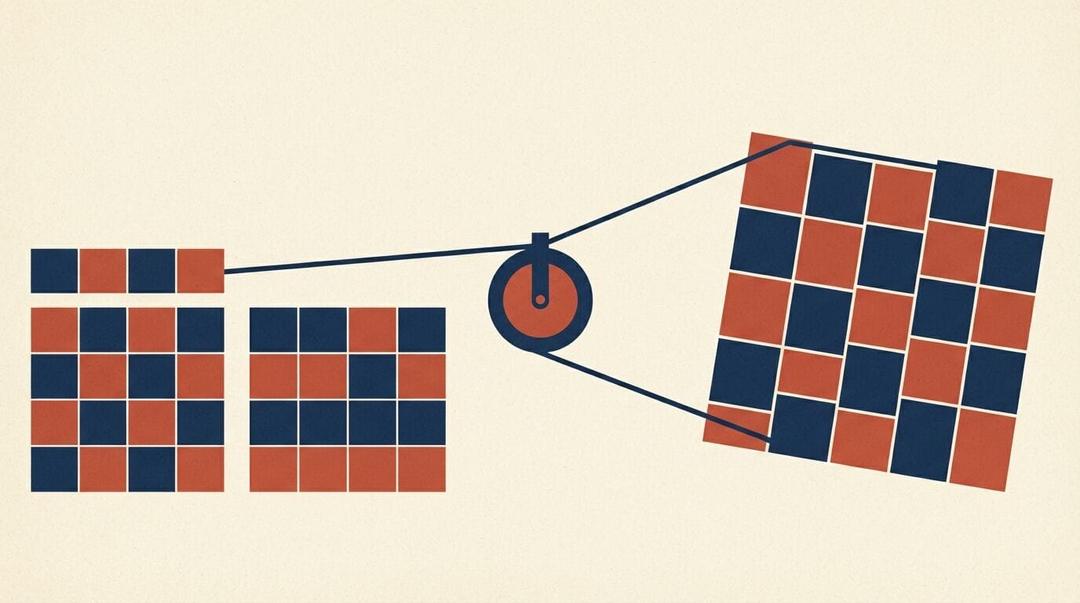
The batch does not stop at matrix multiplication. The same nine manuscripts also claim:
- A deterministic strongly polynomial algorithm for linear programming with arbitrary real coefficients, answering Smale's ninth problem, plus algorithms for convex quadratic programming and turn-based mean-payoff games.
- A disproof of the polynomial Hirsch conjecture: bounded simple rational polytopes whose graph diameter grows faster than every fixed power of the facet count.
- The fixed-petal sunflower conjecture, with an explicit base whose log grows like (log r)^4.
- Quantitative arithmetic circuit lower bounds for the Hamiltonian cycle polynomial and the permanent, of the form exp(c log^2 N / log^2 log N) gates.
- A full separation of Valiant's hierarchy, VF strictly inside VBP strictly inside VP strictly inside VNP, over every field. This subsumes the VP not equal VNP paper OpenAI released on November 23.
Every result ships with partial Lean formalizations; the repo states the matrix-multiplication development proves the 9/4 exponent for division-free circuits computing formal polynomial identities over every field.
Reasons for caution, in OpenAI's own words. The repo's README describes the manuscripts as "raw research data, rather than polished academic papers," notes that some unformalized results could have issues, and the history file records that an October 7 update had to withdraw three papers after a sign error invalidated a shared argument. The October 26 manuscript claiming the Exponential Time Hypothesis is false got an announced independent review group led by Russell Impagliazzo, Ramamohan Paturi and Ryan Williams. The November 24 batch lists none. And the result is asymptotic bookkeeping, not a faster GPU: nothing published here changes what cuBLAS does tomorrow, and no competitive finite-size implementation of the 2.25 scheme is established.
If the lower bound survives scrutiny, an internal model that is not even named has now closed one of the oldest open questions in algebraic complexity, five years after the field's human heroes were still trading third decimal places. The math community's verdict is the only number that matters, and it has not come in yet.
Sources
- https://github.com/openai/math/blob/main/history.md
- https://github.com/openai/math/tree/main/preprints/The-matrix-multiplication-exponent-is-nine-fourths-November-24-2026
- https://github.com/openai/math (README and companion manuscript directories)
- https://openai.com/index/sharing-ai-progress-in-mathematics
- https://arxiv.org/abs/2610.28627
- https://arxiv.org/abs/2610.30054
- https://arxiv.org/html/2611.09716v1
- https://arxiv.org/abs/2608.16884
- https://www.techmeme.com/261125/p5
- https://interestingengineering.com/culture/openai-exact-2-25-matrix-multiplication-exponent
