
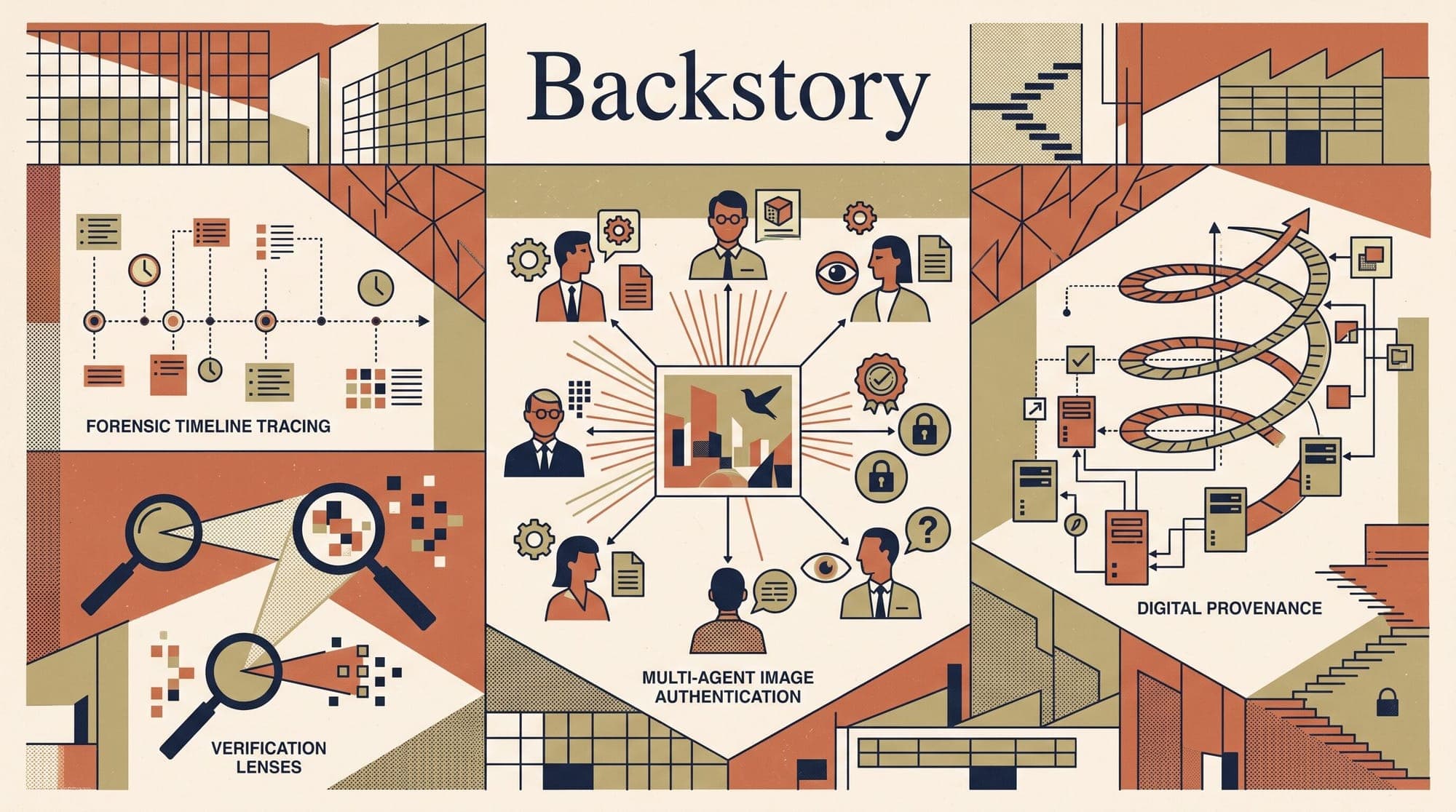
Google DeepMind has expanded live testing of Backstory, an experimental verification platform designed to investigate the origin, manipulation, and dissemination history of digital images. The system, built on the Gemini model family, is currently deployed across newsrooms, open-source intelligence (OSINT) groups, academic researchers, and fact-checking teams participating in Google's Trusted Testers program.
Beyond Binary Synthetic Detection
Traditional automated image forensic tools typically focus on detecting generative synthesis artifacts or surface a single, opaque probability score indicating the likelihood of synthetic generation. In professional fact-checking workflows, however, raw synthetic generation is only one facet of visual misinformation. Authentic photographs are frequently recirculated out of chronological or geographic context, or altered with selective cropping and basic editing techniques that standard pixel-level classifier models do not flag.

Backstory approaches visual verification through an agentic pipeline. When supplied with an image and a user query, the system orchestrates a series of specialized inspection tools rather than executing a static, fixed sequence of checks:
- Watermark Detection: Queries Google's SynthID verification infrastructure to identify imperceptible watermarks embedded in synthetic imagery generated by models like Nano Banana.
- Cryptographic Metadata Parsing: Validates provenance manifests conforming to the Coalition for Content Provenance and Authenticity (C2PA) standard, cross-referencing cryptographic assertions embedded by participating hardware and software vendors.
- Historical Indexing and Reverse Search: Automatically queries reverse image databases to map when and where an asset first surfaced publicly.
- Timeline and Context Reconstruction: Tracks changes in contextual captions and surrounding text across the image's lifecycle, flagging shifts in attribution.
The platform synthesizes these multi-source findings into a structured report that includes inline citations and an auditable execution trace detailing every forensic step taken by the agent.
Newsroom Workflows and Initial Deployment
At news organizations including India Today, whose fact-checking desk handles high volumes of viral social media claims daily, Backstory serves as an automated triage layer. Editorial teams report that the platform consolidates initial discovery steps that previously required manual cross-referencing across multiple distinct tools and separate search logins.
DeepMind product leadership notes that image provenance and informational trustworthiness are distinct technical challenges. Because a completely authentic photograph can become deceptive when presented with fabricated contextual claims, forensic tooling must inspect provenance trails and distribution context alongside algorithmic artifact detection.
Backstory remains accessible exclusively to verified participants in the Trusted Testers program as DeepMind refines tool orchestration rules and expands integration with external verification databases.



