
Google has released Gemini 4 Neon, a new Gemini 4 model. In its launch post on Nov 18, 2026, Koray Kavukcuoglu, SVP, Google DeepMind and Chief AI Architect, Google, sums it up in one line: "Bringing frontier-level intelligence with fast end-to-end task completion across complex software engineering, knowledge work, and science workflows."
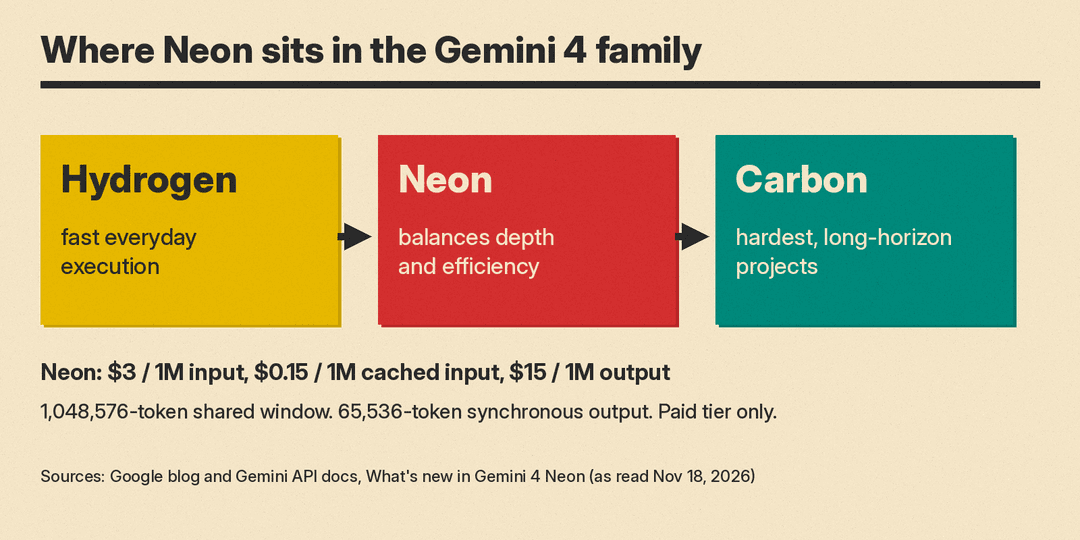
Google places Neon in the middle of the family: "While Carbon tackles your hardest, long-horizon projects and Hydrogen handles fast everyday execution, Neon balances depth and efficiency." For background on the larger model, see our post Gemini 4 Carbon Now Available: Price and Access.
Who can use Gemini 4 Neon now
Google says Neon is rolling out today in these places (as read on Nov 18, 2026):
- Developers: the Gemini API paid tier in Google AI Studio and Android Studio. All Google AI Pro and Ultra subscribers can try it in AI Studio.
- Paid Google AI Pro and Ultra subscribers: Neon in Google Antigravity.
- Pro and Ultra subscribers in the Gemini app: Neon appears in the model drop-down. Google also says Tasks in Gemini can now run on Neon.
- Businesses: Gemini for business, via the API or the model drop-down, and Google Antigravity.
- Security teams: Google says, "Gemini 4 Neon for cyber is rolling out to trusted defenders in the coming days as part of the Fairwind Program." To request access to the Fairwind Program, Google says to contact your Cloud account team. We covered the program when Carbon launched in Gemini 4 Carbon Launches First for Cyber Defenders.
The Gemini API release notes list gemini-4-neon as generally available (GA) on Nov 18, 2026.
Price and the limits builders hit first
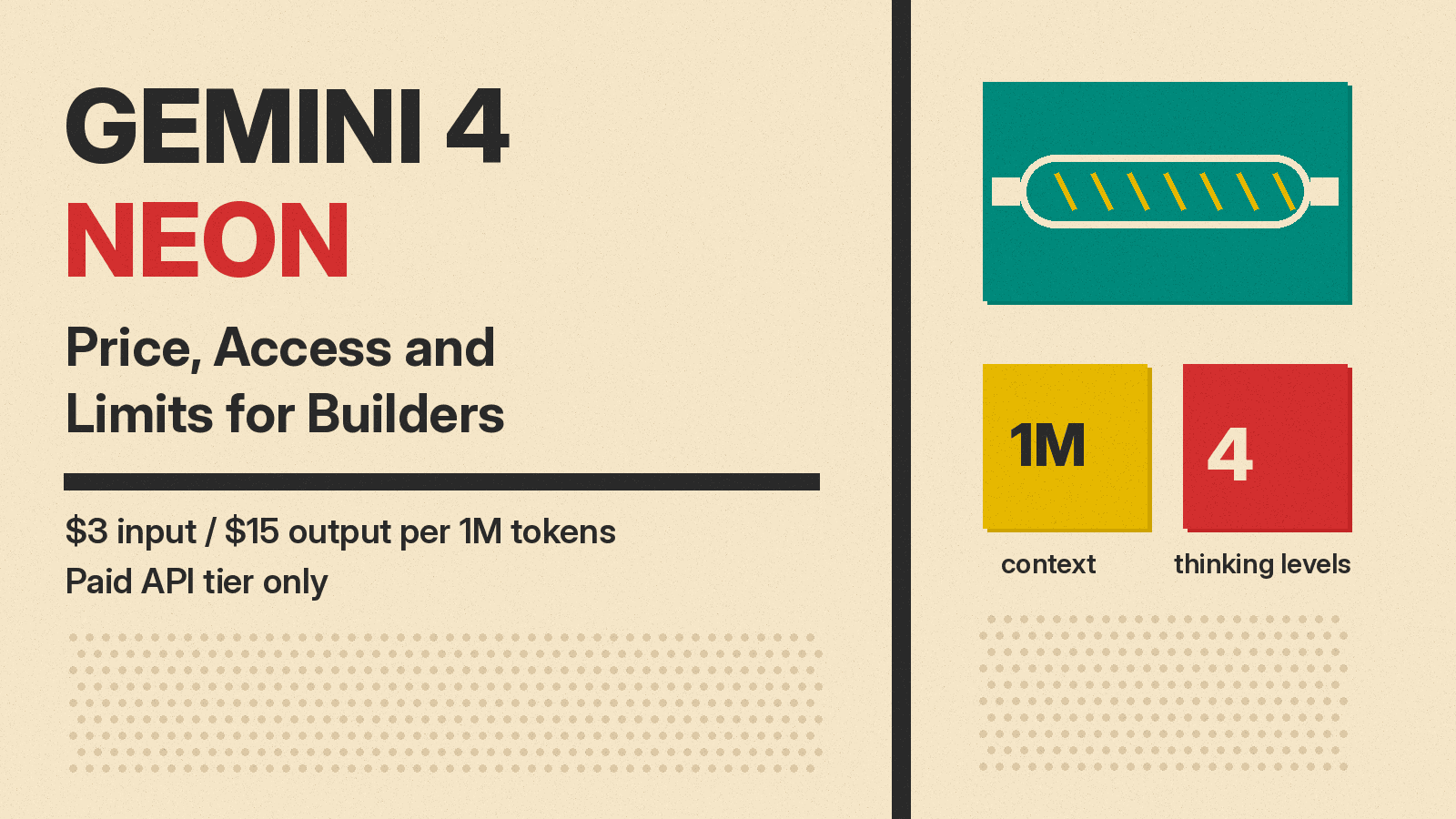
Google prices Neon at $3 per million input tokens, $0.15 per million cached input tokens (a 95% discount), and $15 per million output tokens. The API guide, What's new in Gemini 4 Neon, adds these limits (as read on Nov 18, 2026):
- Paid tier only. The guide says: "Neon is available on the paid tier only (not on the free tier)."
- One shared window. Input, thinking and output tokens share one 1,048,576-token window. A single synchronous response stops at 65,536 tokens. Longer outputs, up to 1M tokens, need background execution or client-side continuation.
- No explicit caching. Neon does not support
cachedContentsorcaches.create. Implicit caching runs by default on prompts of at least 4,096 tokens, and the 95% discount applies on cache hits. - Sampling settings no longer apply. The guide says to remove
temperature,top_pandtop_k. The server ignores in-range values if you send them, and out-of-range values return a400validation error. - Thinking levels. Neon supports
low,medium,high(the default) andxhigh. It rejectsminimal. Carbon and Argon default tomediumand cap athigh. - Slow hard prompts. The guide says: "Hard prompts can take several minutes." It suggests background execution or HTTP client timeouts of at least 15 minutes.
- Billing. Thinking tokens bill as output tokens.
The model page lists text, image, video, audio and PDF as inputs and text as the only output. Image generation, audio generation and the Live API are marked not supported.
What Google's benchmark numbers say
All numbers below are Google's reported results from the launch post.
- Artificial Analysis Intelligence Index: a score of 61 at the xhigh thinking level, which Google says ranks Neon #3 overall.
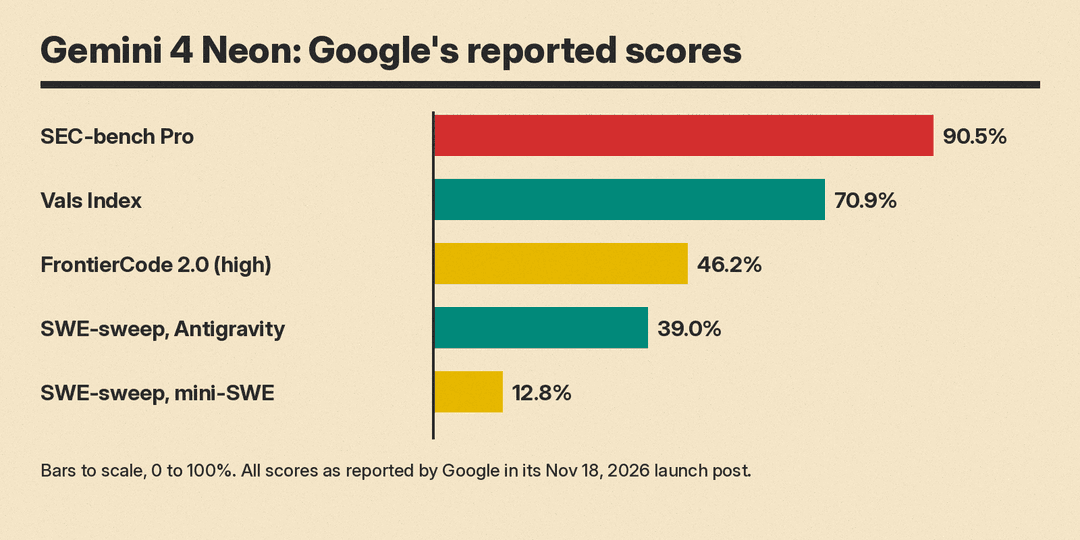
- Vals Index: 70.9%, ranked #2, per Google.
- Artificial Analysis Coding Agent Index: 58.6, ranked #1 overall, per Google.
- FrontierCode 2.0: 46.2% at the default high setting.
- SWE-sweep: 12.8% on the mini-SWE harness and 39.0% in Google Antigravity.
- Agent Arena Index from Arena: a score of 1336, ranked #2, across 4,200+ real-world agent sessions.
- SEC-bench Pro: 90.5%, listed under finding code vulnerabilities in the post's cyber section.
On cost, Google writes: "At its default high thinking level, it pairs a high Artificial Analysis Intelligence Index score with a 32% lower cost per task than Carbon."
Independent groups such as Artificial Analysis, Vals and Arena posted their own scores on X within 30 minutes of the launch. For those numbers and the developer response, see what people are saying about Gemini 4 Neon.
Safety notes
Google says Neon keeps Gemini 4 Carbon-level protections against severe misuse and prompt injection. The launch post reports that Neon refused 1.98% of tasks on Terminal-Bench 4.0 and 0% on Terminal-Bench-Science, had 0.0% cheating on Terminal-Bench 4.0, and took shortcuts on 2.45% of tasks on Google's own coding cheating evaluation, which Google says is the lowest rate of any Gemini 4 model.
The Gemini 4 Neon model card says: "Gemini 4 Neon is adapted from Gemini 4 Carbon." It also says: "The knowledge cutoff for Gemini 4 Neon is March 2026, though in some domains the model’s knowledge may be less up to date." And: "Gemini 4 Neon may exhibit some general limitations such as hallucinations." Google says Neon's capability gain over Gemini 4 Argon fell below the threshold for a full set of critical capability evaluations, so it carried forward Argon's results, including "cannot be ruled out" for the biological and cybersecurity uplift critical capability levels. The full Neon Safety and Security Report is listed as "coming soon."
Where Neon fits
Google's API guide frames the choice this way: use Neon for complex software engineering, knowledge work and science workflows, use Carbon for the hardest architecture, debugging, science and security problems, and keep Hydrogen as the default for everyday coding and agentic workflows. In Antigravity, Google says Neon can run alone or act as an orchestrator that directs parallel Hydrogen subagents.
For teams already on another Gemini 4 model, the guide says switching needs no request schema changes. Its checklist: update the model ID, check the thinking level, and use a paid tier project.
