Standard retrieval-augmented generation (RAG) pipelines follow a rigid, feed-forward paradigm: embed the query, fetch top- chunks via vector or hybrid search, inject the raw chunks into the prompt context, and sample a completion. While functional for homogeneous corpora with high semantic overlap, this naive retrieve-and-generate approach degrades rapidly in production environments. When a vector index returns irrelevant, noisy, or out-of-domain chunks, the generator inevitably suffers from hallucination propagation, factual distortion, or ungrounded extrapolation.
To eliminate the failure modes of blind retrieval, production architectures have shifted toward active, self-correcting retrieval systems. Frameworks such as Corrective Retrieval Augmented Generation (CRAG), Self-RAG, and Adaptive RAG introduce dynamic evaluation, fine-grained knowledge refinement, confidence-based triaging, and external web fallbacks. This guide analyzes the core architectural patterns, confidence scoring mechanics, and engineering trade-offs required to deploy corrective and adaptive retrieval pipelines in production.
The Tri-State Decision Engine of Corrective RAG
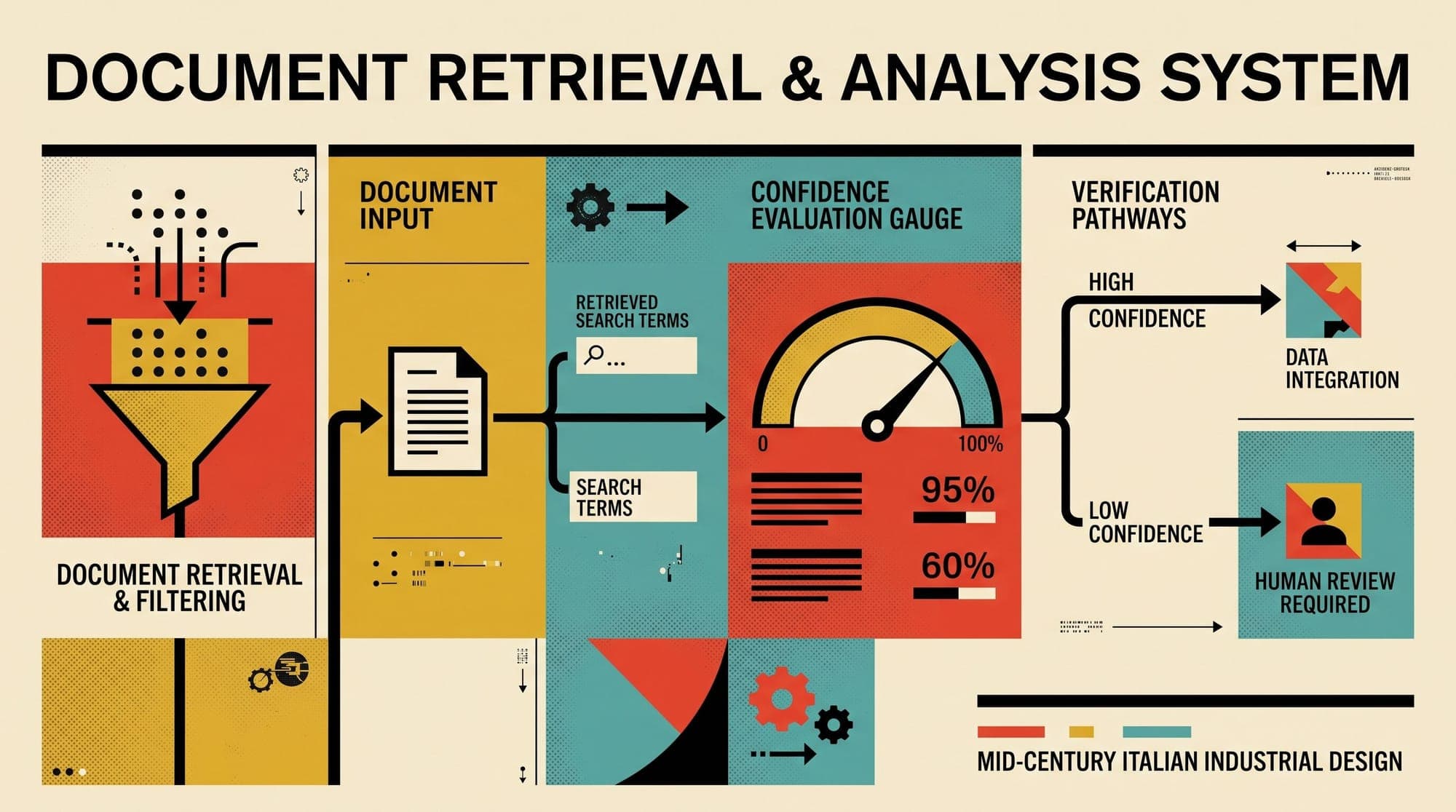
The defining innovation of Corrective RAG (CRAG) is the decoupling of retrieval from generation via an intermediate validation and refinement layer. Rather than treating retrieved passages as ground truth, CRAG passes candidate chunks through a lightweight Retrieval Evaluator that outputs a scalar confidence score reflecting factual relevance to the user prompt.

Based on calibrated upper and lower confidence thresholds ( and ), the system executes one of three deterministic branching actions:
1. Correct Action ()
When retrieval confidence meets or exceeds the upper threshold (typically ), the internal knowledge corpus is judged sufficient and accurate. However, passing entire raw chunks into the context window introduces unnecessary token overhead and distraction. CRAG executes a Decompose-then-Recompose routine:
- Decomposition: Splits retrieved chunks into fine-grained atomic knowledge strips (sentences or 50-to-100 token semantic propositions).
- Filtering: A secondary relevance classifier scores each strip, filtering out irrelevant commentary, boilerplate, and peripheral text.
- Recomposition: Concatenates the surviving high-confidence strips into a dense, noise-free context block for the generator.
2. Incorrect Action ()
When retrieval confidence falls below the lower threshold (typically ), the internal retriever has missed the target entirely, indicating a knowledge gap or out-of-domain query. Conditioning the generator on these chunks guarantees hallucination. CRAG responds by:
- Discarding Internal Chunks: Completely purging the retrieved internal documents from the generation context.
- Query Reformulation: Generating an optimized search query using an LLM or keyword extraction pipeline.
- External Web Search: Executing a web search query across public search engines (e.g., Tavily, Exa, Bing) to retrieve real-time external evidence.
- Synthesis: Cleaning and injecting the external web search snippets into the context prompt.
3. Ambiguous Action ()
When retrieval confidence lands in the intermediate zone, the internal corpus contains partial or uncertain evidence. To balance recall against hallucination risk, CRAG triggers a Hybrid Fusion strategy:
- Internal documents are refined and filtered via the decompose-then-recompose pipeline.
- Concurrently, external web search is executed to retrieve complementary public context.
- Both knowledge streams are concatenated and deduplicated, allowing the generator to reconcile internal domain data with broader web knowledge.
Self-RAG and Adaptive RAG: On-Demand Reflection and Complexity Routing
While CRAG introduces an external evaluation and fallback loop around standard retrievers, complementary paradigms embed evaluation directly into the model's generation process or route queries based on intrinsic difficulty.
Self-RAG: Reflection Tokens and Segment-Level Critique
Introduced by Asai et al. (2023), Self-RAG trains language models to emit specialized reflection tokens during decoding. Instead of retrieving once before generation starts, Self-RAG models dynamically decide when retrieval is required and critique their own outputs at the paragraph or sentence boundary:
[Retrieve] -> (Call Vector Index) -> [IsREL: Relevant] -> Generate Segment -> [IsSUP: Supported] -> [IsUSE: Score 5][Retrieve]Tokens: The model evaluates its parametric knowledge. If it encounters a factual gap, it emits[Retrieve=yes]to trigger retrieval; otherwise, it emits[Retrieve=no]to continue purely parametric generation.[IsREL]Tokens: Assesses whether retrieved passages are relevant to the preceding context.[IsSUP]Tokens: Measures whether the generated output segment is factually supported by the retrieved evidence ([Fully_Supported],[Partially_Supported], or[No_Support]).[IsUSE]Tokens: Evaluates the overall utility and coherence of the generated response.
Adaptive RAG: Query Complexity Classification
Adaptive RAG (Jeong et al., 2024) optimizes latency and token expenditure by routing user queries to different retrieval strategies based on classified task difficulty:
- Tier 1: Simple / Parametric Queries (No-RAG): General knowledge, reasoning tasks, and linguistic transformations skip the retrieval infrastructure entirely, saving 100-300ms of vector database round-trips.
- Tier 2: Direct Factual Queries (Single-Step RAG): Standard single-hop informational lookups route to standard vector/hybrid search with basic cross-encoder reranking.
- Tier 3: Multi-Hop / Complex Queries (Iterative & Corrective RAG): Ambiguous, comparative, or temporally sensitive queries activate full CRAG state machines with query decomposition, multi-step sub-queries, and fallback verification.
Production Latency Economics and Evaluator Selection
The primary operational obstacle in deploying corrective retrieval is latency. Naive implementations that call a frontier LLM (such as GPT-4o or Claude 3.5 Sonnet) to evaluate every retrieved chunk add 600 to 1,200ms of time-to-first-token (TTFT) overhead. Production architectures optimize this evaluation pipeline by substituting heavy LLM prompts with specialized classifiers.
Evaluator Architecture Comparison
- Cross-Encoder Models (e.g., BGE-Reranker-Large): Evaluates candidate pairs in 15 to 35 milliseconds per chunk on a single NVIDIA A10G/L4 GPU. Highly accurate for raw relevance scoring, though limited to scalar output without qualitative explanation.
- Quantized Small Language Models (e.g., Qwen-2.5-1.5B or Llama-3.2-1B): Completes structured JSON evaluations in 40 to 90 milliseconds on an NVIDIA L4 GPU. Delivers high accuracy for both relevance grading and atomic proposition extraction.
- Fine-Tuned Small Encoders (e.g., DeBERTa-v3-large): Completes binary or tri-state classification in 20 to 50 milliseconds on standard CPU or GPU slices with zero API token overhead.
- Frontier LLMs (via API Prompt): Incurs 500 to 1,200 milliseconds of latency and recurring API costs ($2.50 to $10.00 per 1,000 queries). Best reserved for offline golden-dataset generation rather than online user-facing serving paths.
For sub-second production service-level objectives (SLOs), running a self-hosted cross-encoder or quantized SLM on the retrieval service node evaluates top-5 chunks in parallel within 50ms, preserving the user experience while filtering out noise.
Implementation Blueprint: Corrective RAG State Graph
The following implementation blueprint demonstrates an end-to-end Corrective RAG state graph using Python, demonstrating the tri-state decision logic, knowledge strip decomposition, and web search fallback execution.
import os
import re
from typing import List, Dict, Literal, TypedDict
from dataclasses import dataclass

@dataclass
class DocumentChunk:
    chunk_id: str
    text: str
    score: float = 0.0

class CRAGState(TypedDict):
    query: str
    retrieved_chunks: List[DocumentChunk]
    retrieval_confidence: float
    decision_state: Literal["correct", "ambiguous", "incorrect"]
    refined_knowledge: List[str]
    web_search_needed: bool
    final_context: str
    generation: str

class CorrectiveRAGPipeline:
    def __init__(
        self,
        alpha_threshold: float = 0.75,
        beta_threshold: float = 0.35,
        max_knowledge_strips: int = 5
    ):
        self.alpha = alpha_threshold
        self.beta = beta_threshold
        self.max_strips = max_knowledge_strips

    def evaluate_retrieval(self, state: CRAGState) -> CRAGState:
        """
        Evaluates relevance of retrieved chunks using confidence scoring.
        In production, replace mock scoring with a fine-tuned cross-encoder or SLM.
        """
        chunks = state["retrieved_chunks"]
        if not chunks:
            state["retrieval_confidence"] = 0.0
            state["decision_state"] = "incorrect"
            state["web_search_needed"] = True
            return state

        # Compute mean confidence across top retrieved documents
        avg_score = sum(c.score for c in chunks) / len(chunks)
        state["retrieval_confidence"] = avg_score

        if avg_score >= self.alpha:
            state["decision_state"] = "correct"
            state["web_search_needed"] = False
        elif avg_score < self.beta:
            state["decision_state"] = "incorrect"
            state["web_search_needed"] = True
        else:
            state["decision_state"] = "ambiguous"
            state["web_search_needed"] = True

        return state

    def decompose_and_refine(self, text: str) -> List[str]:
        """
        Decomposes document text into atomic sentence propositions and filters noise.
        """
        # Split text into sentence strips
        raw_sentences = re.split(r'(?<=[.!?])\s+', text.strip())
        valid_strips = [
            s.strip() for s in raw_sentences
            if len(s.split()) >= 6 and not s.startswith(("Copyright", "Table of", "Page"))
        ]
        return valid_strips[:self.max_strips]

    def process_internal_knowledge(self, state: CRAGState) -> CRAGState:
        """
        Refines internal documents if state is correct or ambiguous.
        """
        if state["decision_state"] == "incorrect":
            state["refined_knowledge"] = []
            return state

        refined = []
        for chunk in state["retrieved_chunks"]:
            strips = self.decompose_and_refine(chunk.text)
            refined.extend(strips)

        state["refined_knowledge"] = refined[:self.max_strips]
        return state

    def execute_web_fallback(self, state: CRAGState) -> CRAGState:
        """
        Executes web search when internal retrieval is incorrect or ambiguous.
        """
        if not state["web_search_needed"]:
            return state

        query = state["query"]
        # In production: call Tavily, Exa, or Bing API
        # Mock external search result payload
        web_snippets = [
            f"[Web Source] Verified external factual context answering: {query}"
        ]

        if state["decision_state"] == "incorrect":
            # Completely replace internal documents with external web snippets
            state["refined_knowledge"] = web_snippets
        elif state["decision_state"] == "ambiguous":
            # Append external web snippets to existing refined internal knowledge
            state["refined_knowledge"].extend(web_snippets)

        return state

    def compile_context_and_generate(self, state: CRAGState) -> CRAGState:
        """
        Assembles final verified context block for synthesis.
        """
        context_blocks = "\n".join(f"- {item}" for item in state["refined_knowledge"])
        state["final_context"] = context_blocks

        # Generation prompt construction
        state["generation"] = (
            f"Synthesizing response for '{state['query']}' using verified context:\n"
            f"{context_blocks}"
        )
        return state

    def run(self, query: str, chunks: List[DocumentChunk]) -> CRAGState:
        """
        Executes full state machine pipeline.
        """
        initial_state: CRAGState = {
            "query": query,
            "retrieved_chunks": chunks,
            "retrieval_confidence": 0.0,
            "decision_state": "incorrect",
            "refined_knowledge": [],
            "web_search_needed": False,
            "final_context": "",
            "generation": ""
        }

        s1 = self.evaluate_retrieval(initial_state)
        s2 = self.process_internal_knowledge(s1)
        s3 = self.execute_web_fallback(s2)
        s4 = self.compile_context_and_generate(s3)
        return s4

# Example execution
if __name__ == "__main__":
    pipeline = CorrectiveRAGPipeline(alpha_threshold=0.75, beta_threshold=0.35)

    # Scenario 1: High confidence match (Correct)
    docs_correct = [DocumentChunk("doc_1", "Our enterprise API enforces rate limits of 10,000 requests per minute.", score=0.88)]
    result_correct = pipeline.run("What is the API rate limit?", docs_correct)
    print(f"State: {result_correct['decision_state']} | Context: {result_correct['final_context']}")

    # Scenario 2: Unrelated document match (Incorrect -> Web Fallback)
    docs_incorrect = [DocumentChunk("doc_2", "Our annual holiday party will be hosted in Chicago this December.", score=0.18)]
    result_incorrect = pipeline.run("What are the quarterly compliance filing deadlines?", docs_incorrect)
    print(f"State: {result_incorrect['decision_state']} | Context: {result_incorrect['final_context']}")
Production Guardrails and Failure Modes
Operating corrective retrieval systems in mission-critical environments introduces specific failure modes that require defensive engineering:
- Threshold Brittleness and Calibration Drift: Fixed thresholds () derived on one domain frequently misclassify documents when user distribution shifts. Teams should regularly calibrate scoring cutoffs against labeled domain evaluation sets using receiver operating characteristic (ROC) curves.
- Web Fallback Poisoning and Prompt Injection: External search results frequently contain untrusted user-generated content, SEO spam, or prompt injection payloads. Search results must pass through content sanitation layers, domain allowlists, and HTML stripped extractors before injection.
- Cascading Web Latency: Public search APIs introduce network variability (300 to 1,500ms). Web fallback calls must be wrapped in strict timeout budgets (e.g., 800ms cap); if the search timeout expires, the system must fall back to graceful uncertainty disclosures rather than hanging the client session.
- Knowledge Strip Over-Pruning: Aggressive sentence-level filtering can remove necessary coreferences or background qualifiers, leading to truncated context. Using semantic proposition extraction models (such as Dense X Retrieval) preserves standalone contextual integrity across decomposed strips.
Sources
- Yan, S.-Q., Gu, J.-C., Zhu, Y., & Ling, Z.-H. (2024). Corrective Retrieval Augmented Generation. arXiv:2401.15884
- Asai, A., Wu, Z., Wang, Y., Sil, A., & Hajishirzi, H. (2023). Self-RAG: Learning to Retrieve, Generate, and Critique through Self-Reflection. arXiv:2310.11511
- Jeong, S., Baek, J., Cho, S., Hwang, S. J., & Park, J. C. (2024). Adaptive-RAG: Determining When and How to Retrieve for Large Language Models. arXiv:2403.14403
- Chen, S., et al. (2023). Dense X Retrieval: What Retrieval Granularity Should We Use? arXiv:2312.06648
- LangGraph Corrective RAG Workflow Documentation