
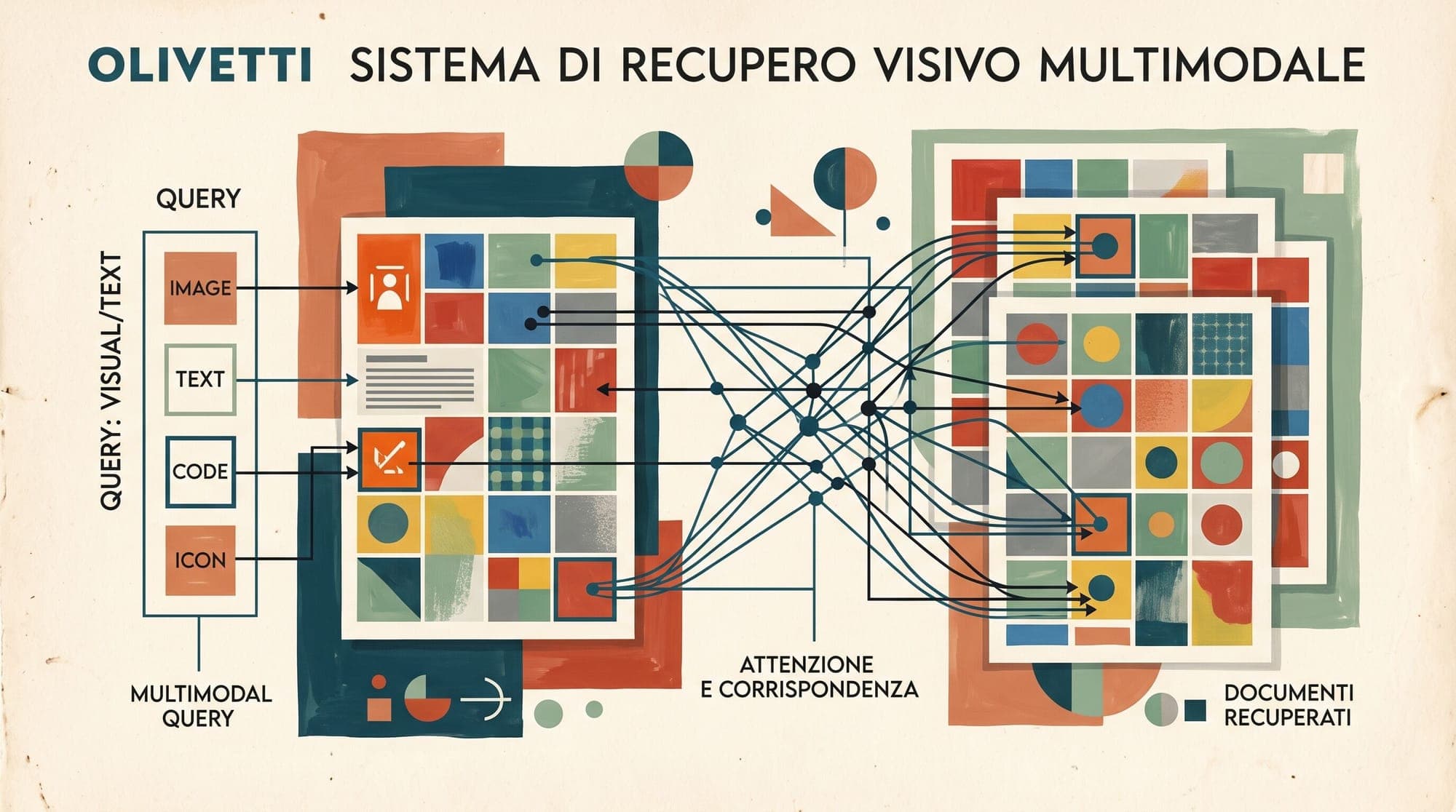
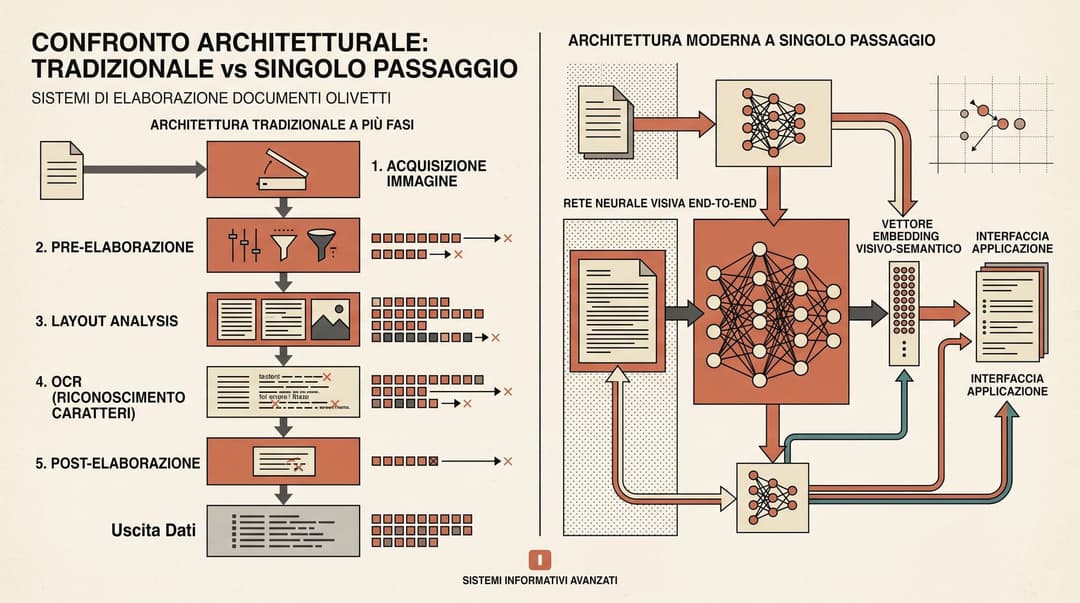
Enterprise Retrieval-Augmented Generation (RAG) systems frequently fail when deployed against real-world document corpora such as financial statements, technical datasheets, medical records, and slide decks. The primary failure mode stems from the ingestion pipeline: traditional architectures rely on multi-stage optical character recognition (OCR) and layout parsing to convert 2D visual layouts into 1D text streams before chunking and embedding.
This linearization process irreversibly discards spatial relationships, reading orders across multi-column formats, table cell alignments, and visual elements such as charts, diagrams, and corporate headers. Recent architectural advancements, led by visual late-interaction models such as ColPali and ColQwen2 evaluated on the Visual Document Retrieval (ViDoRe) benchmark, replace multi-step parsing pipelines with direct vision-language page embeddings.
Architectural Taxonomies for Document Retrieval
Production document search systems broadly fall into four architectural paradigms, each presenting distinct trade-offs across extraction fidelity, indexing overhead, and storage footprint:
- Pipeline 1: Multi-Stage OCR, Layout Parsing, and Text Embeddings. The document is processed by layout detectors and OCR engines (such as Tesseract, Surya, or Docling). Text chunks are serialized into markdown and indexed using sparse engines (BM25, SPLADE) or dense bi-encoders (such as BGE-M3). While storage-efficient (1 to 2 KB per chunk), this approach exhibits catastrophic information loss on dense tables, infographics, and scanned pages with artifacts.
- Pipeline 2: Single-Vector Multimodal Bi-Encoders. Vision-language contrastive models (such as CLIP, SigLIP, or Cohere Multimodal Embed) encode an entire rendered document image into a single dense vector (typically 512 to 1024 dimensions). While fast at search time, compressing an entire information-dense document page into a single vector creates a severe information bottleneck, struggling to capture granular facts, localized numbers, or specific table cells.
- Pipeline 3: Multi-Vector Visual Late Interaction (ColPali, ColQwen2). Rendered document images are passed directly through a Vision-Language Model (VLM) vision encoder and projector. Rather than outputting a single vector, the model outputs a contextualized multi-vector representation (one vector per visual patch token, typically 128 dimensions). Query text tokens are embedded into the same 128-dimensional space, and similarity is computed using the late-interaction MaxSim operator.
- Pipeline 4: Direct VLM Captioning and Synthetic Metadata Indexing. Frontier VLMs inspect pages during ingestion to generate exhaustive textual descriptions, summaries, and structured JSON representations. While highly accurate, this pipeline introduces prohibitive ingestion costs ($0.01 to $0.05 per page) and high processing latency at enterprise scale.
Inside Visual Late Interaction: PaliGemma, Qwen2-VL, and the MaxSim Operator
The visual late-interaction paradigm adapts the ColBERT scoring mechanism to vision-language foundation models. In ColPali, the base model is Google's PaliGemma-3B (combining a SigLIP-So400m/14 vision transformer with a Gemma-2B autoregressive language model). In ColQwen2, the base model is Qwen2-VL or Qwen2.5-VL.
During offline indexing, document pages are rendered as images at fixed (e.g., 448x448 pixels) or dynamic resolutions. The vision transformer segments the page into patches (for example, 1,024 to 1,030 patches per page). A linear projection layer maps each patch representation from the language model hidden dimension to a compact 128-dimensional embedding space:
E_d in R^(N_d x 128), where N_d is the number of document patch tokens (~1030)At query time, the user's text query is tokenized and passed through the language model component to generate query token embeddings:
E_q in R^(N_q x 128), where N_q is the number of query tokens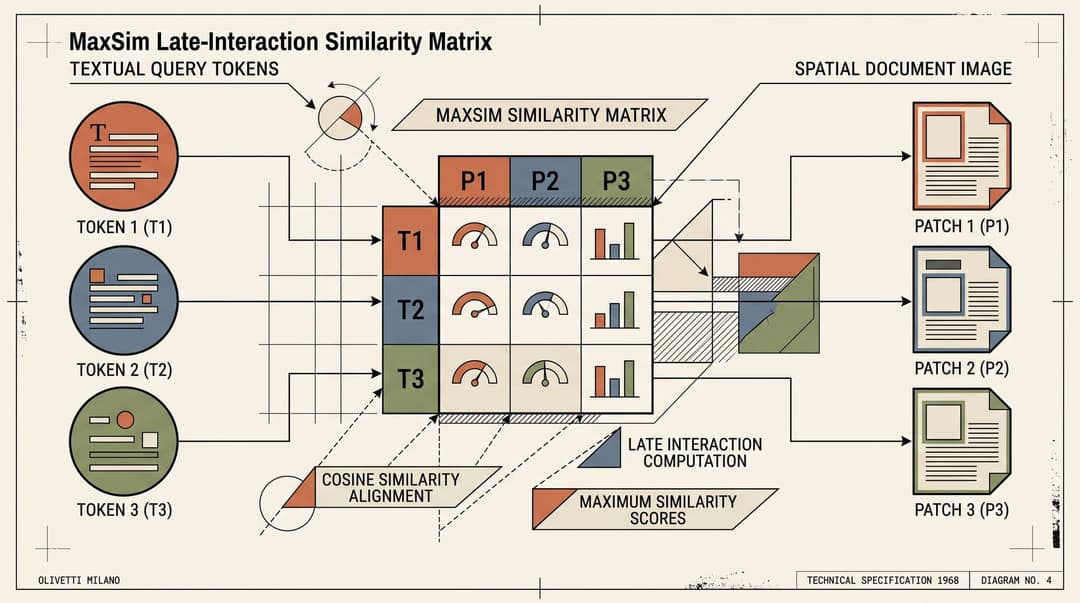
The matching score between query q and document page d is evaluated using the late-interaction MaxSim operator:
Score(q, d) = sum_{j=1}^{N_q} max_{i=1}^{N_d} (E_q^(j) . E_d^(i))For every query token vector, the scoring function finds the maximum inner product across all visual patch vectors on the document page, then sums these maximum scores across all query tokens. This enables query terms (such as specific row names or metric labels) to align directly with the exact spatial image patches containing those values, even when surrounded by complex borders, colored backgrounds, or non-standard typography.
Empirical Performance on the ViDoRe Benchmark
To systematically evaluate retrieval performance across visually complex documents, the Visual Document Retrieval (ViDoRe) benchmark evaluates models across diverse tasks spanning infographics, multi-column research papers, corporate annual reports, financial tables, and scanned administrative forms (including DocVQA, InfoVQA, and TabFQuAD).
Benchmark evaluations demonstrate a substantial performance gap between text-only OCR pipelines and visual late interaction:
- BM25 + OCR: Achieves ~35.8% overall nDCG@5 on ViDoRe (scoring 22.4% on infographics and 38.1% on complex tables).
- BGE-M3 Dense Embedding + OCR: Achieves ~56.4% overall nDCG@5 (scoring 42.1% on infographics and 51.7% on complex tables).
- Cohere Multimodal Embed v3 (Single Vector): Achieves ~64.7% overall nDCG@5 (scoring 58.2% on infographics and 61.3% on complex tables).
- ColPali (v1.2, PaliGemma-3B): Achieves ~81.3% overall nDCG@5 (scoring 78.4% on infographics and 84.2% on complex tables).
- ColQwen2 / ColQwen2.5-7B: Achieves ~83.5% to 84.2% overall nDCG@5, offering superior multilingual understanding and handling mixed-language corpora.
On tabular data and visual infographics, visual late-interaction models outperform OCR-based dense retrieval by over 25 to 30 nDCG points, confirming that optical parsing errors represent the dominant source of retrieval degradation in document RAG.
Storage Economics, Memory Bandwidth, and Quantization
While visual late interaction delivers state-of-the-art recall, storing over 1,000 vectors per document page introduces significant memory and storage challenges compared to standard dense retrieval.
Storage Arithmetic
- Standard Dense Vector (e.g., text-embedding-3-large): 1 vector per chunk x 1536 dimensions x 2 bytes (FP16) = ~3 KB per chunk.
- ColPali Multi-Vector Index: 1,030 vectors per page x 128 dimensions x 2 bytes (FP16) = ~263.7 KB per page.
Indexing a corpus of 1,000,000 document pages in uncompressed FP16 format requires approximately 264 GB of raw vector storage, excluding index graph structures and metadata.
Index Compression and Optimization Techniques
To make visual late interaction viable in production, engineering teams employ three primary optimization strategies:
- Binary Quantization (BQ): Compressing 128-dimensional FP16 vectors into 128-bit (16 bytes) binary representations using sign thresholding. Binary quantization reduces the per-page vector footprint from ~264 KB down to ~16.5 KB (a 16x reduction) and accelerates similarity scoring using hardware-accelerated Hamming distance / XOR popcount instructions, preserving over 95% of retrieval recall.
- Scalar Quantization (SQ8): Quantizing floating-point values into 8-bit integers, reducing memory footprint by 50% (~132 KB per page) while retaining over 99% of original nDCG@5 scores.
- Patch Pruning and Token Merging (Light-ColPali / Light-ColQwen2): Empirical studies published at ACL demonstrated that up to 75% of visual background patches contain negligible discriminative signal. Merging or pruning redundant image patch embeddings by a factor of 4 reduces the stored vector count to ~256 vectors per page, cutting storage and search latency by 75% while maintaining 98% to 99% of retrieval accuracy.
Vector Database Support
Modern vector databases provide native indexing primitives for visual late interaction:
- Qdrant: Supports native multi-vector collections and MaxSim comparator functions with integrated Binary Quantization and oversampling rescore pipelines.
- Vespa: Provides native multi-vector tensor matching operators (
tensor<float>(patch{}, dim{})) with parallel execution. - LanceDB / Milvus: Support multi-vector index partitions and ColBERT-style PLAID index representations.
Serving Pipeline Architecture and Hardware Economics
In a production visual RAG architecture, retrieval and generation operate as a coordinated pipeline:
[Inbound Query]
       |
       v
[ColPali / ColQwen2 Query Encoder] (128-dim vectors)
       |
       v
[Multi-Vector Index (Qdrant / Vespa / LanceDB)]
  - Stage 1: Binary Quantized MaxSim Filter (Top-100 candidates)
  - Stage 2: Scalar / FP16 MaxSim Exact Rescore (Top-5 pages)
       |
       v
[Rendered High-Res Page Images (Top-k)]
       |
       v
[Multimodal LLM Reader (GPT-4o / Claude 3.5 Sonnet / Gemini Pro)]
       |
       v
[Grounded Answer with Bounding Box Citations]
Ingestion Throughput Profiles
Offline page encoding throughput scales with GPU memory bandwidth and compute:
- NVIDIA A100 (80GB SXM4, 2.0 TB/s bandwidth): Processes ~18 pages/second with ColPali-3B and ~12 pages/second with ColQwen2.5-7B.
- NVIDIA H100 (80GB SXM5, 3.35 TB/s bandwidth): Processes ~30 pages/second with ColPali-3B and ~20 pages/second with ColQwen2.5-7B.
- NVIDIA H200 (141GB SXM5, 4.8 TB/s bandwidth): Processes ~42 pages/second with ColPali-3B and ~28 pages/second with ColQwen2.5-7B.
Architecture Decision Matrix
Selecting the appropriate retrieval architecture depends on corpus complexity, query latency targets, and infrastructure budget:
- Standard Dense Text RAG (BGE-M3 / OpenAI text-embedding-3 + Docling): Best suited for clean, narrative, single-column prose corpora (such as articles, blog posts, and legal contracts without complex tables). Lowest storage cost and operational overhead.
- Visual Late Interaction (ColPali / ColQwen2 + Qdrant / Vespa): Best suited for visually rich enterprise collections (such as financial reports, technical manuals, datasheets, slide presentations, and scanned forms) where OCR parsing introduces severe information loss.
- Hybrid Visual-Text Search (Dense Text + Sparse BM25 + ColPali Late Interaction): Best suited for mission-critical enterprise discovery where exact keyword matching (part numbers, entity IDs) must be combined with deep visual layout understanding.
Sources
- ColPali: Efficient Document Retrieval with Vision Language Models (arXiv:2407.01449)
- ViDoRe Benchmark: Visual Document Retrieval Benchmark Leaderboard
- Qdrant: Advanced Retrieval with ColPali and Multi-Vector Search
- LanceDB: Late Interaction and Efficient Multi-Modal Retrievers
- ACL Anthology: An Empirical Study on Reducing Patch-Level Embeddings in Visual Document Retrieval
