
Contextual Retrieval in Production RAG: Architecture, Prompt Caching Economics, Hybrid Fusion, and Reranking Pipelines
Standard Retrieval-Augmented Generation (RAG) architectures suffer from an inherent design flaw at the preprocessing stage: chunking destroys document hierarchy. When a system divides a large document corpus into fixed-size passages (such as 300 to 800 tokens) or applies semantic boundaries, the resulting chunks lose their surrounding narrative, parent headings, entity definitions, and temporal references.
In production environments, this context fragmentation leads to catastrophic retrieval failures. A financial filing chunk stating that "revenue grew by 3% over the prior quarter" contains no mention of the corporate entity, the fiscal year, or the baseline figures. A legal clause stating "the licensee shall indemnify the licensor" fails to resolve which contracting parties hold those roles without the preamble definitions. Bi-encoder embedding models and sparse lexical indexes cannot match user queries against chunks whose critical identifying metadata was amputated during ingestion.
To resolve this limitation, Anthropic introduced Contextual Retrieval, an ingestion-time architectural pattern that leverages small language models and prompt caching to prepend situated document-level context to every individual chunk. When coupled with hybrid search (dense vectors plus BM25) and second-stage cross-encoder reranking, the approach reduces retrieval failure rates by up to 67%.

The Context Fragmentation Failure Mode
In standard dense retrieval systems, a document collection is partitioned into discrete chunks . An embedding model encodes each chunk into a low-dimensional vector space:
At query time, the system encodes the incoming query and computes cosine similarity against stored vectors:
The fundamental flaw in this formula is that represents only the localized token distribution inside . If relies on implicit antecedents established 2,000 tokens earlier, its vector representation drifts far away from queries searching for those antecedents.
Common manifestations of context fragmentation include:
- Entity Ellipsis: Corporate filings, medical histories, and software specifications frequently omit the primary subject name across body paragraphs after establishing it in the header.
- Relative Metrics and Comparative Statements: Statements such as "operating margin declined by 140 basis points" or "latency dropped to 12ms" become ungrounded noise when isolated from the underlying benchmark or system name.
- Domain-Specific Acronyms: Technical documentation defining an acronym in chapter 1 leaves downstream sub-sections unrecognizable to lexical matching algorithms when queries use the fully expanded terminology.
Contextual Retrieval Architecture
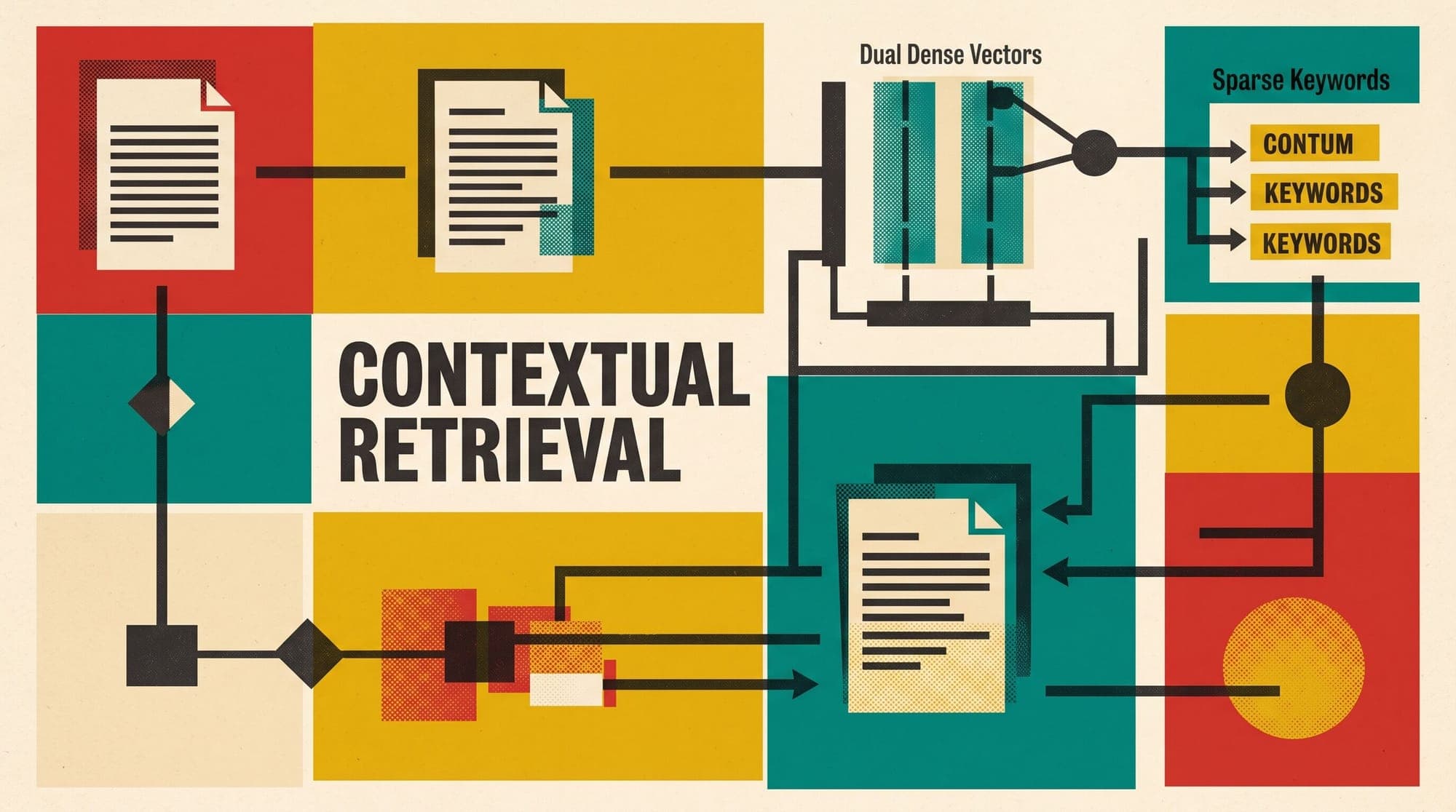
Contextual Retrieval alters the preprocessing lifecycle by inserting an LLM-driven contextualization stage prior to embedding generation and inverted index construction.
Rather than indexing raw chunk , the system constructs a contextualized chunk :
where is a concise, 50-to-100 token explanatory header generated by an LLM that reads the full parent document alongside target chunk .
Prompt Design and Context Contract
According to Anthropic's Contextual Retrieval technical guide, the contextualizer is prompted with the entire parent document in system/cached memory and instructed to generate strictly factual, situating context:
<document>
{{WHOLE_DOCUMENT}}
</document>
Here is the chunk we want to situate within the whole document:
<chunk>
{{CHUNK_CONTENT}}
</chunk>
Please give a short succinct context to situate this chunk within the overall document
for the purposes of improving search retrieval of the chunk. Answer only with the
succinct context and nothing else.
For a raw financial filing chunk reading "Operating income was $42.1 million compared to $38.5 million in the prior year period", the generated context prefix transforms the text into:
"This chunk is from ACME Corp's Q3 2025 Form 10-Q filing regarding North American Enterprise SaaS operations. Operating income was $42.1 million compared to $38.5 million in the prior year period."
Dual Indexing: Contextual Embeddings and Contextual BM25
Once is generated, it is passed in parallel to two distinct indexing backends:
- Contextual Embeddings (Dense Representation): The full string is passed to dense vector embedding models such as Voyage AI embeddings or OpenAI
text-embedding-3-large. The resulting dense vector now encodes both the high-level document semantics and the granular chunk details. - Contextual BM25 (Sparse Lexical Index): The full string is tokenized into an inverted index using the BM25 ranking algorithm. Because the contextual prefix introduces formal entity names, dates, product identifiers, and topic labels, BM25 can match exact lexical tokens that never appeared in the original raw passage.
Hybrid Search and Reciprocal Rank Fusion
At query time, the system executes parallel retrievals across the dense vector collection and the sparse BM25 inverted index. Because raw cosine similarity scores (bounded between or ) and BM25 scores (unbounded positive floats dependent on term frequencies) inhabit non-comparable distributions, direct linear summation leads to severe score distortion.
Production pipelines resolve this through Reciprocal Rank Fusion (RRF). RRF ranks candidates across both lists independently, assigning a unified score based solely on ordinal rank positions:
Where:
- is the set of retrieval systems (dense vector search and BM25).
- is the 1-based rank of document within retriever .
- is a smoothing constant, typically calibrated to to prevent high-ranking items in one list from entirely overwhelming balanced rankings across both lists.
Alternatively, teams deploying vector engines with native hybrid support (such as Qdrant or Pinecone) can apply min-max score normalization:
where balances semantic recall against keyword precision.
Two-Stage Pipelines and Cross-Encoder Reranking
While hybrid retrieval over contextualized chunks recovers top-tier recall, bi-encoder architectures remain constrained by vector dot-product approximations. Bi-encoders process the query and document candidates independently without cross-attention.
To achieve maximum precision, production architectures insert a second-stage cross-encoder reranker, such as Cohere Rerank 3.5 or BGE-Reranker-v2.
[Incoming User Query]
         │
         ├──► [Contextual Dense Search (Top-50)] ──┐
         │                                         ▼
         └──► [Contextual BM25 Search (Top-50)] ──► [Reciprocal Rank Fusion]
                                                           │
                                                           ▼
                                               [Top-50 Merged Candidates]
                                                           │
                                                           ▼
                                               [Cross-Encoder Reranker]
                                                           │
                                                           ▼
                                                [Top-5 Final Chunks]
                                                           │
                                                           ▼
                                               [LLM Generation Context]
Cross-Encoder Attention Mechanics
A cross-encoder concatenates the user query and candidate chunk into a single sequence:
All token positions attend directly to all query tokens across all transformer layers. The model outputs a single scalar relevance logit .
Because full cross-attention is computationally expensive ( in sequence length), it is restricted to the top candidates returned by the hybrid first stage, scoring them in parallel batches down to the final passages delivered to the generator prompt.
Quantitative Benchmark Gains
In Anthropic's evaluation across diverse corpora (spanning codebases, literary fiction, ArXiv scientific papers, and enterprise documents), the combination of Contextual Embeddings, Contextual BM25, and Reranking produced substantial accuracy gains across all metrics.
The evaluation measured retrieval failure rate, defined as (the proportion of test queries where the gold reference passage failed to appear in the top 20 retrieved chunks):
| Retrieval Pipeline Configuration | Failure Rate () | Failure Reduction vs. Baseline | Pass@20 Accuracy | | :--- | :--- | :--- | :--- | | Standard Baseline RAG (Dense Only) | 9.94% | Baseline | 90.06% | | Standard Hybrid RAG (Dense + BM25) | 5.01% | 49.6% reduction | 94.99% | | Contextual Embeddings (Dense Only) | 5.71% | 42.6% reduction | 94.29% | | Contextual Embeddings + Contextual BM25 | 3.57% | 64.1% reduction | 96.43% | | Contextual Hybrid + Cross-Encoder Rerank | 1.94% | 67.0% reduction | 97.45% |
The data confirms two critical architectural insights:
- Contextualizing BM25 yields greater relative gains than contextualizing embeddings alone: Adding situated entity names and domain keywords to sparse indexes unlocks exact-match retrieval paths that previously returned zero hits.
- Rerankers compound first-stage recall: Even the best cross-encoder cannot score a chunk that never made it into the initial candidate pool. Contextual hybrid retrieval elevates recall ceilings, allowing rerankers to operate on high-quality candidate sets.
Production Economics and Prompt Caching Leverage
Historically, running an LLM across every individual chunk in an enterprise corpus of hundreds of thousands of documents was cost-prohibitive. For an 8,000-token document split into ten 800-token chunks, naive processing requires sending the 8,000-token document 10 times (80,000 input tokens per document).
Contextual Retrieval becomes economically viable through LLM prompt caching. By placing the parent document inside the prompt cache prefix, the initial chunk pays the cache write rate, while all subsequent chunks from that document execute against the cache read rate at an 80% to 90% cost reduction.
Ingestion Cost Breakdown
Assuming an average document size of 8,000 tokens, 800-token chunk sizes, 50-token instructions, and 100-token generated context prefixes using Claude 3 Haiku:
- Cache Write (Document 1st chunk): $8,000 \text{ tokens} \times \$0.30/\text{MTok} = \
- Cache Read (Chunks 2 through 10): $9 \times 8,000 \text{ tokens} \times \$0.03/\text{MTok} = \
- Generation Output: $10 \times 100 \text{ tokens} \times \$1.25/\text{MTok} = \
- Total Ingestion Cost per Document: ~$0.0058
- Effective Ingestion Cost: ~$0.72 to $1.02 per million document tokens.
For an enterprise corpus containing 10 million words (roughly 13.3 million tokens across 1,600 documents), the complete contextualization pass costs under $15.
Engineering Implementation and Failure Modes
Deploying Contextual Retrieval in production requires addressing several infrastructure constraints:
1. Document Mutation and Cache Invalidation
When a source document is edited, all child chunks and their contextual headers must be regenerated. Implementing content hashing (SHA-256) at the document and chunk levels prevents unnecessary reprocessing of static documents during scheduled ingestion runs.
2. Context Hallucination and Extraction Drift
Small language models can occasionally invent facts when summarizing ambiguous documents. Guardrail pipelines should verify that generated prefixes do not introduce named entities absent from the parent text. Restricting the contextualizer prompt with strict constraints ("Use only explicit information from the parent document") minimizes divergence.
3. Contextual Prefix Separation at Generation Time
While prepending context to chunks improves search and reranking, passing the concatenated header directly to the downstream generation model can introduce redundancy. Production frameworks separate the storage schema into three fields:
{
  "chunk_id": "doc_4812_chunk_07",
  "document_id": "doc_4812",
  "context_header": "This chunk is from ACME Corp's Q3 2025 Form 10-Q...",
  "raw_chunk_text": "Operating income was $42.1 million...",
  "search_payload": "This chunk is from ACME Corp's Q3 2025 Form 10-Q... Operating income was $42.1 million..."
}
The search_payload is indexed for dense and sparse search, but the synthesis prompt can optionally feed only raw_chunk_text alongside document metadata, saving generator context budget.
Architectural Summary
Contextual Retrieval resolves the fundamental tradeoff between chunk granularity and document-level coherence. By transforming retrieval from an isolated passage search into a situated semantic lookup, engineering teams eliminate the largest source of RAG failure without requiring complex knowledge graph infrastructure or exorbitant runtime compute overhead.
Sources
- Anthropic: Introducing Contextual Retrieval
- Anthropic Claude Cookbook: Contextual Embeddings Guide
- Anthropic Documentation: Prompt Caching
- Cohere: Rerank API Overview and Architecture
- Voyage AI: Embeddings and Reranker Models
- Cormack, Clarke, and Buettcher (2009): Reciprocal Rank Fusion
- Elastic: Practical BM25 Part 2



