
Cohere released Parse on August 27, 2026: a vision language model that turns enterprise documents into structured Markdown for search, retrieval-augmented generation (RAG) and AI agents. The current model ID is parse-v5.0. Cohere's pitch is cost, not a top benchmark score. The API price is $1.50 per 1,000 pages, and in Cohere's own comparison three general-purpose frontier models score higher.
This post covers what the model is, what it returns, how it scored, what it costs, and the limits Cohere lists in its documentation, as of October 27, 2026 (Pacific Time).
What Parse is
Cohere's Parse documentation lists these specs:
- Latest model:
parse-v5.0 - Number of parameters: 2.3B
- Model size: about 4.6GB
- Context length: 8192
- Model architecture: proprietary north-micro-vision-instruct
- File types supported: PDF, PPT, JPEG (Base64 encoded)
- Output format: Markdown
The docs say Parse is "stable for nine input languages": Arabic, English, French, German, Japanese, Korean, Italian, Portuguese and Spanish. It "supports zero-shot parsing of additional languages, though accuracy may be lower than for the recommended languages."
According to the same page, Parse extracts text and reading order, tables, lists, forms and key-value pairs, images and captions, and the locations of page boundaries and visual elements. The Markdown it returns holds tables represented as HTML, bounding box coordinates and image descriptions. If you are new to the idea of feeding documents to a model, our explainer on what RAG is covers why parsing quality matters for retrieval.
How a Parse request works
The Parse API reference describes a single endpoint, POST /v2/parse. A request follows four steps:
- Encode a page image. Pass a base64 data URI or an image URL.
- Send it to the Parse endpoint with the model name
parse-v5.0. - Pick an output format:
markdown(the default) orblocks. - Read the pages array. In Markdown mode each page holds Markdown with tables inlined as HTML and images referenced by ID. In blocks mode each page holds an ordered list of text, image and table regions, "including bounding boxes where available."
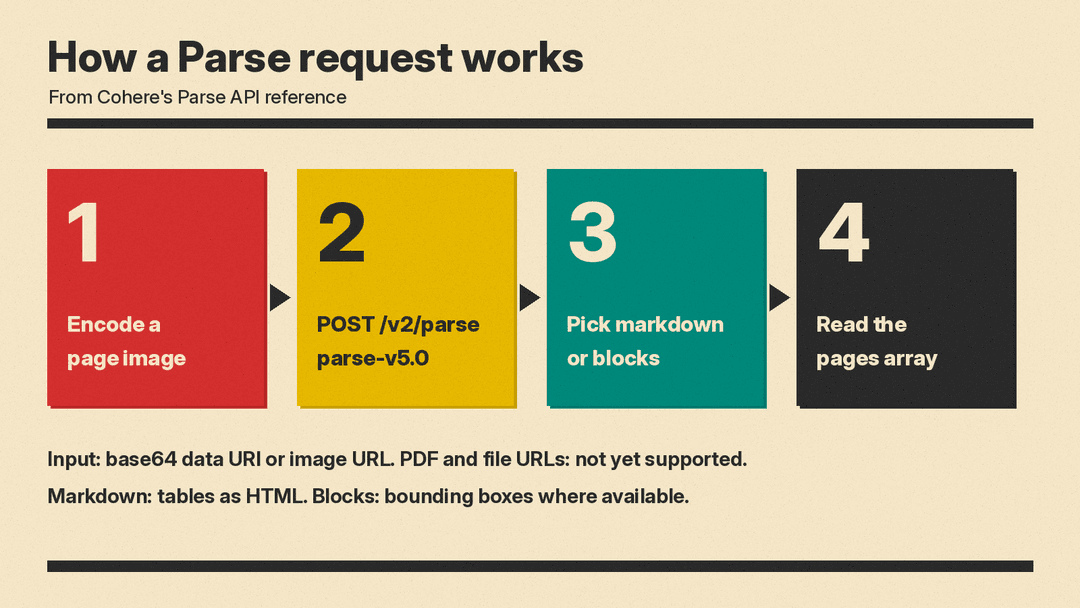
Two details in the reference matter for planning. First, the endpoint "currently supports document.type = image_url only," and "PDF / file URL inputs are not yet supported," even though the overview page lists PDF and PPT among supported file types. Second, each image is limited to 20 MB, and to 50 megapixels or 200 MB decoded, whichever is exceeded first. The response also reports a finish_reason; MAX_TOKENS means the output was cut off at the maximum output token limit.
ParseBench results (launch post, August 27, 2026)
Cohere's launch post reports average scores on ParseBench across three dimensions: Tables, Content Faithfulness and Semantic Formatting. Cohere's figures:
- GPT-5.5: 84.4
- Opus 4.8: 84.3
- Gemini 3.5 Flash: 81.8
- Cohere Parse: 79.2
- LlamaParse (Cost Effective): 78.3
- Chandra OCR 2 (open): 77.7
- Mistral OCR 4: 74.5
- Databricks AI Parse: 72.4
- Azure Document Intelligence: 69.3
- Deepseek-OCR 2 (open): 65.9
- dots.mocr (open): 63.2
- Google Document AI: 57.3
- AWS Textract: 53.3
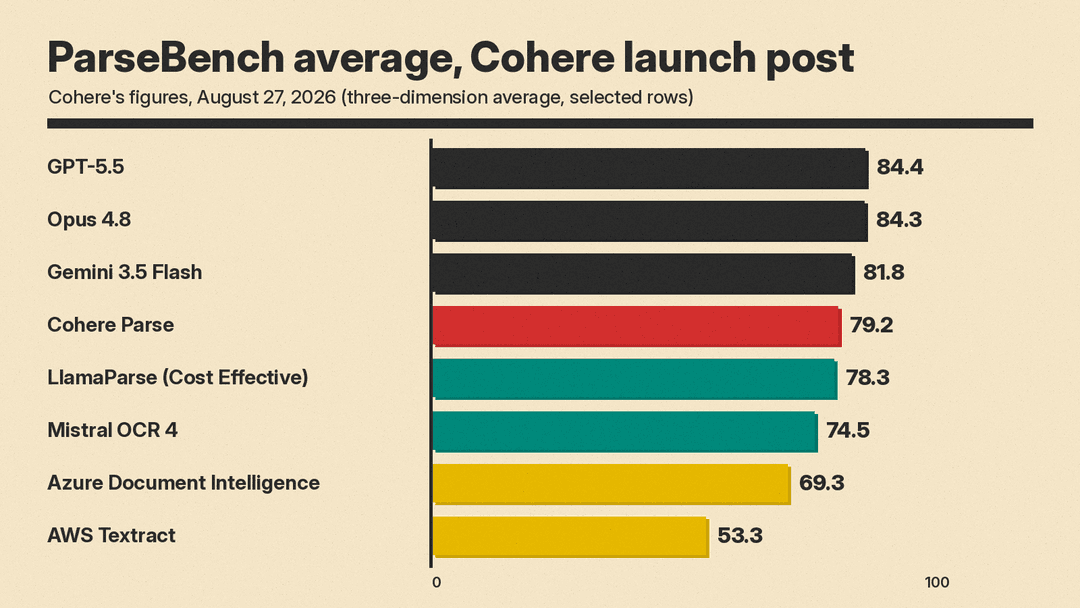
By dimension, Cohere reports Parse at 87.0 on Tables, 86.6 on Content Faithfulness and 64.0 on Semantic Formatting. Cohere says that in its evaluation set Parse "is only bettered by the frontier LLMs (GPT-5.5, Opus 4.8 and Gemini 3.5 Flash)," which it describes as general purpose and "significantly larger than Parse."
The footnotes set the scope. The scores use ParseBench rules as of August 2026, which include a fix to bold and heading detection, and Cohere says it re-scored all competitor models against the updated rules. Cohere left out ParseBench's Layout and Chart dimensions. Its reasons: Parse "does not emit per-element bounding boxes for text, only for tables or images," and it "treats charts as visual elements with descriptive metadata, not as data-extraction targets." Cohere says chart data extraction "is planned for the next Parser version." These are Cohere's own runs, not independent tests.
Throughput
Cohere says Parse "processes 4.5 pages per second (36 pages per second or 2160 pages per minute on an 8 H100 GPU node)." It says that is about 1.4x the throughput of RedNote's dots.mocr and 2.2x that of Chandra OCR 2 on the same GPU setup. Cohere notes that only open-source models were included in this comparison, because it measured throughput directly, and that all models were served with vLLM. For other parsers you can run yourself, see our Baidu Unlimited OCR 2 explainer.
Pricing and deployment
Through the Cohere API, Parse costs $1.50 per 1,000 pages, according to the launch post. Cohere also offers Parse in Model Vault, its single-tenant platform for managed inference, and recommends it for sustained, high-volume workloads. Cohere's figures for Model Vault:
- At 50% GPU utilization, Model Vault reduces inference costs by 23% compared with the Cohere API.
- At full hourly utilization, Cohere says the savings "can grow to 61%."
- For an accounts payable workflow of about 13 million pages per month, Cohere estimates Model Vault would cut inference costs by about $12,000 per month, or $144,000 a year, compared with the Cohere API.
- Against a hyperscaler offering priced at $10 per 1,000 pages, Cohere puts the annual savings for that workflow at about $1.47 million.
Parse is generally available via the Cohere API, Model Vault, Microsoft Foundry and AWS SageMaker, according to the launch post. It is also part of Compass, Cohere's search and retrieval stack, alongside Embed and Rerank. Cohere offers a free Hugging Face Space for testing Parse on your own documents.
Known limitations
The documentation lists three:
- The model does not return confidence scores for extracted content.
- The model does not identify document elements such as headers, footers, or font hierarchy.
- Parsed content is returned as Markdown; structured JSON output is not supported.
Why it matters
In a RAG pipeline, documents are parsed before they can be indexed and searched, so parsing runs on every page a company ingests. Cohere pitches Parse as a small dedicated model at a fixed per-page price for that step. Its own table shows the tradeoff: Parse trails GPT-5.5, Opus 4.8 and Gemini 3.5 Flash on the ParseBench average and sits ahead of the specialized parsers and cloud document services it tested. For a comparison of open-source parsing engines, see our guide to Docling, Marker, MinerU and Unstructured.
Before you commit, run your own documents through the free Space, check that your files can be sent as images, and note what Parse leaves out: chart data, text bounding boxes and confidence scores.
