Days after Anthropic introduced global text watermarking for Claude to comply with the European Union's AI Act transparency requirements, open-source developers and independent researchers have released multiple tools and pipelines aimed at stripping or perturbing the embedded statistical signatures.
The rapid emergence of evasion techniques underscores the structural challenges of applying robust watermarking to natural language generation without introducing perceptible latency, semantic distortion, or reliance on closed detection endpoints.
Statistical Token Biasing and Architectural Vulnerabilities
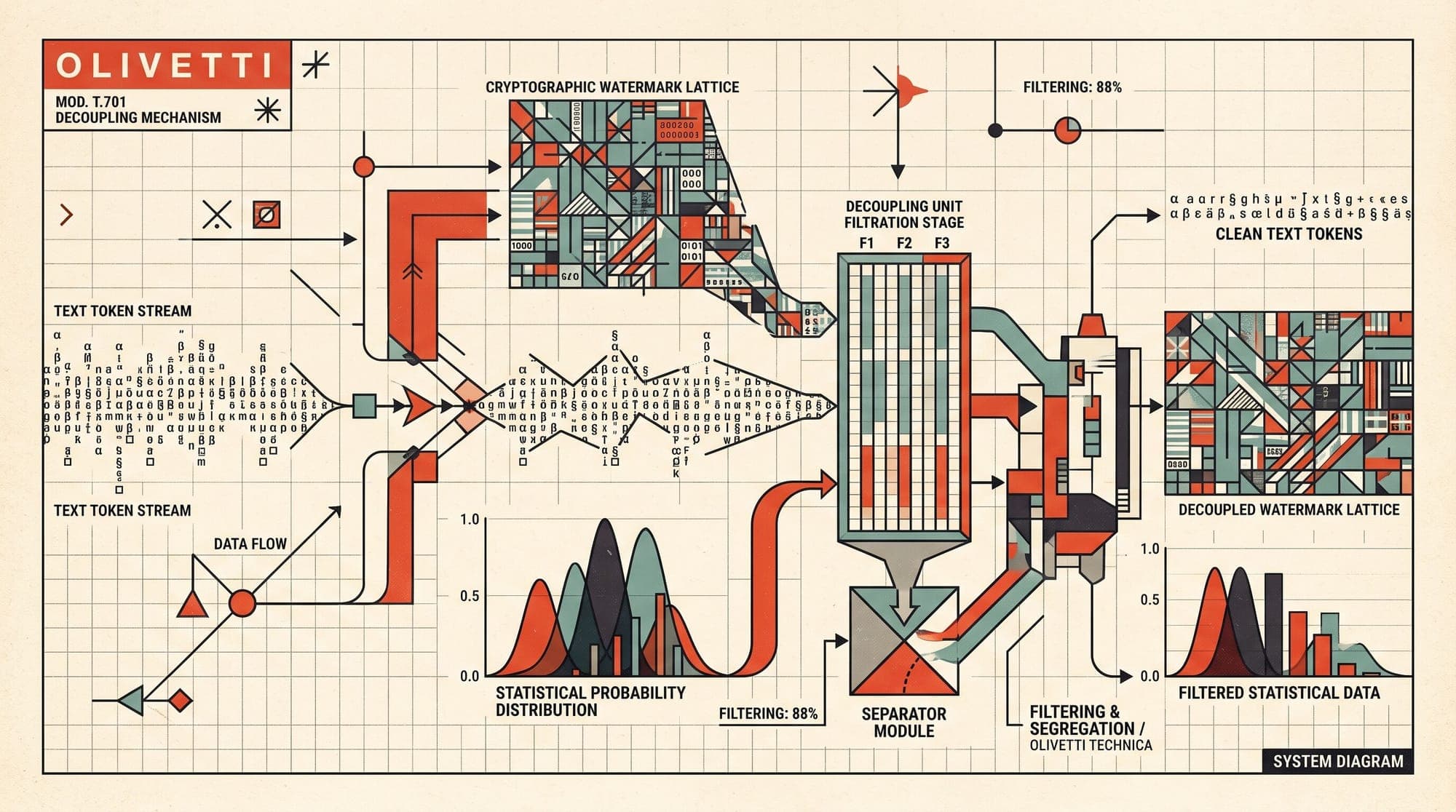
Anthropic's watermarking scheme builds upon the SynthID-Text framework, originally introduced by Google DeepMind and based on theoretical foundations dating to Scott Aaronson's 2022 research. During token generation, the model's sampling logits are biased toward a pseudo-random "green list" of tokens derived from a secret cryptographic seed keyed on preceding token context.
Because the system relies on statistical probability shifts across sequential n-grams rather than hardcoded character sequences, individual sentences may show little trace of the mark. Instead, detection requires aggregating cumulative pseudo-random deviations across hundreds of tokens.

This architecture creates vulnerabilities to relatively light post-processing:
- Paraphrasing and Local Model Rewriting: Running Claude output through an unwatermarked open-weight model (such as Qwen 3.8 or Llama 3) to substitute synonyms and reorganize sentence structures replaces biased token choices, breaking the probability chains required by statistical detectors.
- Semantic Pivot Translation: Translating text into languages with divergent grammatical and semantic structures (such as Arabic or Mandarin) and back into English replaces virtually all surface-level token allocations while preserving core semantic meaning.
- Structural Perturbation: Automated scripts that alter sentence order within paragraphs, swap clauses, or introduce subtle typographic variations degrade the detector's statistical confidence below significance thresholds.
Verification Asymmetry and the EU AI Act Mandate
Anthropic implemented text watermarking primarily to meet the obligations of Article 50 of the EU AI Act, which requires providers of generative AI systems to ensure that synthetic outputs are marked in a machine-readable format. Over 190 organizations, including OpenAI, Google, and Microsoft, have committed to similar transparency frameworks.
However, the current ecosystem suffers from an operational asymmetry: while watermarks are actively injected into public API and web outputs, Anthropic has not made its internal detection API or scoring service publicly accessible. Consequently, third-party developers are testing bypass methods against theoretical SynthID implementations rather than verified provider endpoints.
Anthropic acknowledged in its technical disclosure that heavy human editing or secondary model rewrites inherently dilute the statistical mark. As open-source tools automate these perturbation steps into single-command workflows, the enforceability of statistical watermarking as a compliance and provenance mechanism faces ongoing technical friction.