
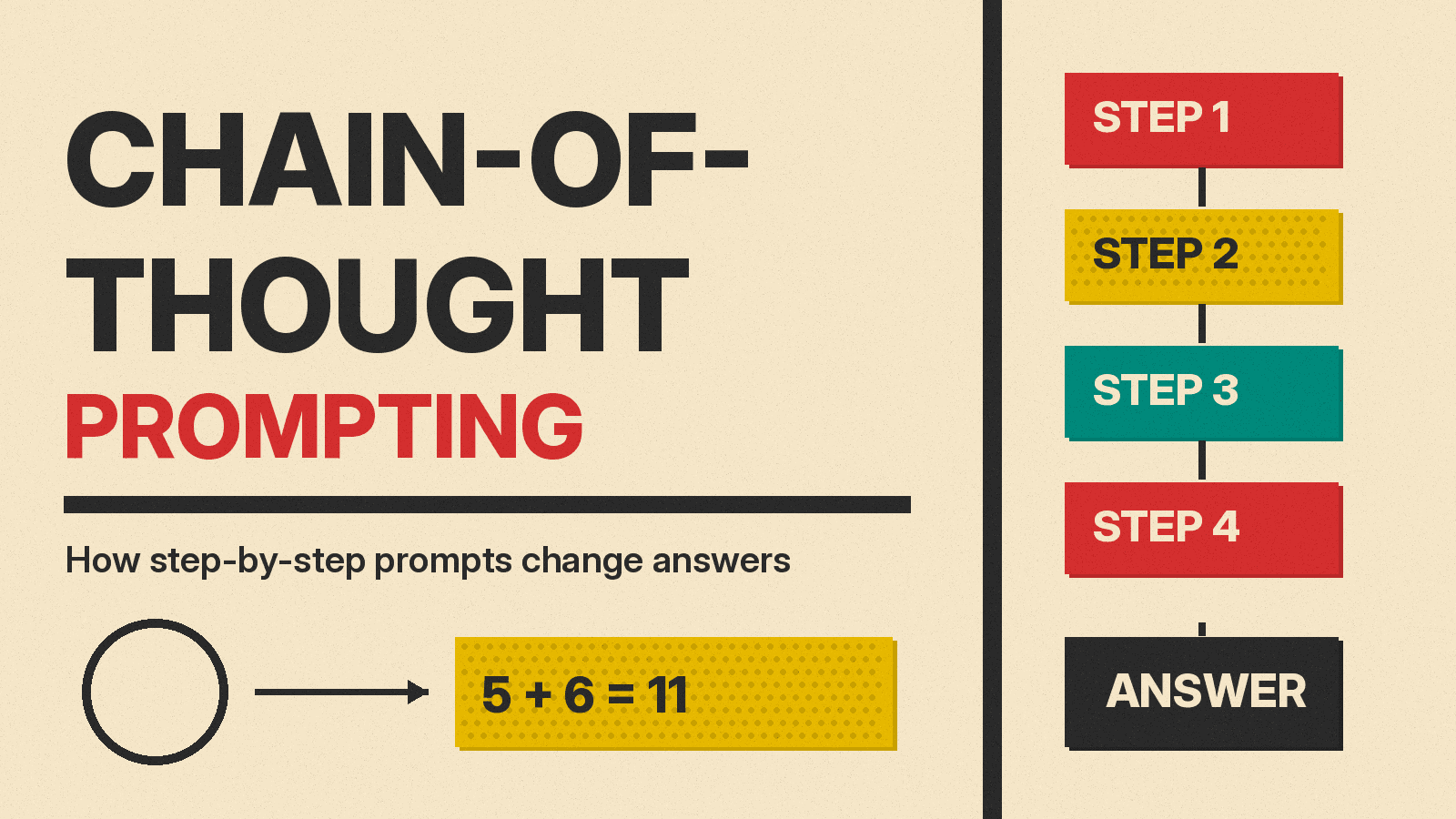
A 2022 Google paper defined a chain of thought as "a series of intermediate natural language reasoning steps that lead to the final output," and showed that asking a large language model to write those steps can change its answers. This explainer walks through three papers on the idea: the 2022 Google paper that named chain-of-thought prompting, the follow-up that found a one-line version, "Let's think step by step", and a method called self-consistency that asks the model the same question many times. Each section sticks to what the papers measured, on the models they tested at the time.
What is chain-of-thought prompting?
The term comes from Jason Wei and colleagues at Google Research, Brain Team. Their paper, presented at NeurIPS 2022, tested a simple change to how a model is prompted.
The paper's baseline is standard few-shot prompting, which it says was popularized by Brown et al. (2020): the model sees a few example questions with their answers, formatted as questions and answers, and then gets a new question. Chain-of-thought prompting keeps that format but adds the worked steps to each example answer.
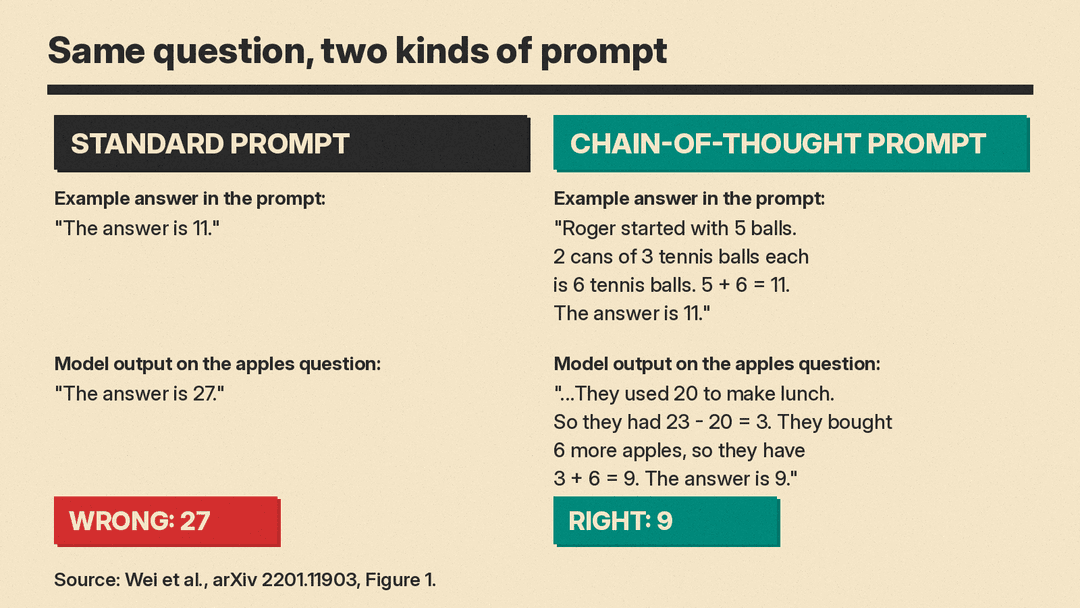
The paper's Figure 1 shows the difference with a tennis-ball problem. In the standard prompt, the example answer reads "The answer is 11." In the chain-of-thought prompt, the same example reads "Roger started with 5 balls. 2 cans of 3 tennis balls each is 6 tennis balls. 5 + 6 = 11. The answer is 11." Faced with a new question about a cafeteria's apples, the standard-prompted model answered 27, which is wrong. The chain-of-thought model wrote out each step and answered 9, which is right.
Nothing about the model changes. The paper says plainly: "No language models were finetuned in the process of writing this paper." The whole method lives in the prompt.
Why the authors thought it would help
The paper lists four properties it calls attractive. In its words, a chain of thought, "in principle, allows models to decompose multi-step problems into intermediate steps," so "additional computation can be allocated to problems that require more reasoning steps." It "provides an interpretable window into the behavior of the model," though the authors add that "fully characterizing a model's computations that support an answer remains an open question." It can apply to math, commonsense and symbolic tasks. And it can be drawn out of "sufficiently large off-the-shelf language models" by putting examples in the prompt.
What the paper found
The authors tested five large language models, including GPT-3, LaMDA and PaLM, on math word problems, commonsense questions and simple symbolic puzzles. Three results stand out.
It worked on hard multi-step math. On GSM8K, a benchmark of grade-school math word problems, PaLM 540B scored 17.9% with standard prompting and 56.9% with chain-of-thought prompting (Table 1). The paper's Figure 2 shows that result as 57%, next to 33% for a finetuned GPT-3 175B and 55% for the prior best, both taken from Cobbe et al. (2021). The PaLM result used eight chain-of-thought example answers in the prompt.
It only helped large models. The paper calls chain-of-thought prompting "an emergent ability of model scale." In its tests it "does not positively impact performance for small models, and only yields performance gains when used with models of ∼100B parameters." The authors write that smaller models "produced fluent but illogical chains of thought, leading to lower performance than standard prompting."
It helped more on harder problems. On GSM8K, performance "more than doubled for the largest GPT and PaLM models." On the easiest single-step subset of one benchmark, the gains "were either negative or very small."
Beyond math, PaLM 540B with chain-of-thought prompting scored 75.6% on StrategyQA, a multi-step question set, against a prior best of 69.4%, and 95.4% on a sports-understanding task against 84% for "an unaided sports enthusiast." The paper notes that the gain "was minimal on CSQA," a set of commonsense questions.
Is it the words, or just extra space to think?
The authors ran checks to see what actually drives the gain (Section 3.3).
- Equation only. The model wrote just the math equation before answering. This "does not help much for GSM8K," which the paper reads as a sign that those questions are "too challenging to directly translate into an equation without the natural language reasoning steps."
- Dots instead of words. The model wrote a row of dots as long as the needed equation, to test whether extra output alone helps. This "performs about the same as the baseline."
- Reasoning after the answer. The model gave the answer first and the steps after. This also "performs about the same as the baseline."
From these, the paper concludes that "there appears to be utility from expressing intermediate steps via natural language," and that the step-by-step order matters "for reasons beyond just activating knowledge." The authors also had different people write the example chains and found that "all sets of chain of thought prompts outperform the standard baseline by a large margin," though results varied between writers.
For a technical look at why written steps can expand what a transformer can compute, see our deep dive on chain-of-thought reasoning and transformer expressivity.
The shortcut: "Let's think step by step"
A later paper by Takeshi Kojima and colleagues at the University of Tokyo and Google Research asked whether the worked examples were needed at all. That paper, also at NeurIPS 2022, adds one phrase, "Let's think step by step," before the answer and gives no examples. They call it Zero-shot-CoT.
It runs in two steps. The first prompt ends with the trigger phrase and lets the model write out its reasoning. The second prompt feeds that reasoning back with a line such as "Therefore, the answer (arabic numerals) is" to pull out a clean answer. The paper notes that this "requires less engineering but requires prompting LLMs twice."
With InstructGPT (text-davinci-002), the phrase raised accuracy "from 17.7% to 78.7% on MultiArith and from 10.4% to 40.7% on GSM8K" compared with plain zero-shot prompting. With PaLM 540B, GSM8K rose from 12.5% to 43.0% (Table 2). The authors are clear that it "underperforms Few-shot-CoT," which reached 93.0% on MultiArith and 48.7% on GSM8K with eight worked examples on the same InstructGPT model.
The wording mattered. The paper tested 16 trigger phrases on MultiArith (Table 4):
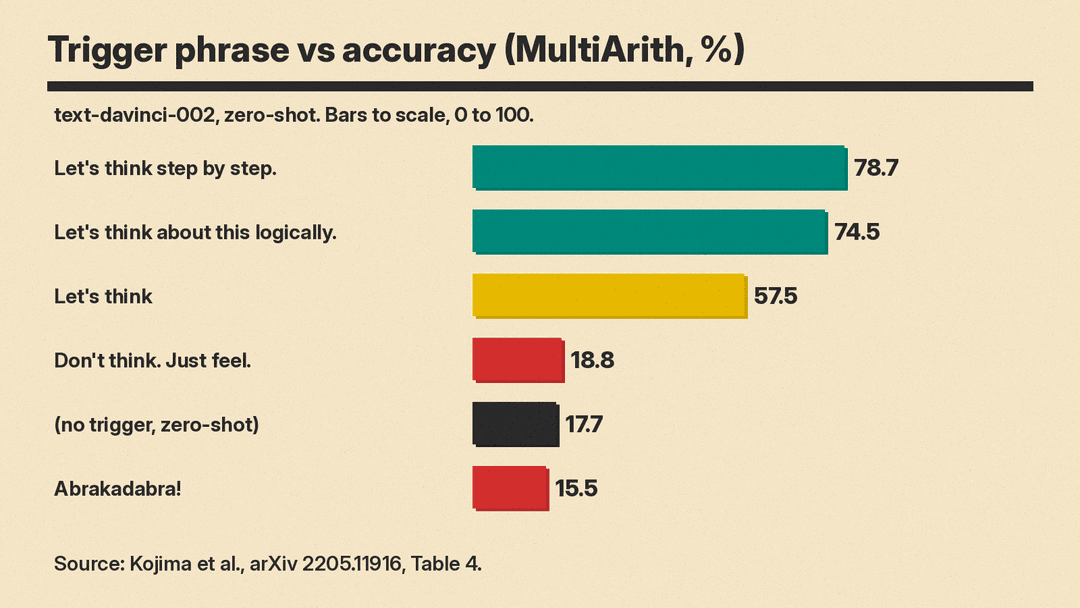
- "Let's think step by step." scored 78.7.
- "Let's think about this logically." scored 74.5.
- "Let's think" scored 57.5.
- "Don't think. Just feel." scored 18.8.
- The nonsense trigger Abrakadabra (with an exclamation mark in the paper) scored 15.5, against 17.7 with no trigger.
The paper's limits section points out that prompting draws on patterns models learned from web data, which "have shown to capture and amplify biases found in the training data," and that prompting "has the same shortcomings." It also reports that the phrase "does not provide performance gains" on its commonsense tasks, though it found many of the generated chains "surprisingly logically correct or only contains human-understandable mistakes."
Self-consistency: ask several times, take the most common answer
The original chain-of-thought paper used greedy decoding, meaning the model takes its single most likely path. Xuezhi Wang and colleagues at Google Research, Brain Team proposed self-consistency, published at ICLR 2023. It "first samples a diverse set of reasoning paths instead of only taking the greedy one, and then selects the most consistent answer." In plain terms: let the model work the problem many times, then take a majority vote on the final answers.
The authors' intuition is that "a complex reasoning problem typically admits multiple different ways of thinking leading to its unique correct answer." In the paper's Table 1, GSM8K accuracy on PaLM-540B was 56.5% with greedy decoding and 74.4% with a majority vote over sampled paths. Its main results sample 40 outputs per question, averaged over 10 runs. The abstract lists gains on GSM8K (+17.9%), SVAMP (+11.0%), AQuA (+12.2%), StrategyQA (+6.4%) and ARC-challenge (+3.9%).
The paper names the trade-off directly: "it incurs more computation cost." It suggests trying "a small number of paths (e.g., 5 or 10)" because "in most cases the performance saturates quickly." It also notes that models "can sometimes generate incorrect or nonsensical reasoning paths."
Our technical explainer on self-consistency decoding covers the sampling and voting steps in more detail.
What the papers say chain of thought does not do
Each paper also names limits. The original paper lists four in its own words:
- Chain of thought "emulates the thought processes of human reasoners," but "this does not answer whether the neural network is actually 'reasoning,'" which the authors leave open.
- Writing worked examples is cheap for a few-shot prompt, but "such annotation costs could be prohibitive for finetuning," though the authors add that synthetic data generation or zero-shot generalization could potentially get around this.
- "There is no guarantee of correct reasoning paths, which can lead to both correct and incorrect answers." Our AI hallucinations explainer covers how to check model claims more generally.
- Because it appeared only at large scale, it is "costly to serve in real-world applications."
The paper's own error check shows why a tidy chain is not proof. Of 50 LaMDA 137B answers that were correct, all but two had correct chains; the two "coincidentally arrived at the correct answer." Of 50 wrong answers, 46% had chains that were "almost correct, barring minor mistakes," and 54% had "major errors in semantic understanding or coherence."
What this means when you write prompts
These results come from 2022-era models on benchmark tasks, so treat them as findings to test, not rules. Within that scope, the papers point to a few practical lessons.
- Show the working in your examples. If you give a model examples, the Wei paper found that worked steps beat bare answers on multi-step problems.
- A short trigger can help. Kojima's results suggest a plain instruction such as "Let's think step by step" can lift accuracy without any examples, and that the exact phrasing changes the result.
- Do not expect gains on one-step tasks. Both papers report small or no gains on easy single-step problems, and Kojima reports none on its commonsense sets.
- Read the steps, but check the answer. A chain can look right and still be wrong, and a right answer can rest on a wrong chain.
- Asking more than once can help, at a cost. Self-consistency trades extra model calls for accuracy, with most of the gain in the first few samples according to its authors.
For background, our context window explainer covers how much text a model can read at once, and our Transformers explainer covers the architecture underneath the models these papers tested. If you would rather split a job across several prompts than ask one prompt to reason through it, see our guide to prompt chaining.
Sources
- Wei et al., Chain-of-Thought Prompting Elicits Reasoning in Large Language Models (arXiv 2201.11903, NeurIPS 2022)
- Kojima et al., Large Language Models are Zero-Shot Reasoners (arXiv 2205.11916, NeurIPS 2022)
- Wang et al., Self-Consistency Improves Chain of Thought Reasoning in Language Models (arXiv 2203.11171, ICLR 2023)
