Britain's employment tribunals are drowning in AI-written claims

Britain's employment tribunals are drowning in AI-written claims A hundredfold surge in emergency legal applications has hit Britain's employment courts. Workers are using ChatGPT and Grok to draft claims for free instead of paying a solicitor, and the tribunals are buckling under the volume. Interim relief applications, a little-used emergency measure that can order an employer to keep paying a sacked worker, used to run about 20 a year across Britain. They now arrive in the thousands. Tribun

1 min
Britain's employment tribunals are drowning in AI-written claims

Britain's employment tribunals are drowning in AI-written claims

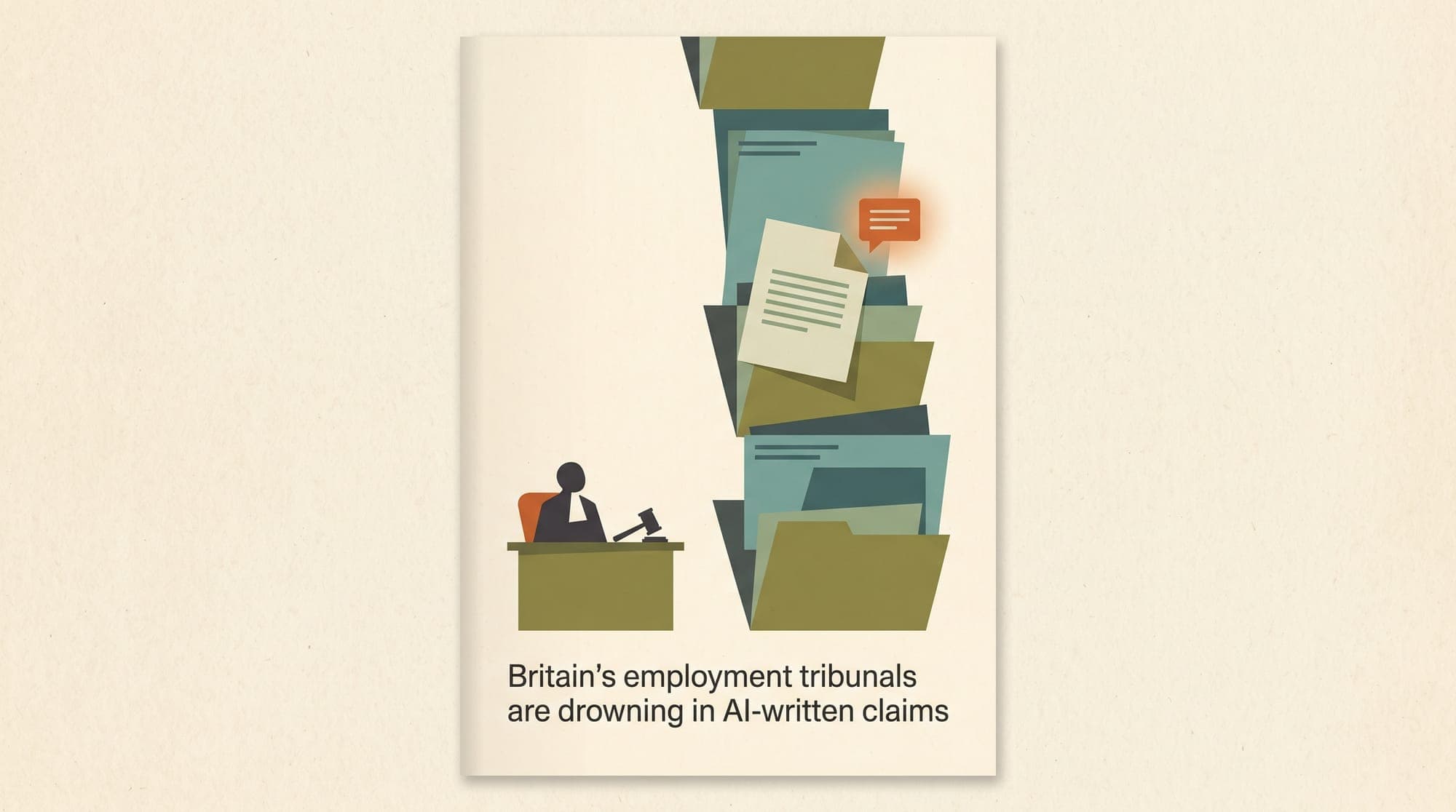
A hundredfold surge in emergency legal applications has hit Britain's employment courts. Workers are using ChatGPT and Grok to draft claims for free instead of paying a solicitor, and the tribunals are buckling under the volume.

Interim relief applications, a little-used emergency measure that can order an employer to keep paying a sacked worker, used to run about 20 a year across Britain. They now arrive in the thousands. Tribunal presidents Barry Clarke and Susan Walker flagged the shift in a memo reported by The Economist. Across the year to March 2026, total claims rose 39 percent and the unresolved backlog jumped 55 percent to 64,000 cases.

Many of the AI-drafted filings are bloated and unreliable. Some run to hundreds of pages and cite laws that do not exist, with demands far outside what tribunals can award. The friction lands on everyone: legitimate claimants wait longer for a hearing, and employers pay to defend claims whether or not they have merit.

The pressure is about to grow. Labour's Employment Rights Act adds roughly 25 new grounds for claims and removes compensation caps. The Economist described the dynamic as a "tragedy of the commons, AI edition," where a free tool spent by individuals collectively degrades a shared public system.

Britain is not alone. A US federal judge called AI-generated litigation an "existential threat to the federal courts." But the effect is not uniformly negative: a study in Pakistan found that judges given AI tools and training cleared backlogs faster, suggesting the problem is adoption without guardrails, not the technology itself.

Sources

Written by

More to read

  • Activation Checkpointing in Large Language Models: How Selective Recomputation Eliminates Memory Bottlenecks

    Large language model pre-training and fine-tuning are fundamentally constrained by GPU memory (VRAM). While distributed techniques such as Fully Sharded Data Parallel (FSDP), ZeRO, and Tensor Parallelism successfully shard model parameters, optimizer states, and gradients across hundreds or thousands of GPUs, activation memory presents a distinct scaling bottleneck. During the forward pass of a transformer model, intermediate tensor outputs must be preserved in GPU memory so that backpropagatio

    1 min
  • Anthropic Demonstrates Autonomous De Novo Protein Design and Chemical Analysis with Claude

    Anthropic Demonstrates Autonomous De Novo Protein Design and Chemical Analysis with Claude Anthropic has published experimental results demonstrating Claude's ability to autonomously design de novo protein binders with physical wet-lab validation and automate complex analytical chemistry workflows. The findings show frontier LLMs acting as autonomous agents across computational biology and molecular characterization pipelines. In the primary experiment, Anthropic evaluated Claude Mythos Previe

    1 min
  • Cerebras Unveils CS-4 Rack-Scale System Powered by Three WSE-3 Turbo Chips and Nexus Architecture

    Cerebras Unveils CS-4 Rack-Scale System Powered by Three WSE-3 Turbo Chips and Nexus Architecture Cerebras Systems has announced the CS-4, a rack-scale AI accelerator system designed around three of its next-generation Wafer Scale Engine 3 Turbo (WSE-3 Turbo) chips and a modular hardware architecture dubbed Nexus. Cerebras confirmed that initial customer shipments for the CS-4 are scheduled to begin in the current quarter. The new system marks a structural shift from Cerebras's single-wafer CS

    1 min


