
Helsing, which Reuters calls a German defence technology company, unveiled Clarity on November 11, 2026. In its press release, Helsing calls Clarity "an agentic intelligence platform that enables armed forces to process vast volumes of data in parallel, identify threats and counter them faster and more reliably." Reuters reported the launch the same day, at 2:31 a.m. PT, and wrote that Helsing is "entering a market led by Palantir."
What Helsing says Clarity does
Helsing says armed forces collect more data than ever, from satellites, sensors, drones and other sources. In its words: "The bottleneck sits in between: turning data into a timely, reliable operational picture and preparing the information needed to act is still done mostly by hand."
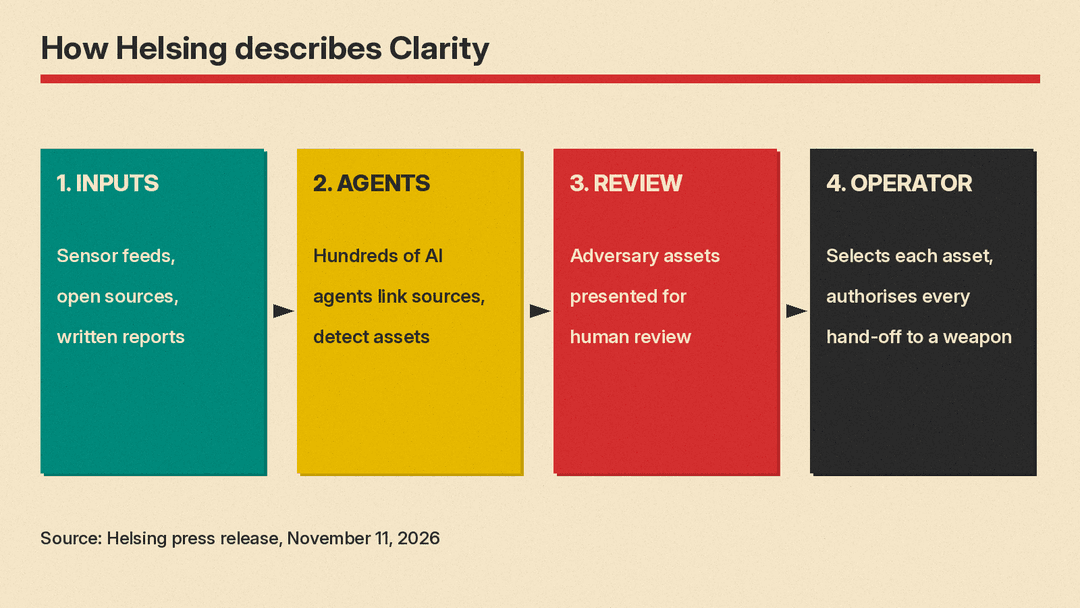
According to Helsing, Clarity processes everything a unit has access to, from sensor feeds and open sources to written reports and the systems it already runs. It links these sources, analyses large volumes of data in seconds and detects military assets and positions across them. Helsing says: "Clarity presents relevant adversary military assets for human review and prepares the information required by the most suitable weapon."
Helsing says the platform is built around AI agents developed specifically for military use. It says its models are trained on real-world military data, synthetic AI-generated data and simulated environments. Helsing writes: "A shared military ontology and evidence base enable hundreds of agents to work in parallel, connecting evidence, using analytical tools and carrying out complex intelligence tasks."
If you are new to the term, our explainer covers what an AI agent is and how agents work.
Where humans come in
Helsing says: "Humans stay in command." According to the company, an operator reviews the evidence and selects each asset for engagement, then authorises every hand-off to a weapon. Helsing writes: "A target is nominated only when independent sources agree, confidence is high and an operator confirms." It also says the platform implements the targeting doctrine and builds in the gates it requires, and that every decision is recorded together with the person who made it.
Reuters, citing Helsing, reported: "Human operators remain responsible for approving any strike."
Who controls it
Helsing says Clarity is "sovereign by design" and runs on infrastructure the customer owns. It says the AI models and integrations are built by Helsing in Europe. The company says the platform follows the MOSA principles, implements relevant NATO standards, works alongside the systems armies already run and connects to effectors from any manufacturer. "Data, models and operations stay under the control of the customer, and Clarity is owned by no one else," Helsing writes.
What Helsing's leaders say
Gundbert Scherf, Helsing co-CEO and co-founder, says in the release: "With Clarity, European armed forces get software that is built in Europe, runs on their own infrastructure and stays under their control." As quoted by Reuters, Scherf said: "We are entering an era where success on the battlefield will depend on how effectively armed forces can transform information into action."
Rob Fink, Helsing's chief technology officer, says in the release: "With Clarity, we have built a sovereign AI-native agentic intelligence platform that allows armed forces to trust the speed that AI agents bring to intelligence."
What is not known yet
Reuters wrote: "Helsing did not disclose whether Clarity was already being used by military customers or when it expected it to enter service." Helsing's release does not name a customer or a price.
Reuters also wrote: "Palantir's Maven sits inside Pentagon and NATO workflows and has been refined through years of operational use." It added that Germany's armed forces have previously said they aim to begin introducing AI-enabled systems from next year.
Related: our post on OpenAI's Daybreak Red on AWS GovCloud.
Sources
- Helsing unveils Clarity, a sovereign software platform for military intelligence, Helsing, November 11, 2026
- Helsing enters market for battlefield software built on combat data, Reuters (Maria Rugamer and Sabine Siebold), via StreetInsider, November 11, 2026, 2:31 a.m. PT
