
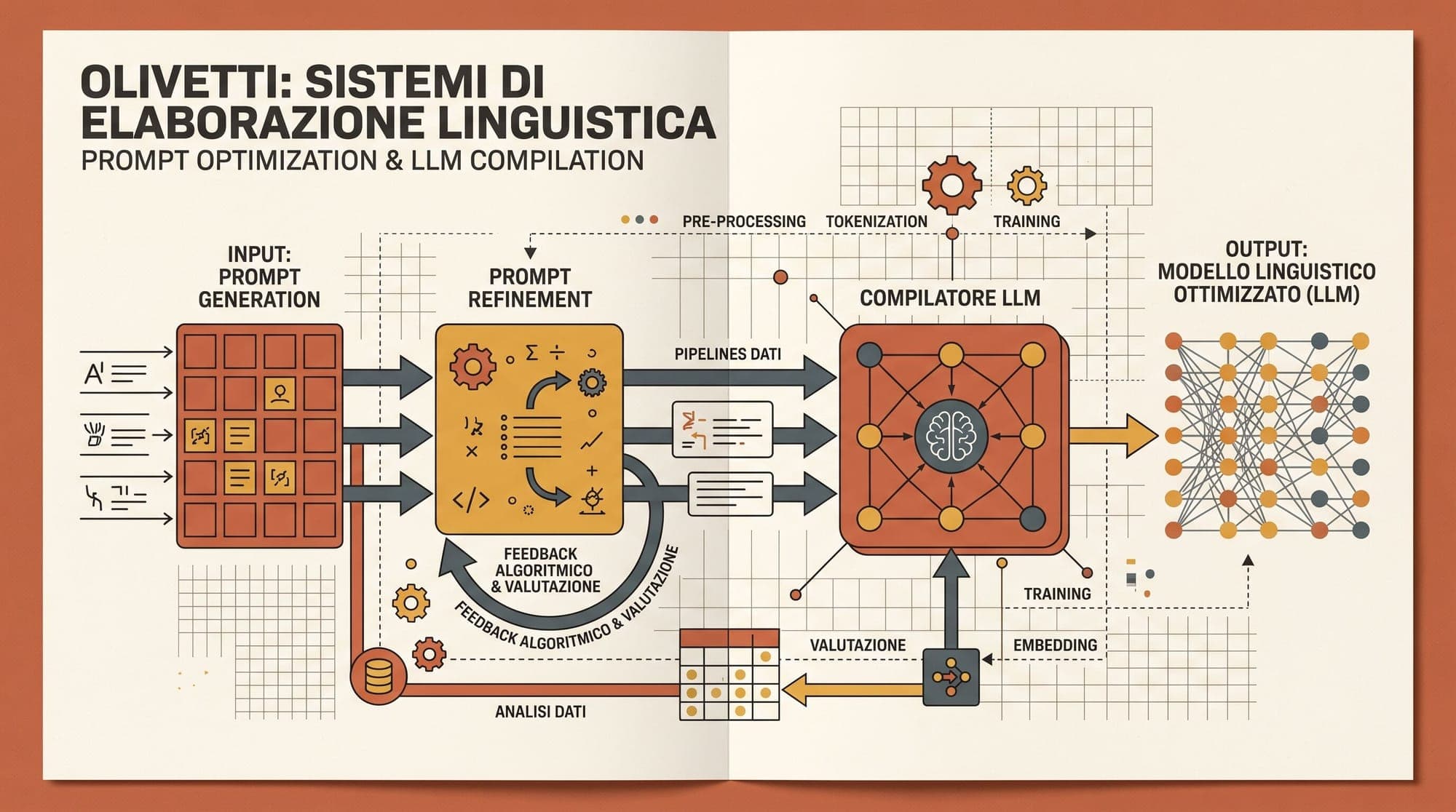
Manual prompt engineering remains one of the largest sources of technical debt in modern LLM applications. Teams routinely spend weeks hand-crafting multi-paragraph system prompts, hardcoding few-shot examples, and tweaking phrasing to extract reliable outputs from specific model checkpoints. When the underlying model is upgraded, migrated to an open-weight alternative, or integrated into a multi-step pipeline, these hand-crafted strings break, requiring another cycle of trial-and-error adjustment.
Declarative frameworks such as DSPy treat prompt engineering as a compilation problem rather than a manual drafting task. By separating pipeline logic into modular signatures and optimizing prompt text and demonstrations against quantitative metrics, automated prompt optimization introduces reproducible software engineering workflows to LLM pipelines.
The Fragility of Manual Prompting
Hand-written prompts suffer from three structural weaknesses in production environments:
- Model Coupling: Prompts are tightly coupled to the specific instruction-tuning nuances and tokenization characteristics of a single model release. A prompt tuned for proprietary frontier models frequently fails when deployed to cost-efficient open-weight models like Llama 3 or Mistral.
- Pipeline Compounding Errors: In multi-stage systems such as retrieval-augmented generation (RAG) or multi-step agent chains, prompt modifications in an upstream module alter the input distribution for downstream modules, causing unpredictable cascading failures.
- Non-Reproducible Heuristics: Hand-selected few-shot examples rarely represent the operational edge cases of production traffic, leading to silent accuracy degradation under distribution shift.
Automated prompt optimization replaces ad-hoc strings with structured signatures and algorithmic optimizers known as teleprompters.
Declarative Core: Signatures and Modules
At the foundation of declarative LLM programming is the separation of interface definition from prompting strategy.
Signatures
A signature defines what an LLM step does, specifying inputs, outputs, and semantic intent without prescribing prompt formatting:
import dspy

class DocumentClassifier(dspy.Signature):
    """Classify technical incident logs into severity tiers and extract root cause entities."""

    incident_log = dspy.InputField(desc="Raw server and application error logs")
    severity = dspy.OutputField(desc="One of: SEV-1, SEV-2, SEV-3, SEV-4")
    root_cause = dspy.OutputField(desc="Primary failing service or component")
The runtime translates this declarative signature into model-specific prompts, handling field formatting, system instruction placement, and role demarcations automatically.
Modules
Modules implement computation strategies over signatures. Standard modules include:
dspy.Predict: Executes direct zero-shot or few-shot completion against the signature.dspy.ChainOfThought: Automatically inserts intermediate reasoning steps (rationale) before generating final fields.dspy.ReAct: Interleaves thought generation with external tool execution in iterative loops.dspy.ProgramOfThought: Prompts the model to express intermediate computation as executable Python code.
These modules can be composed into arbitrary computational graphs, mirroring traditional object-oriented or functional software architectures.
The Compilation Pipeline and Optimizer Hierarchy
Compilation in DSPy optimizes the parameters of a program against a specified dataset and evaluation metric. Unlike deep learning compilation that optimizes machine code, prompt compilation optimizes prompt instructions, demonstration selections, and model weights.

The optimization process evaluates candidate prompts against an objective metric, such as exact match, schema conformance, embedding similarity, or calibrated judge models.
1. Demonstration Selection: BootstrapFewShot
BootstrapFewShot generates few-shot examples automatically:
- The optimizer executes the uncompiled pipeline across an unlabelled training set.
- For each example, the module traces intermediate steps (such as reasoning rationales or tool invocations).
- If the final output satisfies the validation metric, the entire successful execution trace is retained as a candidate few-shot demonstration.
- Selected demonstrations are injected into module prompts during subsequent execution.
BootstrapFewShotWithRandomSearch extends this by generating multiple execution trajectories per input and running random search over demonstration combinations across pipeline modules to find the optimal set.
2. Instruction Optimization: COPRO
COPRO (Coordinate Prompt Optimization) searches the space of natural language task instructions:
- A proposer model generates candidate instruction variants for each signature in the pipeline.
- The optimizer uses coordinate ascent to evaluate and refine instructions iteratively across validation splits.
- Prompts that achieve the highest metric scores are retained as the new module instructions.
3. Joint Instruction and Demonstration Search: MIPROv2
MIPROv2 (Multiprompt Instruction PRoposal Optimizer Version 2) optimizes instructions and few-shot demonstrations simultaneously:
- Phase 1 (Bootstrapping): Collects candidate execution traces across training data.
- Phase 2 (Instruction Proposal): Generates multiple grounded instruction candidates based on dataset characteristics, task tips, and execution traces.
- Phase 3 (Bayesian Optimization): Uses Tree-structured Parzen Estimators (TPE via Optuna) to search the combinatorial space of instruction variants and demonstration subsets.
MIPROv2 evaluates the joint interaction between instructions and examples, avoiding local optima where an instruction performs poorly with independently chosen demonstrations.
4. Weight-Level Compilation: BootstrapFinetune
For low-latency or cost-constrained workloads, BootstrapFinetune compiles prompt traces directly into model weights:
- Successful execution traces from a teacher model (e.g., a larger frontier LLM) are serialized into supervised fine-tuning datasets.
- The target student model (e.g., an 8B open-weight model) undergoes parameter fine-tuning via LoRA or full-weight SFT.
- The resulting model achieves the target reasoning quality without requiring long few-shot prompts at inference time.
Computational Constraints: Assertions and Backtracking
To ensure deterministic reliability, pipelines can incorporate computational constraints via assertions.
dspy.Assert: Enforces mandatory criteria (such as JSON schema validation, length limits, or forbidden token constraints). If violated, the runtime catches the failure, appends an error message to the prompt, and initiates a localized retry loop.dspy.Suggest: Encourages soft constraints, initiating a retry attempt if violated but continuing execution if the threshold is not met after maximum retries.
During compilation, assertions act as active filters. Trajectories that violate assertions are discarded from demonstration candidate pools, ensuring that bootstrapped examples only contain verified, compliant outputs.
Production Architecture and Serving Economics
Deploying compiled prompt pipelines involves distinct offline and online phases.
Zero-Overhead Serving
Prompt compilation occurs entirely offline. Once optimization completes, the program state is serialized to disk:
# Save compiled state
compiled_pipeline.save("incident_classifier_v1.json")

# Load in production serving environment
production_pipeline = DocumentClassifierPipeline()
production_pipeline.load("incident_classifier_v1.json")
At runtime, the loaded pipeline executes static, optimized strings and demonstrations without calling optimizer search loops or incurring optimization latency.
Continuous Optimization in CI/CD
Compiled prompts can be integrated into deployment pipelines:
- Automated Regression Suites: When underlying foundational model APIs are updated or fine-tuned weights are retrained, the CI pipeline runs the compilation suite against regression benchmarks.
- Dataset-Driven Recompilation: Ingestion of new domain data triggers automated MIPROv2 runs to regenerate instructions and demonstration sets.
- Model Portability: Migrating from commercial APIs to on-premises open-weight infrastructure requires only rerunning the compiler with the new target model endpoint.
Inference Cost Considerations
While automated compilation increases offline token consumption during Bayesian search (often requiring several hundred thousand tokens per optimization run), it provides significant runtime cost benefits:
- Shorter, targeted instructions discovered by optimizers reduce input token counts compared to bloated manual prompts.
- When paired with prompt caching, static compiled few-shot prefixes achieve high cache-hit rates across high-throughput endpoints.
- Transitioning to smaller, compiled open-weight models can reduce per-query inference costs by an order of magnitude.
Operational Pitfalls
Implementing automated prompt optimization introduces specific engineering trade-offs:
- Metric Overfitting: Optimizing against small validation sets (under 50 examples) can yield prompts tailored to idiosyncratic dataset quirks rather than generalizable task logic.
- Metric Gaming: When using an LLM-as-a-Judge for soft evaluation, optimizers can discover prompt variations that exploit judge biases (such as verbosity or formatting preferences) without improving underlying accuracy.
- Context Window Growth: Unconstrained few-shot bootstrapping can inject excessive demonstration tokens, increasing time-to-first-token latency. Setting explicit demonstration limits (
max_bootstrapped_demos) is necessary for latency-sensitive deployments.
Sources
- Khattab, O., et al. (2024). "DSPy: Compiling Declarative Language Model Calls into Self-Improving Pipelines." International Conference on Learning Representations (ICLR). arXiv:2310.03714
- Khattab, O., et al. (2022). "Demonstrate-Search-Predict: Composing Retrieval and Language Models for Knowledge-Intensive NLP." arXiv:2212.14024
- Stanford NLP Group. (2024). "DSPy Documentation and Optimization Architecture." DSPy.ai
- Srivats, P., et al. (2024). "Optimizing Instructions and Demonstrations for Multi-Stage Language Model Programs (MIPROv2)." arXiv:2406.11695
- Singhvi, A., et al. (2023). "DSPy Assertions: Computational Constraints for Large Language Model Pipelines." arXiv:2312.13382



