
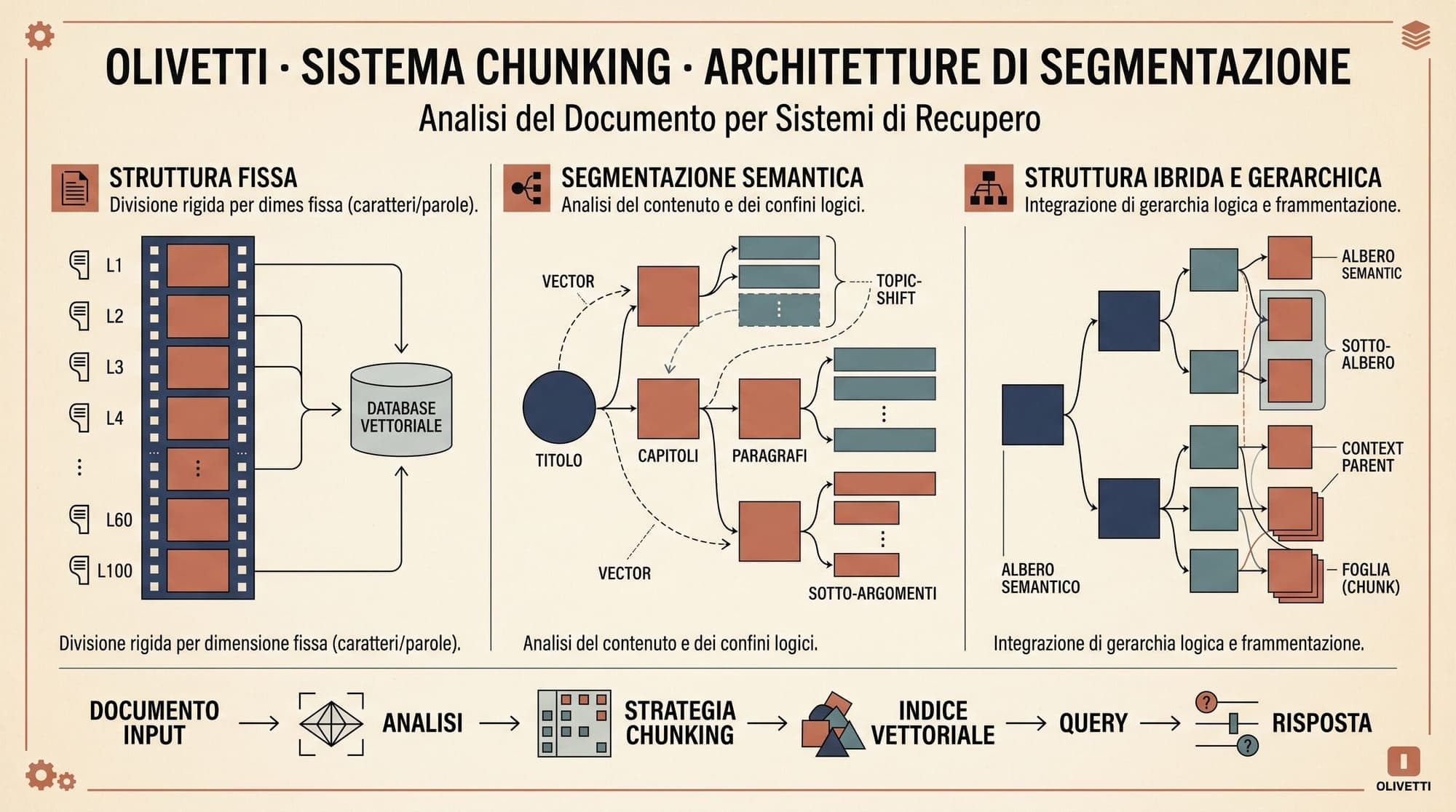
In retrieval-augmented generation (RAG) systems, document chunking dictates the upper bound of downstream retrieval quality and generation fidelity. Naive document fragmentation breaks cross-sentence references, severs entity co-occurrences, and discards global discourse structure. Conversely, oversized chunks inject extraneous noise into context windows, diluting the dense embedding representation and wasting generation budget.
Production architectures have moved beyond static character counting toward methods that preserve semantic boundaries and global document context. This analysis evaluates the core chunking paradigms used in production systems: Recursive Character Splitting, Embedding-Based Semantic Chunking, Late Chunking via long-context bi-encoders, and Anthropic's Contextual Retrieval pattern.

The Context-Granularity Dilemma
Dense vector retrieval relies on mapping textual units into fixed-dimensional vectors (typically 768, 1024, or 1536 dimensions). The mathematical capacity of a single dense vector is inherently bounded. When an entire multi-page document is encoded into one vector, fine-grained factual details are averaged out through pooling operations, causing loss of specific entity relationships.
Splitting documents into smaller chunks resolves representation capacity limits but introduces three structural failure modes:
- Anaphora and Pronoun Detachment: A chunk stating "The company acquired the subsidiary for $4.2 billion in Q3" loses its referent if "The company" was defined two paragraphs prior.
- Contextual Inversion: A sentence asserting "This hypothesis was subsequently disproven by secondary trials" loses its meaning if severed from the preceding trial methodology.
- Table and Schema Fracturing: Arbitrary token boundaries split tabular rows across different chunks, rendering structured numeric comparisons impossible for dense retrieval models.
To balance retrieval precision and contextual coherence, production systems select chunking strategies based on indexing compute budgets, token economics, and downstream latency constraints.
1. Fixed-Size and Recursive Character Splitting
The historical baseline for RAG ingestion is hierarchical recursive character splitting, implemented standardly in frameworks like LangChain and LlamaIndex.
Algorithm and Mechanics
Recursive splitting operates on an ordered list of separators: ["\n\n", "\n", " ", ""].
The splitter attempts to segment text along the highest-priority separator (\n\n). If resulting segments exceed the target token budget (e.g., 512 tokens), the algorithm recursively applies lower-level separators (\n, then whitespace) to sub-segments until all pieces satisfy the token constraint.
To mitigate edge truncation, a sliding window overlap (typically 10% to 20% of the chunk size) duplicates boundary tokens across consecutive chunks.
Production Limitations
While computationally trivial (string operations with minimal CPU overhead), recursive character splitting exhibits systematic production drawbacks:
- Semantic Blindness: The algorithm treats a section header, a code fence, and an explanatory paragraph identically, frequently severing cohesive reasoning blocks.
- Index Redundancy: A 20% sliding window expands vector database storage and embedding inference compute by 20% across the corpus without increasing the net information volume.
- Inability to Resolve Antecedents: Overlap windows rarely span far enough to capture document-level definitions or preamble constraints established pages earlier.
2. Semantic Chunking via Embedding Distance
To eliminate arbitrary token cutoffs, semantic chunking approaches dynamically determine split points based on statistical shifts in local semantic similarity, as detailed in LlamaIndex Semantic Splitter implementations.
Mechanics and Thresholding
- The raw document is parsed into sentence units using NLP tokenizers.
- Each sentence or small sliding sentence window is passed to an embedding model to generate dense vectors.
- Consecutive cosine distances are computed along the sequence.
- Split boundaries are injected wherever the cosine distance exceeds a predetermined statistical threshold (such as the 90th or 95th percentile of distances across the document, or a moving-average z-score).
Trade-offs and Failure Modes
- Indexing Compute Surge: Generating embeddings for every individual sentence scales embedding inference costs by 3x to 6x relative to chunk-level encoding.
- Threshold Sensitivity: A static threshold causes severe over-fragmentation in technical manuals with high syntactic variance, while under-segmenting uniform narrative text.
- Context Isolation: Even when sentences are cleanly grouped into coherent semantic clusters, each chunk is still encoded in isolation during the final indexing pass, leaving cross-chunk anaphora unresolved.
3. Late Chunking: Full-Context Bi-Encoder Attention
Introduced by researchers at Jina AI (Günther et al., 2024), Late Chunking shifts chunking from a pre-processing step to a post-encoding pooling operation, leveraging long-context transformer embedding models (such as jina-embeddings-v3 or ModernBERT).
Mathematical Formulation
In standard naive chunking, a document is split into chunks prior to model execution. Each chunk is tokenized and encoded independently.
In Late Chunking, the entire document (up to the model's maximum sequence length, e.g., 8,192 tokens) is fed into the transformer bi-encoder in a single forward pass to generate contextualized token hidden states.
Because the transformer's multi-head self-attention mechanisms operate across the entire document token sequence, every token representation attends to every other token in the document, conditioning each token's embedding on preceding definitions, section titles, and global context.
Once hidden states are computed, chunk boundaries derived from layout or character spans are applied directly to the token slices via mean-pooling.
Standard Chunking:
  [Chunk 1] -> Encoder -> Vector 1 (Isolated attention)
  [Chunk 2] -> Encoder -> Vector 2 (Isolated attention)

Late Chunking:
  [Token 1, Token 2, ... Token N] (Full Document)
                |
          Transformer
      (Bidirectional Attention)
                |
  [h_1, h_2, ... h_a] [h_{a+1}, ... h_b] ... [h_{x}, ... h_N]
         |                     |                     |
     Mean-Pool             Mean-Pool             Mean-Pool
         |                     |                     |
     Vector 1              Vector 2              Vector K
Empirical Gains and Systems Efficiency
Evaluation across MTEB retrieval benchmarks demonstrated that Late Chunking consistently outperforms naive chunking across multiple embedding backends:
- On synthetic needle-in-a-haystack and cross-reference retrieval tasks, Late Chunking improves nDCG@10 scores by 4.5% to 11.2% over identical chunk spans generated naively.
- Inference Speedup: Encoding an 8,192-token document in a single batch pass utilizing FlashAttention-2 avoids the repeated kernel launch overhead and duplicate padding associated with batching 16 isolated 512-token segments, yielding a 1.8x to 2.4x indexing throughput improvement on NVIDIA H100 GPUs.
- Zero Query-Side Overhead: The resulting chunk vectors reside in the standard embedding space and require no special handling or custom distance metrics during cosine similarity lookup in vector databases.
4. Contextual Retrieval: LLM-Prepended Metadata
Developed by Anthropic Engineering in late 2024, Contextual Retrieval addresses the anaphora problem by using an auxiliary language model to generate explicit explanatory context for each chunk prior to embedding and inverted index creation.
Ingestion Workflow and Prompt Caching
For each chunk extracted from a document, an LLM (such as Claude 3.5 Haiku) is prompted with the full parent document and the specific target chunk:
<document>
{FULL_DOCUMENT_TEXT}
</document>

Here is the chunk we want to situate within the whole document:
<chunk>
{CHUNK_TEXT}
</chunk>

Please give a short succinct context to situate this chunk within the overall document for the purpose of improving search retrieval of the chunk. Answer only with the context, in 50-100 tokens.
The model generates a concise prefix (e.g., "This chunk discusses Q3 2024 revenue growth for Acme Corp's enterprise cloud division..."). The transformed chunk prepends this prefix to the original chunk text. Both dense vector embeddings and sparse BM25 / SPLADE lexical representations are built using the augmented text.
Economic Optimization via Prompt Caching
Running an LLM over every chunk across millions of enterprise documents is cost-prohibitive without caching. By setting cache breakpoints on the <document> block, subsequent chunk generation calls for the same document read from cached prompt KV activations:
- Anthropic prompt caching reduces input token pricing by 90% and decreases generation time-to-first-token (TTFT) from seconds to milliseconds.
- At typical pricing tiers, indexing 1,000,000 chunks across 50,000 documents requires approximately $120 to $180 in compute when leveraging Claude 3.5 Haiku with prompt caching, compared to >$1,200 without caching.
Benchmark Efficacy
Anthropic's internal evaluations on financial filings, legal contracts, and technical documentation showed:
- Contextual Embeddings alone reduced retrieval failure rates by 35%.
- Combining Contextual Embeddings with Contextual BM25 reduced retrieval failure rates by 49%.
- Adding a neural reranking stage (such as Cohere Rerank or BGE-Reranker) on top of Contextual Hybrid Retrieval reduced overall failure rates by 67%.
5. Structural and Hierarchy-Aware Parsing
Document layout analysis engines parse files into hierarchical Abstract Syntax Trees (ASTs) rather than raw text streams.
Tree-Based Chunking Rules
- Heading Inheritance: A chunk located under
H1: Architecture->H2: Ingestion->H3: Chunkingautomatically prepends structural breadcrumbs to its metadata dictionary. - Table Isolation: Tables are detected via layout bounding boxes and serialized as standalone Markdown or HTML blocks, ensuring rows and header columns are never severed across boundary limits.
- List Atomicity: Ordered and unordered list elements below a maximum length threshold are retained within a single parent node.
Systems Comparison
+----------------------+--------------------+---------------------+----------------------+------------------------+-------------------+
| Chunking Strategy    | Indexing Compute   | Token Latency       | Anaphora Resolution  | BM25 Compatibility     | nDCG@10 Lift      |
+----------------------+--------------------+---------------------+----------------------+------------------------+-------------------+
| Recursive Character  | Near Zero (CPU)    | Baseline (1.0x)     | None                 | Standard               | Baseline (0.0%)   |
| Semantic Distance    | Low-Medium (3x emb)| 2.5x - 4.0x         | Low                  | Standard               | +2.1% to +4.8%    |
| Late Chunking        | Low (1x embed)     | 0.6x - 0.9x         | High                 | Unchanged (Dense Only) | +5.2% to +11.4%   |
| Contextual Retrieval | Medium-High (LLM)  | 5.0x - 12.0x        | Very High            | High (Context Keywords)| +14.0% to +22.5%  |
| Hierarchical AST     | Low (Layout parse) | 1.5x - 3.0x         | Medium               | High (Breadcrumbs)     | +4.0% to +8.5%    |
+----------------------+--------------------+---------------------+----------------------+------------------------+-------------------+
Production Implementation Guidelines
When designing production RAG pipelines, architectural constraints dictate the optimal strategy:
- High-Throughput / Cost-Sensitive Pipelines: Deploy Late Chunking with long-context bi-encoders (
jina-embeddings-v3, ModernBERT, or BGE-M3). It eliminates LLM generation overhead while capturing full document attention patterns in a single transformer forward pass. - High-Precision Enterprise Search (Legal / Financial): Deploy Contextual Retrieval paired with hybrid dense-sparse indexing (e.g., Qdrant / Elasticsearch) and prompt caching. The injection of explicit entity names into sparse BM25 indices dramatically elevates keyword matching precision for specialized terminology.
- Structured Document Archives (PDFs / Technical Manuals): Deploy Hierarchical AST Parsing to segment along document headers and tables, followed by Late Chunking over the resulting structural segments.
Sources
- Günther, M., Mohr, I., Williams, D. J., Wang, B., & Xiao, H. (2024). Late Chunking: Contextual Chunk Embeddings Using Long-Context Embedding Models. arXiv:2409.04701.
- Anthropic Engineering. (2024). Contextual Retrieval in AI Systems. Anthropic Blog.
- LangChain Documentation. (2024). How to recursively split text by characters. LangChain Docs.
- LlamaIndex Documentation. (2024). Semantic Splitter Node Parser. LlamaIndex Docs.
- Muennighoff, N., et al. (2022). MTEB: Massive Text Embedding Benchmark. arXiv:2210.07316.
- Warner, B., et al. (2024). ModernBERT: Modernizing BERT for Long-Context and High-Throughput Encoders. arXiv:2412.13663.



