
Production retrieval-augmented generation (RAG) and semantic search architectures frequently suffer from domain mismatch when relying on general-purpose embedding models. Off-the-shelf bi-encoders trained on broad web corpora often experience a 15% to 30% degradation in retrieval metrics such as NDCG@10 and MRR@10 when deployed on specialized enterprise corpora, including proprietary codebases, internal API schemas, clinical trials, and technical documentation.
While downstream cross-encoder rerankers improve precision over top candidates, they cannot rescue documents that fail to appear in the initial top- retrieval candidate pool. Fine-tuning dense embedding models directly on domain corpora closes this retrieval gap. However, standard supervised fine-tuning often fails due to three failure modes: lack of labeled query-passage pairs, trivial negative sampling that prevents discriminative boundary learning, and memory bottlenecks that limit contrastive batch sizes.
Solving these bottlenecks requires a structured pipeline combining synthetic data generation, multi-stage hard negative mining, memory-efficient contrastive objectives, and distillation from cross-encoders.

The Out-of-Domain Retrieval Problem
Dense bi-encoders map text sequences into a shared low-dimensional latent space such that semantic similarity corresponds to inner product or cosine similarity:
General embedding models (such as BAAI/bge-large, OpenAI text-embedding-3, or nomic-embed) are optimized on web datasets like MS MARCO and Wikipedia. On specialized enterprise text, two structural failures occur:
- Vocabulary and Acronym Misalignment: Domain-specific terms (such as internal project codenames, specialized API parameters, or medical classifications) map to generic subword token sequences whose aggregated embeddings cluster near unrelated concepts.
- Asymmetric Granularity: User queries are frequently short and telegraphic (e.g., "gRPC retry backoff configuration"), while target documents contain dense, heterogeneous technical prose. Without domain adaptation, bi-encoders prioritize surface lexical matches or broad thematic overlap over exact semantic relevance.
As documented in the BEIR benchmark evaluation, zero-shot dense retrievers routinely underperform traditional BM25 lexical search on domain-specific collections (such as BioASQ or COVID datasets) unless adapted to the target distribution.
Synthetic Training Pair Generation with GPL
Enterprise environments rarely possess large corpora of human-annotated (query, relevant_passage) pairs. Supervised fine-tuning therefore relies on synthetic data synthesis.
The standard unsupervised domain adaptation workflow is Generative Pseudo-Labeling (GPL). The pipeline executes three sequential phases across an unannotated document collection :
- Query Generation (): An instruction-tuned large language model scans document chunks and synthesizes realistic user queries for each chunk. The prompt enforces variety in query length, phrasing, and specificity (e.g., keyword queries, full natural-language questions, and troubleshooting scenarios).
- Negative Retrieval: For each generated query , an initial retrieval system (typically a combination of BM25 lexical search and an off-the-shelf dense retriever) retrieves the top 50 candidate passages from .
- Cross-Encoder Pseudo-Labeling: A high-capacity cross-encoder (such as
BAAI/bge-reranker-large) scores the query against all retrieved passages, computing soft relevance scores .
Synthetic query generation requires strict verification guardrails. Prompts must constrain the LLM to generate questions answerable solely using facts present in the text chunk. Chunks containing low information density (such as navigation breadcrumbs or copyright footers) must be filtered prior to generation to prevent hallucinated training signals.
Hard Negative Mining Topologies
Contrastive learning fails when trained exclusively on in-batch random negatives. Random passages sampled from a corpus are semantically distant from the anchor query; distinguishing between a database query and an unrelated paragraph about supply chain logistics requires minimal gradient adjustment.
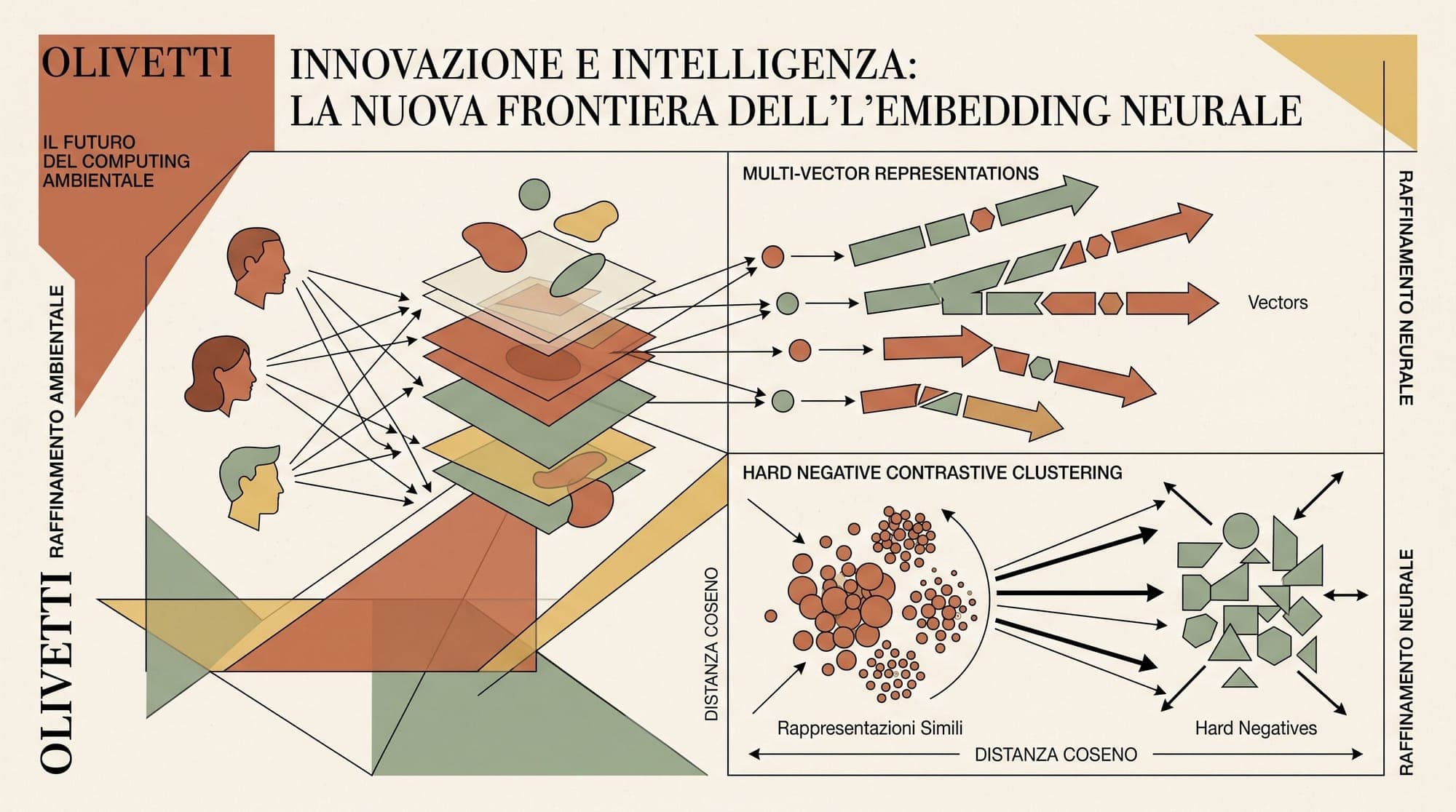
Effective fine-tuning requires hard negatives: passages that share vocabulary, formatting, or topical category with the query but do not contain the target answer.
Mining Architecture:

  [Generated Query]
          |
          +---> Lexical Index (BM25) ----------> Mined Candidates (Lexical)
          |
          +---> Dense Retriever (Baseline) ----> Mined Candidates (Dense)
          |
          v
  [Candidate Union Pool (Top-50)]
          |
          v
  [Cross-Encoder Scoring] ---> Filter false negatives: Keep 0.20 <= s_ce <= 0.65
          |
          v
  [Final Triplet: (Query, Positive Passage, Mined Hard Negatives)]
1. Lexical Hard Negatives (BM25)
BM25 hard negative mining retrieves passages that share high term overlap with the query but lack semantic alignment. For example, if the query is "How to configure JWT expiry in Envoy", a BM25 hard negative might be a chunk discussing "How to configure JWT claims in Kong". This forces the bi-encoder to learn fine-grained token relationships rather than relying on naive keyword counting.
2. Dense Hard Negatives (Cross-Encoder Filtered)
Dense hard negative mining uses the baseline embedding model to retrieve nearest neighbors. However, dense retrieval frequently surfaces false negatives: passages that actually answer the query but were not labeled as the primary positive.
Treating a valid answer as a negative penalizes correct model predictions and degrades embedding quality. To prevent this, candidate negatives must pass through a cross-encoder score filter:
Candidates scoring above (typically 0.70 on normalized cross-encoder scales) are discarded as potential false negatives. Candidates scoring below 0.20 are discarded as trivial negatives.
Contrastive Loss Objectives
Once triplets are assembled, the bi-encoder is trained using contrastive objectives.
Multiple Negatives Ranking Loss (MNRL)
Multiple Negatives Ranking Loss (MNRL) optimizes the InfoNCE objective over in-batch samples and explicit hard negatives. Given a mini-batch of pairs where each sample contains anchor , positive , and explicit hard negatives , the loss is formulated as:
Here, is a learnable or fixed temperature parameter (commonly set to , corresponding to a scale multiplier of ). The denominator sums over the true positive, all in-batch positives from other queries (), and all mined hard negatives ().
Cross-Encoder Distillation via MarginMSE
Rather than enforcing binary cross-entropy labels ( for positive, for negative), MarginMSE Loss distills continuous score margins from a teacher cross-encoder into the student bi-encoder:
MarginMSE eliminates discrete thresholding errors and teaches the bi-encoder relative distance preservation across fine-grained semantic distinctions.
Matryoshka Representation Learning (MRL)
To support variable vector dimensions and reduce vector database storage costs, fine-tuning should integrate Matryoshka Representation Loss. MRL evaluates the contrastive loss simultaneously across nested embedding slices :
This forces the model to compress the most critical variance into earlier dimensions, allowing production systems to truncate embeddings by 75% at search time with minimal accuracy degradation.
Memory Scaling with Gradient Caching (GradCache)
Contrastive learning quality scales with batch size . However, loading large batches with long sequence lengths (e.g., 512 tokens) and multiple hard negatives quickly causes GPU Out-of-Memory (OOM) errors.
GradCache (CachedMultipleNegativesRankingLoss) decouples the contrastive loss computation from neural network forward-backward memory graphs:
- Sub-batch Forward Pass: The model processes small mini-batches without retaining activation graphs, computing and caching only the final normalized representation vectors.
- Global Loss & Gradient Computation: The contrastive loss is evaluated across the aggregated cached vectors, producing gradients with respect to the embedding representations: .
- Sub-batch Backward Pass: Mini-batches are re-executed through a forward pass with activations tracked, and representation gradients are backpropagated into model parameters.
GradCache enables effective batch sizes of on single commodity GPUs with an approximate 20% compute time overhead.
Production Implementation with SentenceTransformers v3
The following script implements end-to-end domain adaptation using sentence-transformers v3, combining CachedMultipleNegativesRankingLoss, MatryoshkaLoss, and LoRA parameter-efficient adaptation.
import torch
from datasets import Dataset
from peft import LoraConfig, TaskType, get_peft_model
from sentence_transformers import (
    SentenceTransformer,
    SentenceTransformerTrainer,
    SentenceTransformerTrainingArguments,
)
from sentence_transformers.losses import (
    CachedMultipleNegativesRankingLoss,
    MatryoshkaLoss,
)
from sentence_transformers.training_args import BatchSamplers

# 1. Base Model & LoRA Configuration
base_model_name = "BAAI/bge-base-en-v1.5"
model = SentenceTransformer(base_model_name)

# Apply LoRA to retain general semantic capabilities while adapting domain weights
lora_config = LoraConfig(
    r=32,
    lora_alpha=64,
    target_modules=["query", "key", "value", "dense"],
    lora_dropout=0.05,
    bias="none",
    task_type=TaskType.FEATURE_EXTRACTION,
)
model = get_peft_model(model, lora_config)

# 2. Training Data Format: (anchor, positive, hard_negative_1, hard_negative_2)
train_records = [
    {
        "anchor": "How to configure gRPC client keepalive parameters?",
        "positive": "In gRPC, configure keepalive via ClientParameters: set keepalive_time_ms to 30000 and keepalive_timeout_ms to 10000.",
        "negative": "HTTP/2 ping frames are supported in Envoy by setting the idle_timeout parameter on downstream connections.",
    }
    # Load remaining mined triplets from production dataset
]
train_dataset = Dataset.from_list(train_records)

# 3. Loss Architecture: Matryoshka-wrapped Cached Multiple Negatives Ranking Loss
inner_loss = CachedMultipleNegativesRankingLoss(
    model=model,
    mini_batch_size=32,  # Sub-batch size fitted to physical VRAM
    scale=20.0,          # Temperature inverse (1 / 0.05)
)

matryoshka_dimensions = [64, 128, 256, 512, 768]
loss_func = MatryoshkaLoss(
    model=model,
    loss=inner_loss,
    matryoshka_dims=matryoshka_dimensions,
)

# 4. Training Arguments & Optimization
training_args = SentenceTransformerTrainingArguments(
    output_dir="./fine_tuned_embedding_model",
    num_train_epochs=3,
    per_device_train_batch_size=256,  # Virtual batch size across GradCache
    gradient_accumulation_steps=1,
    learning_rate=2e-4,              # LoRA LR (use 2e-5 for full fine-tuning)
    warmup_ratio=0.1,
    fp16=True,
    logging_steps=10,
    save_strategy="epoch",
    evaluation_strategy="no",
    batch_sampler=BatchSamplers.NO_DUPLICATES,
)

trainer = SentenceTransformerTrainer(
    model=model,
    args=training_args,
    train_dataset=train_dataset,
    loss=loss_func,
)

trainer.train()
model.save_pretrained("./fine_tuned_embedding_model/final")
Mitigating Catastrophic Forgetting
Fine-tuning solely on a narrow in-domain dataset can cause representation collapse, where the model loses its ability to distinguish general linguistic structures or handle diverse query phrasing.
Production training recipes apply three mitigation strategies:
- Replay Corpus Mixing (80/20 Rule): Mix in-domain synthetic triplets (80%) with general retrieval pairs from standard benchmarks like MS MARCO or Natural Questions (20%).
- Parameter-Efficient Adaptation (LoRA): Training Low-Rank Adaptation matrices ( or ) on projection layers freezes the underlying pre-trained base weights, preserving fundamental language representations.
- Weight Regularization and Early Stopping: Implement strict early stopping based on NDCG@10 evaluations against a held-out gold test set, applying weight decay () to prevent parameter divergence.
Model Export and Serving Optimization
Once fine-tuning completes, the adapter weights should be merged and converted for low-latency inference. Serving raw PyTorch models introduces high per-token latency and memory overheads.
- Merge LoRA Adapters: Merge low-rank matrices into the base transformer layers using PEFT's
merge_and_unload(). - ONNX Runtime / TensorRT Optimization: Export the model to ONNX with graph simplifications (fused LayerNorm and Multi-Head Attention kernels).
- Hugging Face Text Embeddings Inference (TEI): Deploy the compiled model in Hugging Face TEI, which provides continuous batching, FlashAttention-2 execution, and dynamic token padding.
- Vector Quantization: Quantize output embeddings to INT8 or FP8. When combined with Matryoshka dimensions (e.g., 256d INT8 vs 768d FP32), index memory consumption drops by up to 12x while preserving over 96% of full-precision retrieval recall.
Sources
- BEIR: A Heterogeneous Benchmark for Zero-shot Evaluation of Information Retrieval Models
- GPL: Generative Pseudo-Labeling for Unsupervised Domain Adaptation of Dense Retrieval
- Scaling Deep Contrastive Learning Batch Size under Memory Constraints (GradCache)
- Matryoshka Representation Learning
- Improving Efficient Neural Ranking Models with Cross-Architecture Knowledge Distillation
- Sentence Transformers Documentation: Losses and Domain Adaptation
- Hugging Face Text Embeddings Inference



