
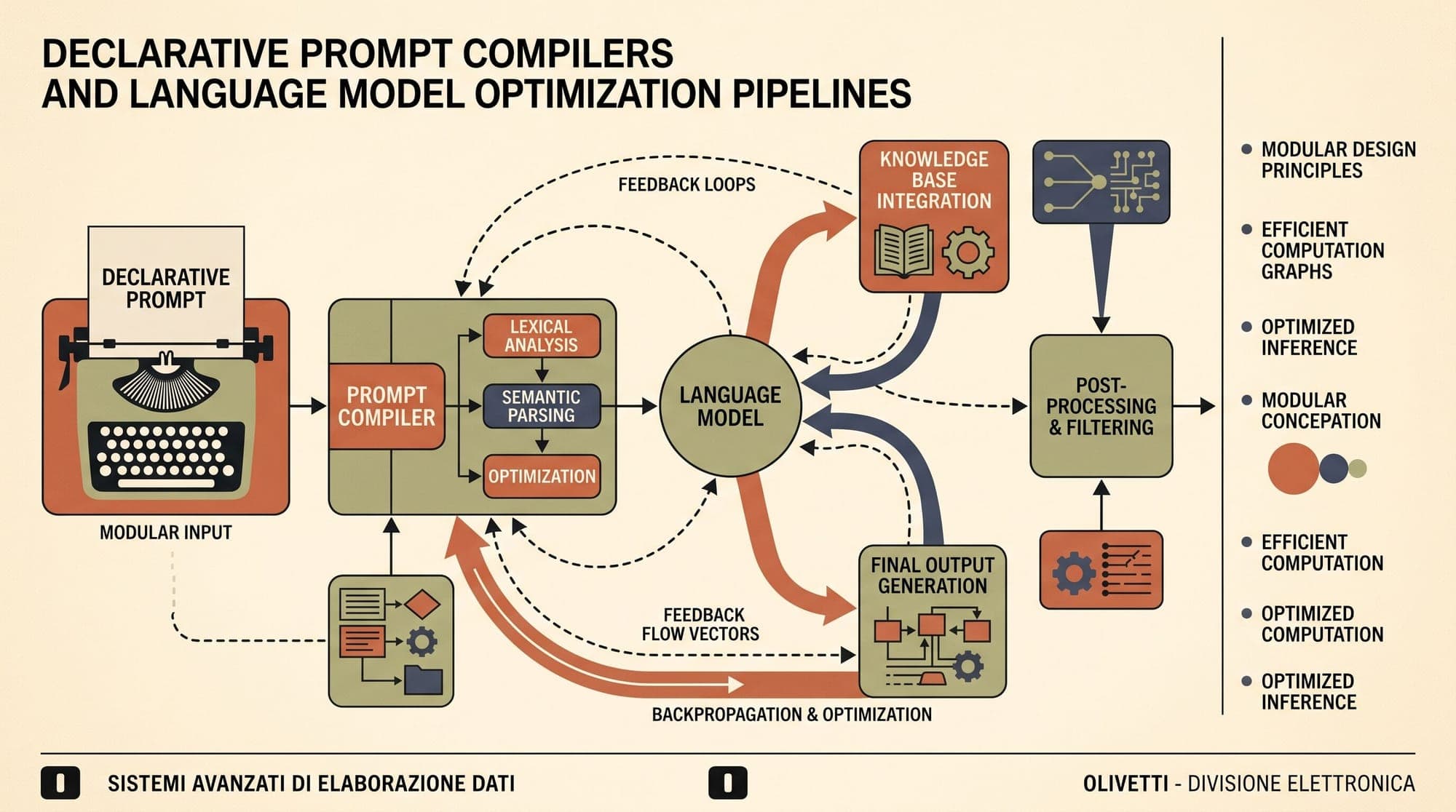
Production AI applications are rapidly moving away from hardcoded prompt strings and manual trial-and-error tweaking. As language model systems expand into multi-stage pipelines, retrieval-augmented generation (RAG) graphs, and multi-agent loops, manual prompt adjustments fail to scale. Changing a system prompt or upstream retrieval format frequently degrades downstream extraction, reasoning, or tool-calling performance.
To resolve this fragility, the industry is adopting declarative prompt optimization and LLM compiler frameworks. These systems separate the declarative specification of an LLM program (signatures, input/output types, and workflow graphs) from its runtime execution parameters (instructions, few-shot demonstration exemplars, dynamic prefixes, and model assignments). Instead of requiring engineers to hand-craft instructions, prompt compilers automatically search, refine, and compile optimal prompt parameters against quantitative evaluation metrics.
Four primary frameworks define the current state of declarative prompt optimization in production: DSPy from Stanford NLP, TextGrad from Stanford University, SAMMO from Microsoft Research, and AdalFlow from SylphAI. While all four automate prompt refinement, they rely on fundamentally different mathematical and architectural paradigms, spanning discrete combinatorial search, textual gradient backpropagation, symbolic syntax tree mutations, and unified autograd runtimes.

Core Architectural Paradigms
DSPy: Modular Signatures and Teleprompter Compilation
Introduced by Stanford NLP in Compiling Declarative Language Model Calls into State-of-the-Art Pipelines, DSPy reframes prompt engineering as a compiler problem inspired by PyTorch and classical programming languages.
DSPy structures LLM applications around three core abstractions:
- Signatures: Declarative specifications that define the input fields, output fields, and task intent without dictating exact prompting language (for example,
question -> answerorcontext, query -> rationale, response). - Modules: Composable building blocks that encapsulate prompting techniques over signatures, including
dspy.Predict,dspy.ChainOfThought,dspy.ProgramOfThought, anddspy.ReAct. Modules can be nested into arbitrary multi-hop computation graphs. - Optimizers (Teleprompters): Algorithms that tune the parameters of a DSPy module (instructions and demonstration examples) to maximize a user-defined metric function over a training dataset.
DSPy provides several distinct optimizer classes:
- BootstrapFewShot: Generates candidate traces through the pipeline on unlabelled or training examples. Successful traces that pass metric validation are curated into few-shot demonstration pools.
- BootstrapFewShotWithRandomSearch: Extends bootstrapping with randomized combinatorial search over subsets of candidate demonstrations, evaluating validation split performance.
- MIPROv2 (Multi-prompt Instruction PRoposal Optimizer): A Bayesian optimization engine that simultaneously proposes and tunes both candidate instruction strings and demonstration sets across multi-stage modules.
- COPRO and SIMPRO: Iteratively generate instruction candidates via LLM reflection and coordinate ascent over prompt candidates.
DSPy also introduces runtime LM Assertions (dspy.Assert and dspy.Suggest), which dynamically intercept invalid model outputs during execution, append correction guidelines to the prompt context, and trigger targeted retries without halting the pipeline.
TextGrad: Backpropagation via Natural Language Feedback
Published in Nature and on arXiv:2406.07496 by researchers at Stanford University, TextGrad implements an automatic differentiation engine where the backpropagated signals are textual feedback (critiques, diagnostic evaluations, and improvement directions) rather than numerical gradients.
TextGrad mirrors PyTorch's execution model:
- Variables: Inputs, system prompts, code snippets, intermediate reasoning steps, and final outputs are wrapped as
Variable(value, requires_grad=True). - Computation Graphs: When variables pass through LLM calls, tool executions, or deterministic transformations, TextGrad records an execution DAG.
- Loss Functions: Objective functions are defined as natural language evaluation modules (
TextLoss), which evaluate outputs against test rubrics, ground-truth targets, or constraint checkers. - Backward Pass (
loss.backward()): TextGrad traverses the computation graph in reverse topological order. For each node, an LLM critiques how that node's value contributed to errors in its downstream consumers, computing a natural language gradient (var.grad). - Textual Optimizers (
TextualGradientDescent/ TGD): An optimizer module takes the accumulated textual gradients and produces an updated text variable, incorporating past momentum and update constraints.
Beyond prompt tuning, TextGrad's instance-level optimization allows it to backpropagate directly into code generation, reasoning chains, and molecular structures.
SAMMO: Symbolic and Structural Metaprompt Optimization
Developed by Microsoft Research and published in EMNLP Findings, SAMMO (Structure-Aware Multi-Objective Metaprompt Optimization) treats prompts as executable programs represented as Abstract Syntax Trees (ASTs).
While DSPy focuses on module-level trace collection and TextGrad uses continuous textual feedback, SAMMO operates on the structural grammar of metaprompts. Prompts are constructed from modular AST components representing sections, instructions, few-shot examples, dynamic context containers, and output parsers.
Key architectural mechanics in SAMMO include:
- Structural Mutation Operators: Operators that programmatically alter the AST structure by pruning redundant components, reordering sections, compressing text, or swapping formatting styles (such as Markdown vs. JSON vs. XML).
- Instruction Rewriting: Localized semantic operators that mutate instruction phrasing, tone, and role definitions while preserving AST validity.
- Minibatching and Packing: Structural operators that pack multiple data samples into a single batched prompt call to amortize token overhead and reduce API round-trips.
- Multi-Objective Pareto Search: SAMMO optimizes simultaneously across competing objectives, searching for configurations that maximize task accuracy while minimizing prompt token length and API execution latency.
AdalFlow: PyTorch-Native Declarative Autograd
Developed by SylphAI, AdalFlow synthesizes the structural paradigms of PyTorch, DSPy, and TextGrad into a unified framework for building and auto-optimizing LLM pipelines.
AdalFlow adopts standard machine learning design patterns:
ComponentandSequential: Base classes for building modular pipelines, retrieval chains, and agentic workflows.Parameter: Explicitly tracks optimizable elements (instructions, demonstration sets, model hyperparameters) withinGeneratormodules.AdalComponentandTrainer: Modeled after PyTorch Lightning, providing structured training loops, train/val data loaders, validation checkpoints, and early stopping.- Dual Optimization Engine: AdalFlow supports both discrete demonstration bootstrapping (similar to DSPy) and Textual Gradient Descent (TGD, similar to TextGrad) with momentum-weighted textual gradients and Gumbel-Top-k exploration to prevent search stagnation.
Technical Comparison Across Dimensions
1. Optimization Mechanics and Search Strategy
- DSPy: Combines data-driven trace bootstrapping with discrete Bayesian optimization (MIPROv2) and coordinate search (COPRO). It optimizes prompts by discovering which concrete execution traces and high-level instructions yield the highest empirical score across a dataset.
- TextGrad: Implements backpropagation through an execution graph using natural language gradients. LLMs inspect intermediate outputs and loss evaluations to construct localized textual critiques that update upstream prompt variables.
- SAMMO: Uses symbolic AST program search over structural mutations, section reordering, dynamic few-shot pruning, and semantic paraphrasing, evaluated via beam search or greedy search with candidate pruning.
- AdalFlow: Unifies textual gradient descent with parameterized few-shot bootstrapping in a modular PyTorch-like execution graph, supporting both continuous-style textual updates and discrete exemplar curation.
2. Multi-Stage Pipeline and Latent Step Optimization
- DSPy: Native support for multi-stage pipelines (such as multi-hop RAG and ReAct loops). Bootstrappers trace inputs through all intermediate modules, validating whether intermediate rationales and sub-queries contribute to the final metric score.
- TextGrad: Excels at multi-stage graph optimization via backward chain rules. Textual gradients propagate backward through intermediate LLM calls, attributing specific failure modes to intermediate nodes.
- SAMMO: Optimized primarily for metaprompt structures and RAG pipeline configurations; requires explicit AST definition for complex multi-agent graphs.
- AdalFlow: Deep multi-stage support via PyTorch-style computational graphs where each intermediate
Generatorparameter can accumulate textual gradients or bootstrap demonstration traces.
3. Compilation Cost and API Token Budgets
- DSPy: Moderate to high compilation cost.
BootstrapFewShotrequires relatively few API calls (proportional to dataset size), whereasMIPROv2evaluates dozens of instruction and demonstration candidates across training splits, requiring hundreds of model evaluations during compilation. - TextGrad: High token overhead during optimization. Each backward step requires dedicated LLM calls to compute textual gradients for every active variable in the graph, followed by an optimizer call to synthesize updates.
- SAMMO: Moderate token overhead. Employs candidate pruning, cached evaluation, and minibatch sample packing to minimize redundant LLM calls during structural search.
- AdalFlow: Configurable token budget. Supports fast few-shot sampling or full textual gradient descent with validation tracking and early stopping.
4. Cross-Model Portability
- DSPy: High portability. Program signatures remain constant; switching backends from a frontier model (such as GPT-4o or Claude 3.7) to a compact open-weight model (such as Llama 3.3 70B or Qwen 2.5 7B) requires re-running the compiler to generate model-specific instructions and demonstration pairs.
- TextGrad: Prompts and solutions can be optimized specifically for any model by running TextGrad with that model as the execution engine, though textual gradient synthesis typically benefits from stronger evaluator models.
- SAMMO: High structural portability. Mutated AST configurations and prompt compressions generalize well across model families of varying parameter scales.
- AdalFlow: High portability. Parameterized templates and generators can be compiled independently for diverse local and cloud backends.
Production Trade-Offs and Engineering Guidelines
When deploying declarative prompt optimization frameworks into production engineering workflows, consider the following trade-offs:
Compile-Time Cost vs. Runtime Latency
Prompt compilation shifts engineering effort and LLM token consumption from runtime trial-and-error to offline compilation. Once a prompt or pipeline is compiled in DSPy, SAMMO, or AdalFlow, the resulting artifacts are static, optimized prompts or frozen few-shot demonstration sets. At inference time, there is zero framework overhead beyond the standard token cost of the compiled prompt.
TextGrad can operate either as an offline prompt compiler or as an online instance-level optimizer (iteratively refining complex code or medical reasoning at test time), which incurs substantial runtime latency.
Metric Design and Evaluator Stability
The quality of compiled prompts depends directly on the stability and sensitivity of the metric function.
- Boolean metrics (exact string match or regex validation) provide clear binary feedback but can suffer from sparse gradients in continuous search spaces.
- LLM-as-a-judge metrics provide nuanced multi-criteria scoring but introduce evaluation variance. When using subjective metrics with MIPROv2 or TextGrad, pin evaluation models to deterministic settings (temperature 0) and use structured criteria rubrics.
Dataset Requirements
- Bootstrapping (DSPy, AdalFlow): Requires 50 to 300 representative input-output pairs. Unlabelled inputs can be used if an automated validation metric (e.g., code execution or assertion passing) can filter successful traces.
- Textual Gradient Descent (TextGrad, AdalFlow): Can optimize with smaller sample sets (10 to 50 detailed examples) because each sample generates rich diagnostic critique tokens.
- Structural Search (SAMMO): Effective on small-to-medium datasets (20 to 100 samples), especially when compressing prompts to reduce inference token bills.
Decision Matrix: Choosing the Right Framework
- Choose DSPy when building complex multi-hop RAG systems, multi-agent workflows, or pipelines that require modular signatures, dynamic assertions, and automated bootstrapping of few-shot demonstrations across different model tiers.
- Choose TextGrad when optimizing non-text artifacts (such as synthetic code generation, chemistry/molecular representations, or mathematical proofs), or when you need deep diagnostic backpropagation through multi-step computational graphs.
- Choose SAMMO when the primary objective is prompt compression, structural metaprompt refactoring, minibatch data packing, or multi-objective Pareto trade-off analysis (accuracy vs. token cost).
- Choose AdalFlow when your team standardizes on PyTorch-like patterns, requiring a unified autograd environment that combines modular component pipelines with both textual gradient descent and few-shot trace optimization.
Sources
- DSPy: Compiling Declarative Language Model Calls into State-of-the-Art Pipelines (arXiv:2310.03714)
- TextGrad: Automatic Differentiation via Text (Nature 2025 / arXiv:2406.07496)
- Prompts As Programs: A Structure-Aware Approach to Efficient Compile-Time Prompt Optimization (SAMMO / arXiv:2404.02319)
- Stanford NLP DSPy Framework Repository
- Stanford Zou Group TextGrad Repository
- Microsoft Research SAMMO Repository
- SylphAI AdalFlow Auto-Optimization Library



