
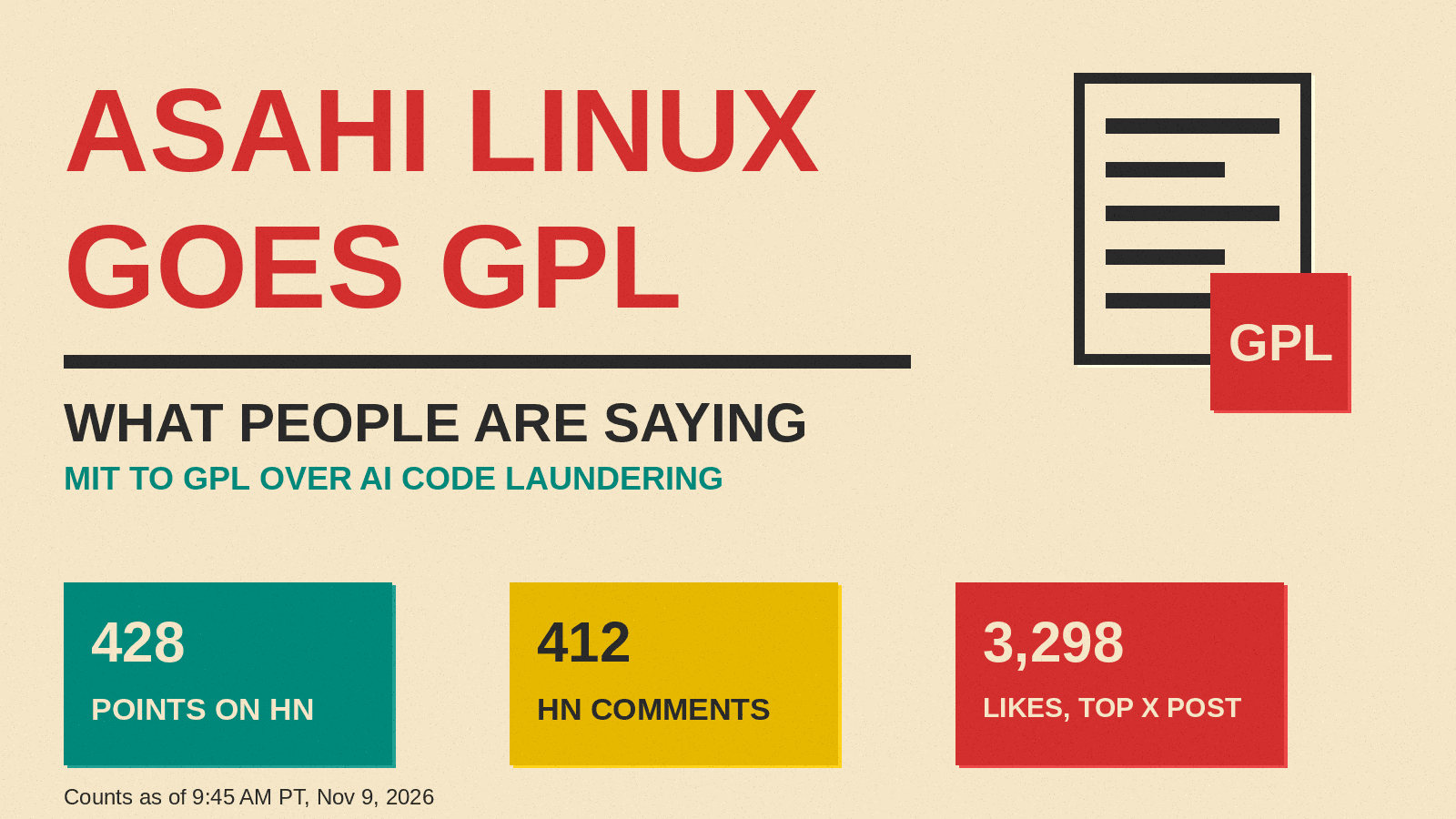
Asahi Linux, the volunteer project that gets Linux running on Apple Silicon Macs, is moving all of its code from the permissive MIT license to the GPL. The reason it gave is new: people lifted its unreleased code and, in some cases, rewrote it with AI tools to hide where it came from. The reaction on X and Hacker News split three ways, and much of it ran through Omarchy, the MIT-licensed Linux distribution from David Heinemeier Hansson (DHH).
Counts below are as of 9:45 AM PT on Nov 9, 2026.
What did Asahi Linux announce?
The news sat at the end of the project's Linux 7.3 progress report, written by James Calligeros and dated Nov 7. Two terms help here, in It's FOSS's summary. The MIT license only asks users to keep the original copyright notice, so the code can end up in closed products. The GPL is a "copyleft" license: anyone who distributes a modified version has to release the source under the same license.
The report says Asahi chose MIT so the BSDs and other free operating systems could reuse its work. Then: "Unfortunately, this is no longer viable." It says the team learned of "multiple attempts to exploit our permissive licensing to hijack our work, with a direct view to replacing the project and aggressively monetising Linux on Apple Silicon." And: "In some extreme cases, in-development feature code was being lifted straight out of our personal forks and published without attribution or lazily rewritten with LLM assistance to obfuscate its origin."
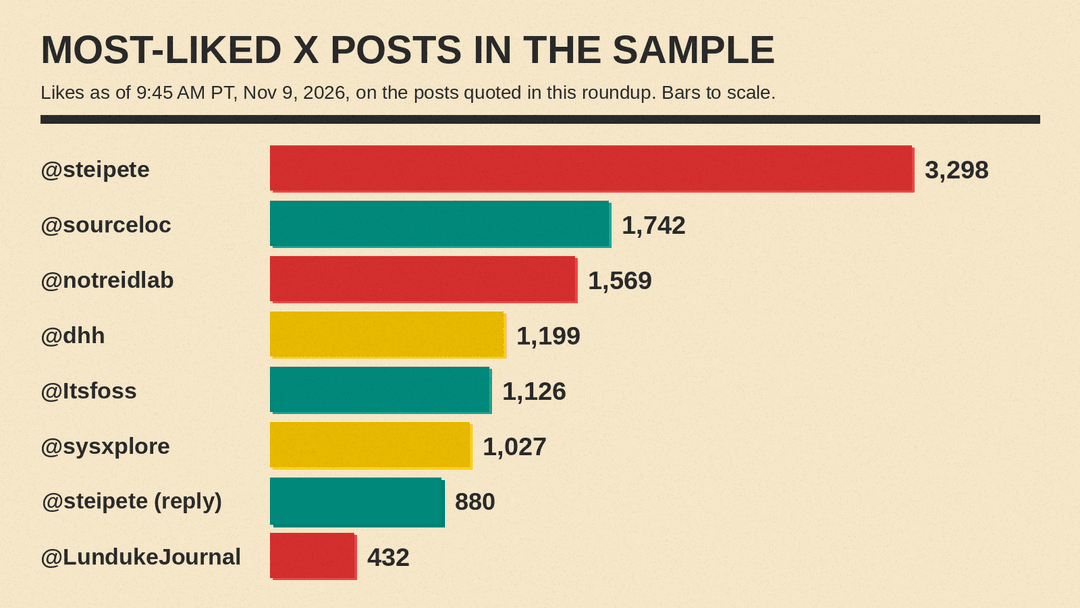
@sysxplore spread the news early with a summary that opens "Asahi Linux is moving everything from the MIT licence to GPLv2-or-later" (1,027 likes).
That last practice is what people call code laundering: passing code through a rewrite so its origin and license are hidden. The report says this was driven in large part by "the insatiable appetite of frontier AI labs for high-quality training data, and militant animosity toward the Free Software community." It points to WINE, which moved from MIT to the LGPL in 2002 to stop proprietary forks, and says the team will "begin the process of transitioning all of our repositories to the GNU General Public License version 2 or later."
Asahi named no project or company. It's FOSS notes that, and that the report does not say how existing contributions will be relicensed. It lists two AI-assisted forks (Aurora Silicon's Borealis Vulkan driver and Gravity Linux) as context only, and says the report mentions neither.
Why are Omarchy fans upset?
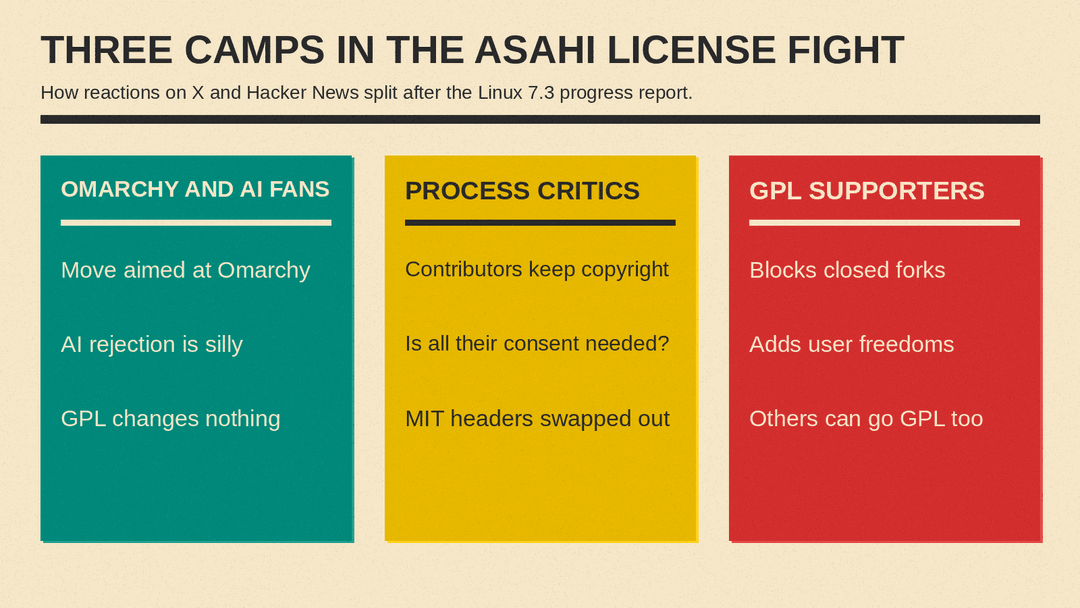
The timing drew the first wave. @sourceloc (1,742 likes) posted a two-line meme, "Omarchy releases support for ARM Macs" then "2 days later Asahi Linux conveniently switches to GPL license", and added: "rather than improve the project, they sabotage the one that’s actually moving. stagnant for years and still acting like someone cares." @notreidlab quoted it with a 6-second video and a mocking edit that swaps the word Omarchy for a joke web address (1,569 likes).
The most-liked post we found came from @steipete, Peter Steinberger, whose bio lists OpenClaw and OpenAI (3,298 likes): "The Asahi project was all about taking something closed and restricted and opening it up. Adding new restrictions that make it harder for other projects to build on that is not the way. And that AI rejection is just silly." In a reply (880 likes), Steinberger wrote: "That sure aint the reason they moved to GPL days after Omarchy integrated and credited a bunch of Asahi’s work."
DHH played it down. "Asahi changing to GPLv2 changes nothing, btw," @dhh wrote (1,199 likes), noting that the Linux kernel is already GPLv2. "We make all the source changes we have against the Linux kernel available, as we do with anything based on Asahi. Omarchy itself is MIT, the most permissible license."
That left people asking what the fight was about. @OiMauricioGomes replied to Steinberger: "How does this impact Omarchy, though? The kernel is under the same license." @Itsfoss (1,126 likes) asked the same: "How does it impact Omarchy negatively?" @outlineaddict replied that it does not: "The license change just tries to prevent Omarchy / Aurora from using Asahi work downstream since they'd have to relicense from MIT to GPL to do it." The same post adds: "O/A doesn't need Asahi anymore, so the issue is moot in practice."
Was it aimed at Omarchy?
On Hacker News, the main thread on the progress report has 428 points and 412 comments. A second thread on the It's FOSS write-up has 63 points and 29 comments.
aroman asked early: "Is this referring to Omarchy? Anyone have context? TBH I'm surprised their work was ever MIT-licensed instead of GPL." Hacker News user ADevWithAnIdea replied to a commenter who doubted it was Omarchy: "They're referring to Omarchy, it's very clear on their IRC." That IRC claim is unverified here: we could not confirm it, and Asahi's public report names no project or company.
The AI question sits underneath. porphyra wrote: "The whole reason why people are trying to replace them is because they have stubbornly refused to use AI, which has directly impeded progress in getting M3/M4/M5/M6 working." Hacker News user cromka criticized Omarchy's patches in another subthread: "No one consciously designs anything in their code, it's all LLM output." In the same comment, cromka wrote of Omarchy's Touch ID code: "I personally vetted that TouchID code you mentioned and it's an absolute hellhole." That is cromka's opinion about the code, not a finding we verified.
Does Asahi need every contributor's consent?
This is the second camp. Asahi's copyright policy says it asks for no contributor agreement or copyright assignment: "You retain all copyright ownership of any code you write."
@canadianbryan, Bryan Steele, an OpenBSD developer according to It's FOSS, wrote that Asahi is "stripping any mention of MIT license from them individual files, adding a GPL-2.0-or-later SPDX marker", linked an m1n1 commit, and added: "Unless you have permission from all past contributors, this kind of "relicensing" is verboten", followed by a ruder remark. (m1n1 is Asahi's bootloader, which OpenBSD's Apple Silicon support uses.) It's FOSS quotes another Steele post calling the move "entirely disingenuous and misguided."
@LundukeJournal (432 likes) argued: "This sort of licensing change requires the consent of every copyright holder (aka developer) on every component which Asahi wishes to re-license."
Others say MIT already allows it. @trbutler replied: "No, it does not require consent -- that's the whole point of the MIT license; changing FROM the GPL would require consent." @McLeanBen drew the line this way: "Asahi absolutely cannot revoke the MIT license for all past code. But they absolutely can say that all commits past the license change are now GPL and that the version they're now distributing is GPL." This is a dispute among commenters. None of the posts quoted here cites a court ruling or a lawyer, it is not a settled legal answer, and Asahi has not addressed it in the report.
Does the GPL stop AI code laundering?
The commenters quoted here doubt it. phendrenad2 disputed the report's reading of MIT: "MIT requires that the license text be included." On AI rewrites, the same comment says: "But GPL won't save you from that." It does grant that the GPL can block "scammers who want to make closed-source forks and charge money for them." wmf replied to that point: "I've yet to see evidence that this is real."
snvzz predicted: "There will still be AI rewrites of their work, but they will no longer give Asahi any attribution." In a later comment, snvzz pointed to AI coding agents: "This has always been true, but recreating has become easier through agentic programming tools, upsetting the balance."
WhyNotHugo worried about the cost to other free projects: "proprietary platforms will just regurgitate it with LLMs, but other open ecosystems will have to re-invent things from scratch." jlundberg, who describes themselves as a "(tiny) financial supporter", wrote: "Will probably be a road block for *BSD and other bare metal experiments on Apple Silicon."
habitue saw a mismatch between problem and fix: "In this case, it seems to be a random unrelated action they've taken to the problem they identified."
What do supporters say?
The third camp backs the switch. skywhopper wrote: "GPL is more realistic about the motives of much of the tech world, and in practice is much more encouraging of collaborative, open, and free software development." palata pointed out that the copying Asahi described already breaks MIT: "Permissive licences require attribution. It's okay to complain when people publish your permissively-licenced work without attribution, and hence without honouring the licence."
To mythz, who wrote "You cannot exploit permissive licensing when its entire purpose is to encourage others to use it," guax replied: "The way you can exploit an open license is to grab the code, invest massive amounts of resources in it and close the platform."
On X, @ananthbh replied to Steinberger: "The GPL is about adding user freedoms. If projects want Asahi code so bad, they are welcome to relicense to GPL and grant users even more freedom."
Why it matters
It's FOSS calls this, as far as its writer can tell, the first time a major open source project moved to copyleft specifically because of AI-assisted code laundering. The thread shows the limits of that defense. Commenters quoted here, including phendrenad2 and snvzz, say a license cannot stop a determined AI rewrite, and It's FOSS agrees. What the GPL changes, in It's FOSS's reading, is that anyone who distributes a modified version has to release its source. Whether that protects Asahi, or mainly pushes BSD and other permissive projects away, is the open question. Asahi has not yet said how the transition will handle past contributions.
Sources
- Asahi Linux: Progress Report: Linux 7.3
- Asahi Linux: Copyright policy
- It's FOSS: Asahi Linux Drops MIT and Goes Full GPL
- AsahiLinux/m1n1 commit ce2b8a4
- Hacker News: Asahi Linux Progress Linux 7.3
- Hacker News: Asahi Linux Drops MIT, Goes Full GPL
- @sysxplore on X
- @sourceloc on X
- @notreidlab on X
- @steipete on X
- @steipete reply on X
- @dhh on X
- @OiMauricioGomes on X
- @Itsfoss on X
- @outlineaddict on X
- @canadianbryan on X
- @LundukeJournal on X
- @trbutler on X
- @McLeanBen on X
- @ananthbh on X
