
Alibaba has cleared a key step toward a separate stock listing for T-Head, its in-house chip design unit. In a Hong Kong Stock Exchange filing dated November 10, 2026, Alibaba said the exchange "has confirmed that the Company may proceed with the Proposed Spin-off" of T-Head and a listing of its H shares on the Main Board in Hong Kong.
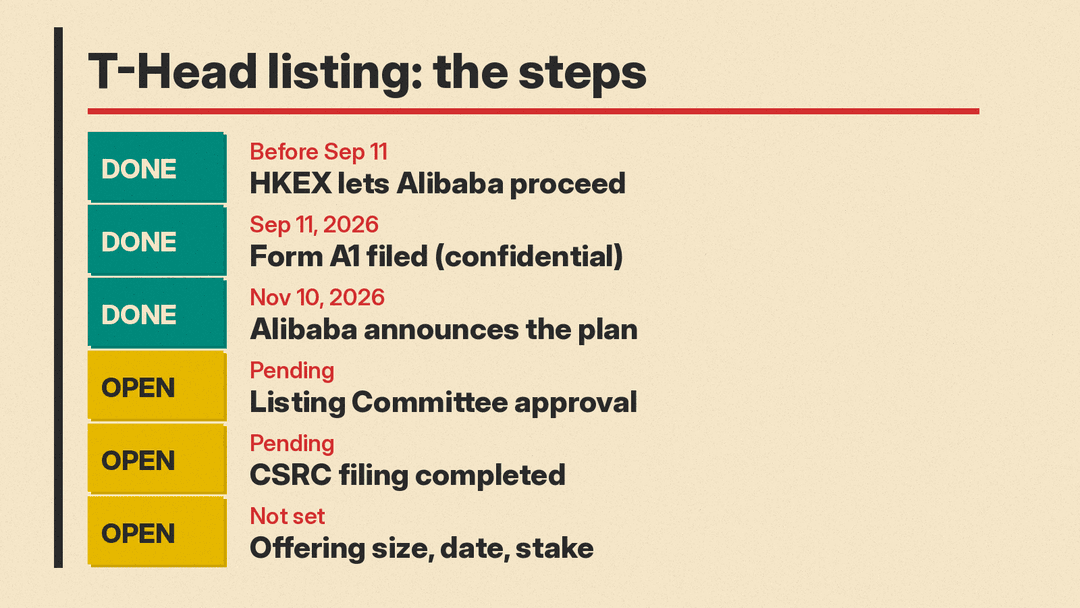
The exchange gave that confirmation before September 11, 2026, the filing indicates: "therefore, on September 11, 2026," T-Head filed its listing application (Form A1) on a confidential basis. That was 60 days before Alibaba made the plan public.
No date, deal size or valuation was given. The filing says the size and structure of the offering "have not yet been finalized."
What Alibaba announced
According to the filing:
- T-Head (Shanghai) Technology Co., Ltd. is a wholly owned Alibaba subsidiary. Alibaba describes it as "a leading provider of full-stack data center chips which enable system-level compute solutions in China."
- The listing would be a global offering of T-Head H shares, made up of a Hong Kong public offering and a placing with institutional and professional investors.
- Alibaba expects T-Head to remain a subsidiary of the company after the listing.
- The size and structure of the offering, and how much Alibaba's stake in T-Head will fall, are not yet set.
- The deal still needs approval from the exchange's Listing Committee, a completed filing with the China Securities Regulatory Commission (CSRC), and final decisions by Alibaba and T-Head. Alibaba wrote that "There is no assurance that the Proposed Spin-off will take place or as to when it may take place."
CNBC reported that Alibaba's Hong Kong-listed shares traded 1% lower on Wednesday morning after the news.
Why Alibaba says it wants to spin off T-Head
The filing lists four reasons. In Alibaba's words, the spin-off:
- "should enable investors to better assess and value Alibaba's Retained Group business"
- "could better reflect the value of the T-Head Group on its own merits"
- "may attract investors seeking dedicated exposure to its business"
- would let T-Head "directly and independently access both equity and debt capital markets in the future on a standalone basis should the need arise"
Alibaba also says a listing would "enhance T-Head's standalone profile among its customers, suppliers and potential strategic partners."
In plain terms: a separate listing would put a price on the chip unit by itself and give T-Head its own access to equity and debt markets.
No guaranteed shares for Alibaba shareholders
Hong Kong spin-off rules (Practice Note 15) normally require a parent company to give its existing shareholders an "assured entitlement" to shares in the spun-off unit. Alibaba asked for a waiver from that rule, and the filing says the exchange granted it.
Alibaba gave several grounds. One is that giving the entitlement would mean T-Head must run a public offering in the United States and file a registration statement with the SEC, which the filing calls "unduly burdensome." Another is PRC legal and operating limits on T-Head, a company set up under Chinese law. The filing also says the spin-off "is insignificant to the Company and its Shareholders with reference to the Company's total assets, revenue and net income."
So, unless plans change, Alibaba shareholders will not get a reserved slice of T-Head shares.
What T-Head makes
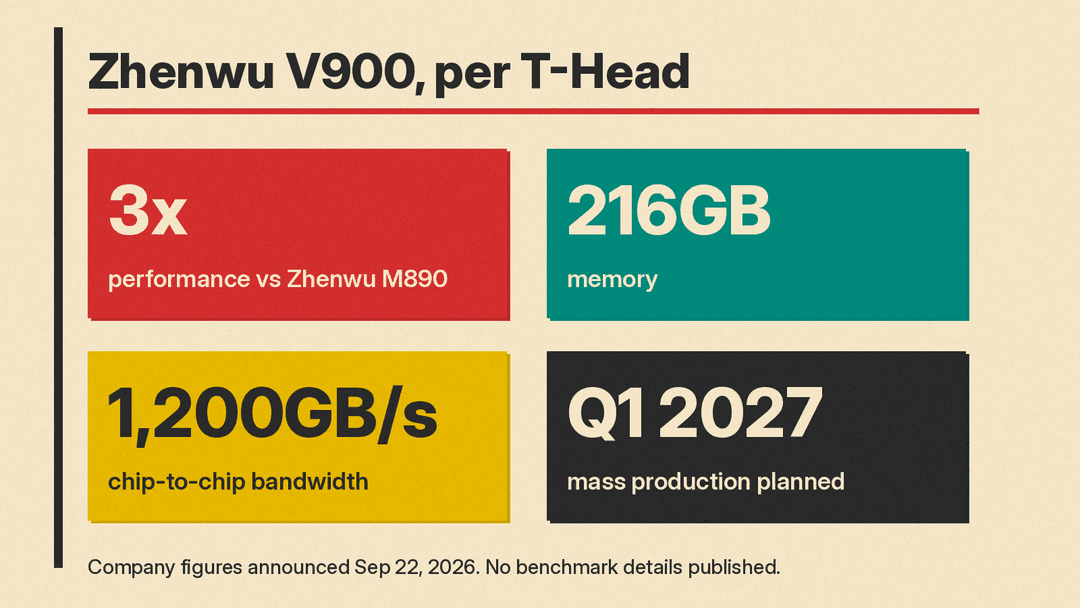
T-Head is Alibaba's chip design unit. At Alibaba Cloud's Apsara Conference on September 22, 2026, T-Head unveiled the Zhenwu V900, a chip for AI training and inference. TechNode reported these company figures for the V900:
- Three times the performance of its predecessor, the Zhenwu M890, per T-Head
- 216GB of memory
- 1,200GB/s of chip-to-chip bandwidth
- Native support for FP8 and FP4 low-precision formats
- Mass production and sales expected in the first quarter of 2027
CNBC reported in September that Alibaba said its existing Zhenwu chips were used by more than 650 customers across industries including automotive, finance, energy and manufacturing. Alibaba has not published the benchmark details behind the threefold claim, CRN Asia noted.
T-Head also makes Yitian server CPUs. Per TechNode, the Yitian 720 and Yitian 730 are scheduled to launch in the third quarter of 2027.
Why it matters
CNBC described Alibaba as "one of several Chinese companies, including Huawei, developing homegrown semiconductors to power artificial intelligence, amid growing U.S. restrictions on China's ability to access the chips." For the rules themselves, see our explainer on US AI chip export controls on China.
A separately priced T-Head would give investors a market value for Alibaba's chip unit on its own, which is the first reason Alibaba lists in the filing. Our guides to Alibaba's Qwen models and the Qwen4-Max preview cover the model side of the company.
The timing is not simple. CNBC reported that China's financial regulators "have increased their scrutiny on tech IPOs and the rush of capital into the sector" in recent months. CNBC also cited news reports this month that Baidu has delayed the listing of its AI chip unit Kunlunxin. The CSRC filing step means Beijing still has a say in whether and when T-Head lists.
What to watch
- Approval from the Hong Kong exchange's Listing Committee
- Completion of the CSRC filing
- A public prospectus, which would show T-Head's revenue, profit and customer figures for the first time
- The offering size, and how much of T-Head Alibaba keeps
Alibaba said it will make further announcements "as and when appropriate."
Sources
- Alibaba Group: Proposed spin-off and separate listing of T-Head (HKEX filing, Nov 10, 2026)
- CNBC: Alibaba announces plans to list T-Head (Nov 11, 2026)
- CNBC: Alibaba shares jump as new AI chip, data center buildout plans unveiled (Sep 22, 2026)
- TechNode: T-Head unveils Zhenwu V900 AI chip (Sep 22, 2026)
- CRN Asia: Zhenwu V900 to enter mass production in Q1 2027
