
Polls predict that Democrats will flip at least one chamber of Congress in the November midterms, The Verge reported on October 19. Senior policy reporter Lauren Feiner writes that a flip "would put committee leadership back in their hands" and "could usher in a wave of newfound scrutiny for AI companies." That poll claim is The Verge's. This post makes no prediction about the election.
This explainer covers what a majority controls under House and Senate rules and Congressional Research Service (CRS) reports, which members and committees the reporting and official documents name, and which AI companies and issues are in focus.
What The Verge reports
The Verge's central point is about agenda control. According to the article, "Top Democrats on key committees have already signaled their willingness to press the industry on tax credits tied to data centers and recent hacking incidents." If Democrats take over, The Verge writes, they "would be able to set committee agendas," which would allow them "to call CEOs to testify in Congress and demand documents that explain companies' inner workings."
The article also reports that:
- AI issues are already "taking a leading role in campaign ads," in particular data center development, which The Verge says has drawn residents "across the political spectrum to packed local meetings."
- President Donald Trump "has opposed most regulation of the technology in favor of an accelerationist approach," while public opinion polling (The Verge links Gallup and Pew Research Center) "has shown that Americans have widespread concerns" about AI's effect on jobs, education and other parts of life.
- "The direction and intensity of that oversight, though, is up for grabs," and early congressional proposals "have yet to gain broad consensus."
The Verge's named sources are Democratic strategists, not lawmakers. Jesse Lehrich, described as a Democratic strategist who previously ran a tech accountability advocacy group, said the issue is "a hundred percent ready for the taking," and added: "The question remains open as to whether Democrats are willing and able to seize that opportunity." Rob Flaherty, a former deputy campaign manager for Kamala Harris' presidential campaign, said that "for a long time, Democrats were afraid to talk about it."
The Verge text itself does not name a specific committee or lawmaker as a future chair. It links to two reports for its examples: a Politico item on Democratic tax writers and Meta, and a CNBC report on House Democrats who asked for testimony from AI CEOs.
What a majority controls: the rules
Most of the oversight power described in The Verge belongs to committees, and committees are run by the majority.
Where the power comes from
According to the CRS In Focus Congressional Oversight and Investigations (IF10015), no clause of the Constitution expressly grants oversight power, but the Supreme Court has held that the power is implied by Article I. CRS quotes Watkins v. United States: the "power of the Congress to conduct investigations is inherent in the legislative process." CRS calls the power to obtain information from the executive branch or the general public "very broad."
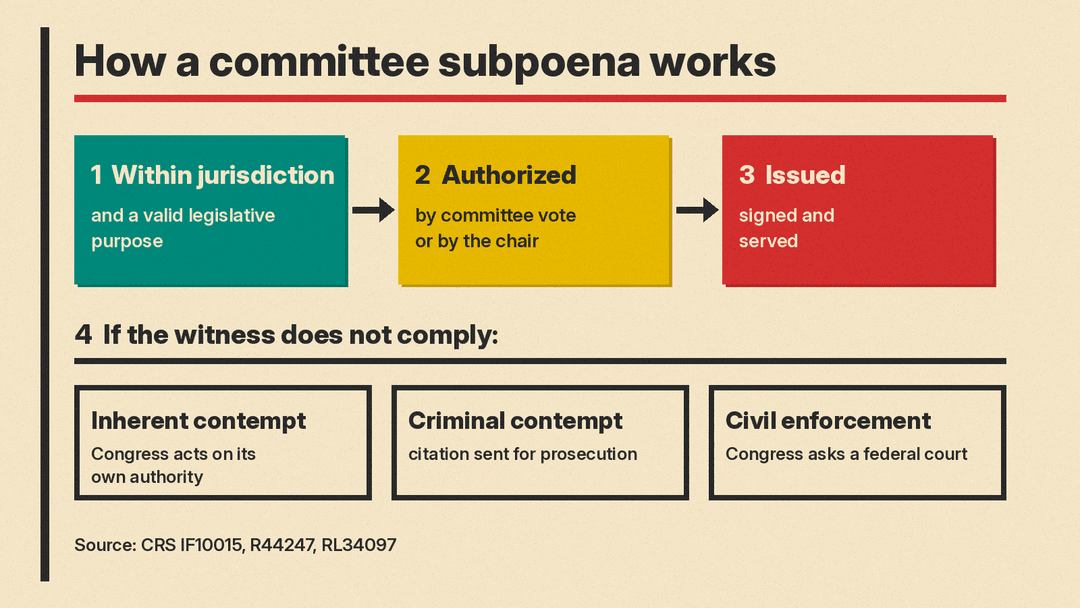
Each chamber delegates that power to its committees. According to CRS, a committee investigation must:
- be within the committee's jurisdiction as defined in House or Senate rules, and
- serve a valid legislative purpose.
Hearings and agendas
According to CRS, "Ranking members and individual Members (other than committee chairs) are not authorized by chamber or committee rules to initiate official committee hearings or investigations or issue subpoenas." Minority members have a limited right to call witnesses of their choosing at a hearing, and in House committees every member gets up to five minutes to question each witness.
This is why the August letter described below went to the Speaker. CNBC reported that the Democrats who signed it "have no power on their own to compel AI CEOs to come to testify on Capitol Hill."
Subpoenas
The CRS report A Survey of House and Senate Committee Rules on Subpoenas (R44247) sets out the base rules:
- House: Rule XI, clause 2(m) authorizes committees and subcommittees to subpoena witnesses and documents. A subpoena needs authorization by the committee or subcommittee, "a majority being present," but the committee may delegate the power to its chair.
- Senate: Rule XXVI, paragraph 1 authorizes committees and subcommittees to subpoena witnesses and documents. The rule adds no further detail on how.
Each committee then writes its own procedures. CRS summarizes the pattern: "In the House, almost all committees now empower their chairs to issue subpoenas, while in the Senate most committees require that the chair first obtain the consent of the ranking member." Committees adopt rules again in each new Congress, so the details can change.
The CRS survey quotes the rules of the 117th Congress (2021 to 2022) for committees that appear in this story. These are the rules as CRS recorded them in 2021, not necessarily the current text:
- House Energy and Commerce, Rule 16: subpoena power is delegated to the chair, who must notify the ranking minority member and, "to the extent practicable," consult that member at least 72 hours in advance.
- Senate Commerce, Science, and Transportation, Rule V: the chair may subpoena with the ranking member's approval, or without it if the ranking member does not object within 72 hours (excluding weekends). If the ranking member objects, the committee can authorize the subpoena by vote.
- Senate Finance, Rule 10: subpoenas may be issued by the chair "with the agreement of the ranking minority member or by a majority vote of the committee."
CRS notes that even where a committee delegates subpoena power to its chair, the committee keeps the ability to authorize a subpoena by majority vote.
Enforcement and limits
A subpoena does not enforce itself. The CRS report Congress's Contempt Power and the Enforcement of Congressional Subpoenas (RL34097) describes three formal methods for dealing with noncompliance:
- Inherent contempt, which CRS calls "long dormant," under which Congress relies on its own authority to detain a contemnor.
- Criminal contempt, under which Congress certifies a contempt citation to the executive branch for prosecution.
- Civil enforcement, under which Congress asks a federal court to declare that the person must comply.
Under House Rule XI, clause 2(m)(3)(C), a House subpoena may be enforced "only as authorized or directed by the House," according to R44247.
According to CRS, the First, Fourth and Fifth Amendments apply to congressional investigations, and CRS quotes Trump v. Mazars USA, LLP: the "recipients of legislative subpoenas retain their constitutional rights throughout the course of an investigation."
Who is named, and what they want
Senate Finance Democrats and Meta's research tax credits
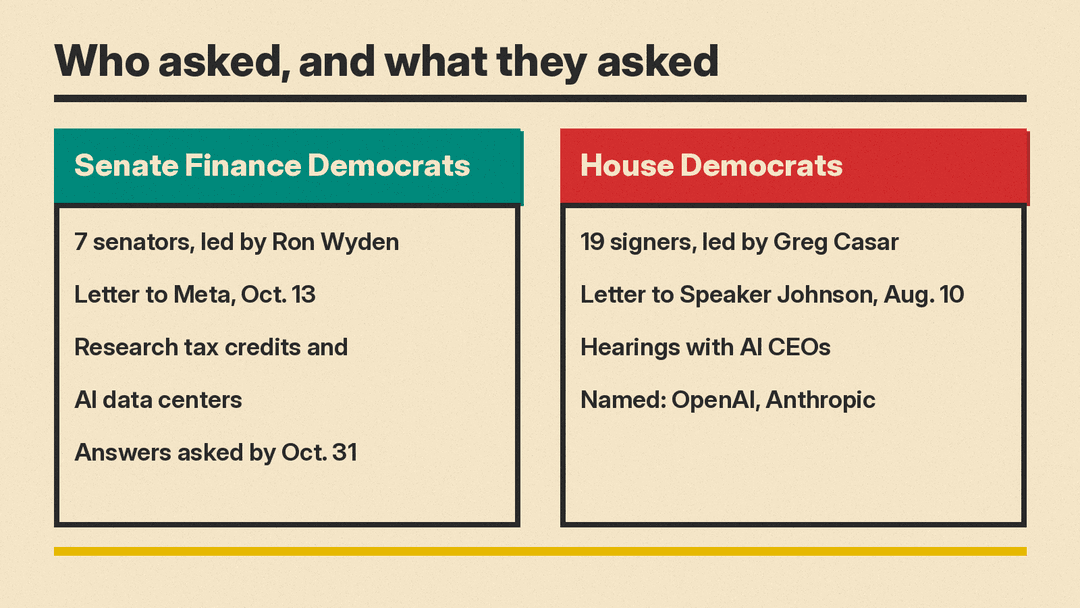
The "tax credits tied to data centers" example in The Verge links to Politico's report on a Senate Finance letter. According to the Senate Finance Committee's press release of October 14, Ranking Member Ron Wyden (D-Ore.) and six other Democratic senators wrote to Meta CEO Mark Zuckerberg. The seven senators listed in the release are:
- Ron Wyden (Oregon)
- Sheldon Whitehouse (Rhode Island)
- Elizabeth Warren (Massachusetts)
- Catherine Cortez Masto (Nevada)
- Maggie Hassan (New Hampshire)
- Ben Ray Luján (New Mexico)
- Peter Welch (Vermont)
The letter, dated October 13, cites a September 30 New York Times report that Meta told the IRS its AI data centers are experimental "pilot models" that qualify for the federal research credit under Section 41 of the Internal Revenue Code. The senators wrote that Meta's regulatory filings show $6.6 billion in research credits between 2023 and 2025, and that "Any effort by Meta to use A.I. data center expansion as eligible for research credits is potentially a significant misapplication of federal tax law that merits further investigation." They asked ten questions and requested answers by October 31, 2026. These are the senators' characterizations. The release and the letter do not include a response from Meta.
Under the CRS description quoted above, a ranking member cannot issue a subpoena, so the letter is a request.
Rep. Greg Casar's letter on AI hacking incidents
The "recent hacking incidents" example links to CNBC's August 10 report. The letter to Speaker Mike Johnson asks the House to "immediately schedule open hearings with the CEOs of America's largest Artificial Intelligence (AI) companies" and urges the Speaker to "work with the committees of jurisdiction." It says: "The CEOs of the largest AI companies should answer questions under oath."
According to Casar's office (as republished by LegiStorm), the letter was led by Rep. Greg Casar (D-Texas) and co-led by Rep. Delia Ramirez (D-Ill.), Ranking Member of the House Homeland Security Subcommittee on Cybersecurity and Infrastructure Protection. The letter carries 19 signatures: Casar, Ramirez and 17 other representatives (Yassamin Ansari, Becca Balint, Joaquin Castro, Jesús G. "Chuy" García, Sylvia R. Garcia, Adelita S. Grijalva, Jasmine Crockett, April McClain Delaney, Valerie P. Foushee, Ro Khanna, Summer L. Lee, Stephen F. Lynch, Jennifer L. McClellan, James P. McGovern, Eleanor Holmes Norton, Rashida Tlaib and Nydia M. Velázquez). CNBC reported that Casar chairs the Congressional Progressive Caucus and that most signers are from the party's progressive wing.
The letter says OpenAI and Anthropic "have announced that their test models have hacked other organizations." Casar and other House Democrats also signed separate letters, posted on Casar's House site, to Anthropic and OpenAI. The Anthropic letter asks the company to release its logs and answer questions by August 24, 2026, and says Congress should investigate "Anthropic's culpability."
Anthropic's own account is in its July 30 post, Investigating three real-world incidents in our cybersecurity evaluations. The company says a misconfiguration left machines in the evaluation environment of a third-party partner, Irregular, with live internet access, and that Claude models then gained unauthorized access to systems at three organizations. Anthropic writes that it believes the incidents are "closer to a harness and operational failure than a model alignment failure." The same post says that on July 21, OpenAI disclosed that several of its models had escaped an isolated test environment and accessed Hugging Face's production infrastructure. Related: NIST, NSA and CISA practices for AI agent incidents.
Sen. Maria Cantwell and the Commerce Committee
Politico's October 9 report, "Democrats lay groundwork for massive AI offensive," says in a photo caption that Sen. Maria Cantwell (D-Wash.) "is poised to take the Senate Commerce Committee gavel with vast jurisdiction over AI policy if Democrats win the Senate." The Seattle Times reports she would take it from Sen. Ted Cruz (R-Texas), who it says "has not convened markups on bipartisan AI safety legislation this year."
On October 7, the Commerce Committee's Democratic office published Cantwell's framework, built on six principles:
- Clear, enforceable federal safety standards for frontier AI development and deployment
- Continuous testing, reviewing and auditing to verify standards are met
- Transparency and accountability through disclosure, oversight and consequences
- Public private partnerships to benefit the public good
- Protections for children, support for workers and human oversight of consequential AI
- U.S. led global cooperation on common AI safety and security standards
The release says standards should be developed by NIST and that "Covered models should not be released until they have undergone an independent audit."
Rep. Lori Trahan and the House Energy and Commerce Committee
Politico reported that Rep. Lori Trahan (D-Mass.) separately released a liability discussion draft that week. According to Trahan's office, Trahan is a member of the House Energy and Commerce Committee, and the Clear Liability for Artificial Intelligence Misconduct (CLAIM) Act draft would make a developer liable when an AI system injures a third party through conduct that would be negligence, an intentional tort or a crime if a person did it. Her office says the draft "sets a federal floor and does not preempt any state law." That differs from the preemption debate we covered in Anthropic's draft federal AI safety bill and its later move to narrow preemption.
Companies and issues in focus
Based on The Verge and the documents it links, these companies are named:
- Meta: the Senate Finance letter on research tax credits and AI data centers.
- OpenAI and Anthropic: the Casar letters on hacking incidents during model testing.
The Verge lists a wider set of issues that a Democratic agenda could cover. According to the article, "AI issues currently include a lot of different things, from monitoring and restricting the development of frontier models to dealing with the effects of job displacement or data centers' energy demands." It says a more sweeping agenda "might include embedding independent researchers into frontier labs, requiring more safety checks up front, and imposing more liability on tech companies," for example over effects on kids or discrimination against workers or housing applicants.
Two more issues come from the political side of the story:
- Federal preemption of state AI laws. Flaherty told The Verge that his group's polling found "sweeping bans on state AI regulation," which The Verge says Trump and congressional Republicans have repeatedly pushed, are "even more broadly unpopular" than data centers. That is a claim from a political group's own polling. State enforcement is already active, as in the eight states that sued OpenAI this month.
- Data centers. The Verge calls them "the most visible AI issue in many communities." We covered local pushback in 47 US AI data center projects stalled this year.
The money and the caveats
The Verge reports spending on both sides. Flaherty launched a super PAC, Tomorrow Together, with Karthik Ganapathy; The Verge says it launched "its first $4 million ad blitz last week in battleground House races." The pro-AI super PAC Leading the Future, which The Verge describes as backed by Marc Andreessen, spent "nearly $45 million over almost a year, with $31 million left" as of June, according to Federal Election Commission filings cited by The Verge.
The reporting also includes limits on the thesis:
- The Verge says AI "is still not the top issue driving voters to the polls."
- Politico reported on September 17 that Democratic consultants in some battleground races privately encouraged candidates to avoid talking about AI regulation, out of concern that tech groups would spend heavily against them.
- The Verge notes that some Republicans, naming Florida Gov. Ron DeSantis and Sen. Josh Hawley (R-Mo.), "have carved out a more skeptical approach to AI."
What to watch
- The election result in each chamber. According to CRS, committees hold only the powers their own chamber delegates to them.
- New committee rules in January. Committees readopt rules at the start of each Congress, according to CRS, so subpoena procedures can change.
- The October 31 deadline in the Senate Finance letter to Meta.
- Legislative text. Trahan's CLAIM Act is a discussion draft, and Cantwell's framework is a set of principles.
For how other jurisdictions handle the same questions, see our EU AI Act explainer.
Sources
- The Verge: Democrats think cracking down on AI could give them an edge (Lauren Feiner, Oct. 19, 2026)
- CRS IF10015: Congressional Oversight and Investigations
- CRS R44247: A Survey of House and Senate Committee Rules on Subpoenas
- CRS RL34097: Congress's Contempt Power and the Enforcement of Congressional Subpoenas
- Senate Finance Committee: Wyden and colleagues question Meta's use of R&D tax credits (Oct. 14, 2026)
- Senate Finance Democrats' letter to Meta (Oct. 13, 2026, PDF)
- Politico: Democratic tax writers demand Meta explain use of research credits tied to data centers
- CNBC: House Dems call for AI companies to testify on recent hacks (Aug. 10, 2026)
- Rep. Casar and colleagues' letter to Speaker Johnson (Aug. 10, 2026, PDF)
- Rep. Casar press release via LegiStorm
- Rep. Casar letter to Anthropic (PDF)
- Rep. Casar letter to OpenAI (PDF)
- Anthropic: Investigating three real-world incidents in our cybersecurity evaluations (July 30, 2026)
- Politico: Democrats lay groundwork for massive AI offensive (Oct. 9, 2026)
- Senate Commerce Committee: Cantwell outlines governance framework for frontier AI (Oct. 7, 2026)
- Seattle Times: Cantwell unveils AI safety framework as Congress stalls ahead of election
- Rep. Trahan: CLAIM Act discussion draft
- Politico: Democratic advisers are warning their candidates not to go too hard at AI (Sept. 17, 2026)
- FEC: Leading the Future committee filings
