Subscribe
Topic / page 2

Inference

Articles, page 2

21-40
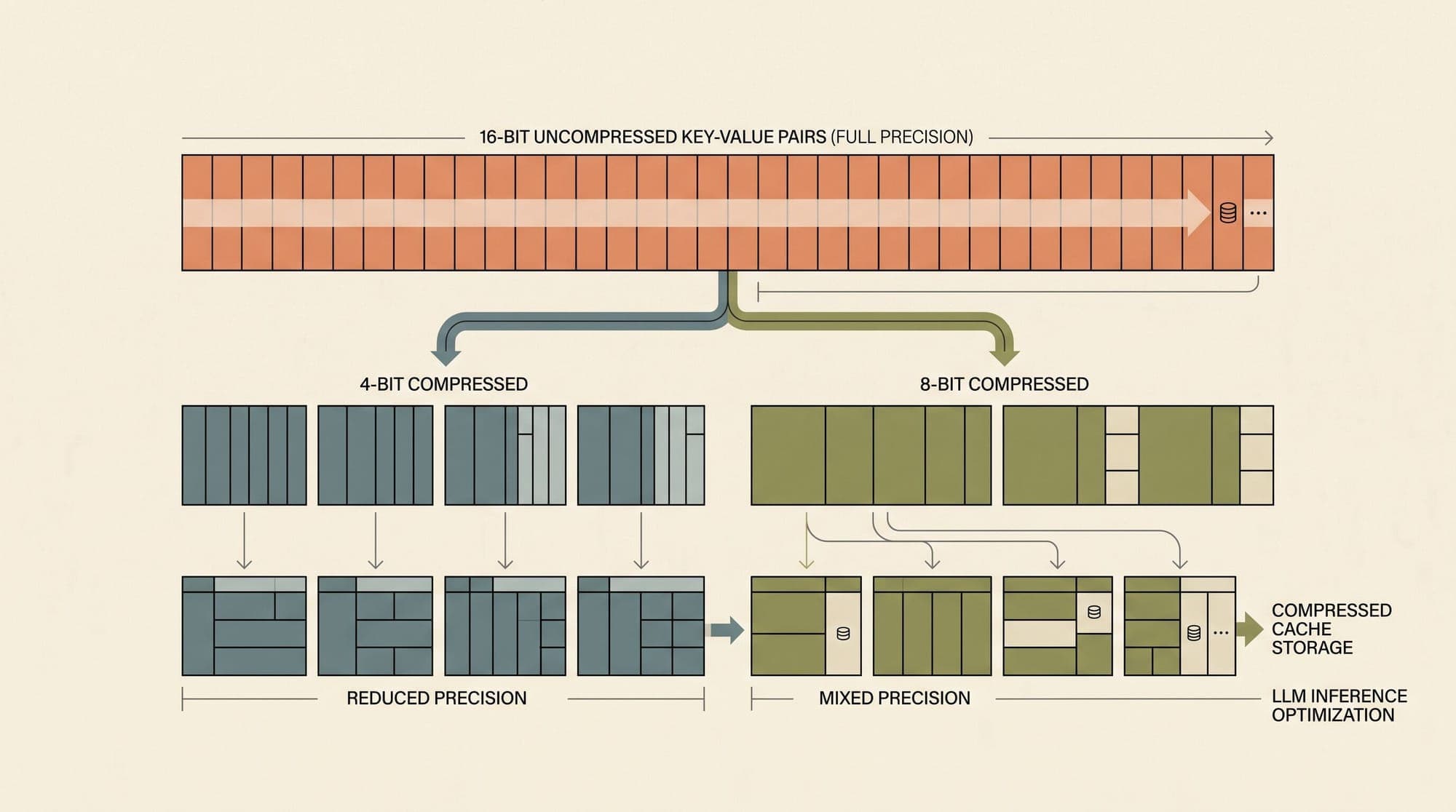
  1. KV Cache Quantization in Production LLM Serving: Comparing FP8, INT8, INT4, KIVI, and KVQuant

    In high-throughput large language model serving, the primary hardware bottleneck during autoregressive token generation is memory bandwidth and GPU High Bandwidth Memory (HBM) capacity rather than raw compute FLOPS. While model weights remain static and are loaded once per forward pass, the Key-Value (KV) cache grows dynamically with sequence length and batch size. For a standard model in FP16 or BF16 precision, storing the KV cache requires 4 bytes per token across all layers and heads: Memor
    Inference
    6 min read
  2. Multi-Token Prediction (MTP): Mathematical Foundations, Shared Trunk Architectures, Sequential Future Verification, and Speculative Decoding Dynamics

    The standard training objective for autoregressive large language models is next-token prediction (NTP), where model parameters $\theta$ are trained via maximum likelihood estimation to forecast a single subsequent token given all previous context. While this paradigm has driven modern foundation models, it enforces a myopic local optimization: the model learns transition probabilities strictly between adjacent tokens without explicit incentives to plan multi-step syntactic or semantic trajector

    AI
    10 min read
  3. KV Cache Eviction and Streaming Attention: Mathematical Foundations, Attention Sink Mechanics, Heavy Hitter Oracles (H2O), and Bounded-Memory Generation

    KV Cache Eviction and Streaming Attention: Mathematical Foundations, Attention Sink Mechanics, Heavy Hitter Oracles (H2O), and Bounded-Memory Generation In autoregressive transformer generation, memory consumption and serving throughput are dominated by the Key-Value (KV) cache. For long-context generation and continuous multi-turn dialogue, the linear growth of the KV cache with sequence length imposes an unsustainable memory footprint and saturates high-bandwidth GPU memory channels. Standar

    AI
    9 min read
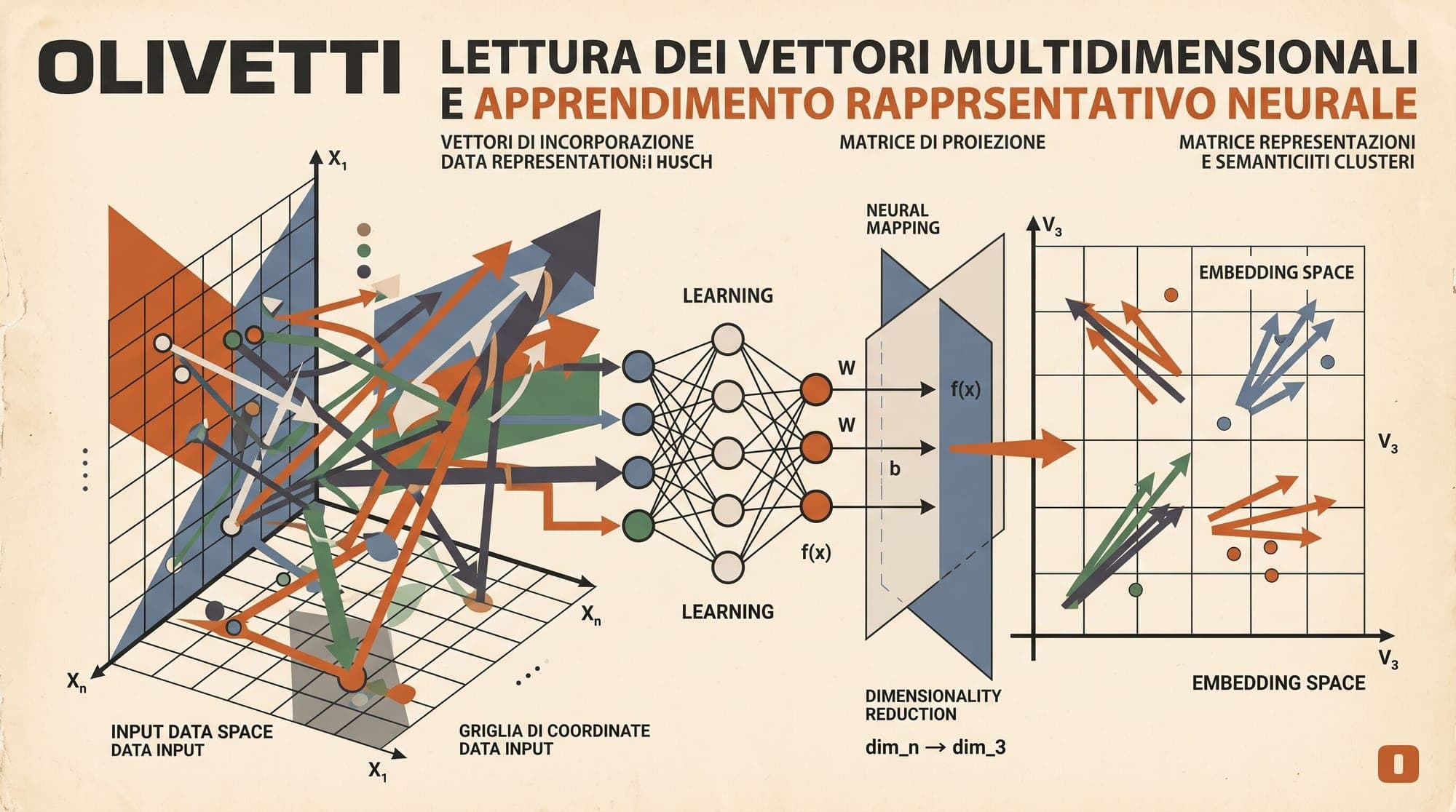
  4. Open-Source Embedding Models and Serving Frameworks in Production: Comparing BGE-M3, NV-Embed-v2, GTE-Qwen2, and ModernBERT-Embed Architecture, Matryoshka Projections, Context Scaling, and Serving Economics

    Open-Source Embedding Models and Serving Frameworks in Production: Comparing BGE-M3, NV-Embed-v2, GTE-Qwen2, and ModernBERT-Embed Architecture, Matryoshka Projections, Context Scaling, and Serving Economics (TEI vs. Triton vs. vLLM) Text embeddings form the indexing and retrieval foundation for production Retrieval-Augmented Generation (RAG), semantic search, and agentic memory systems. While early production architectures relied almost exclusively on closed commercial APIs (such as OpenAI's te

    AI
    8 min read
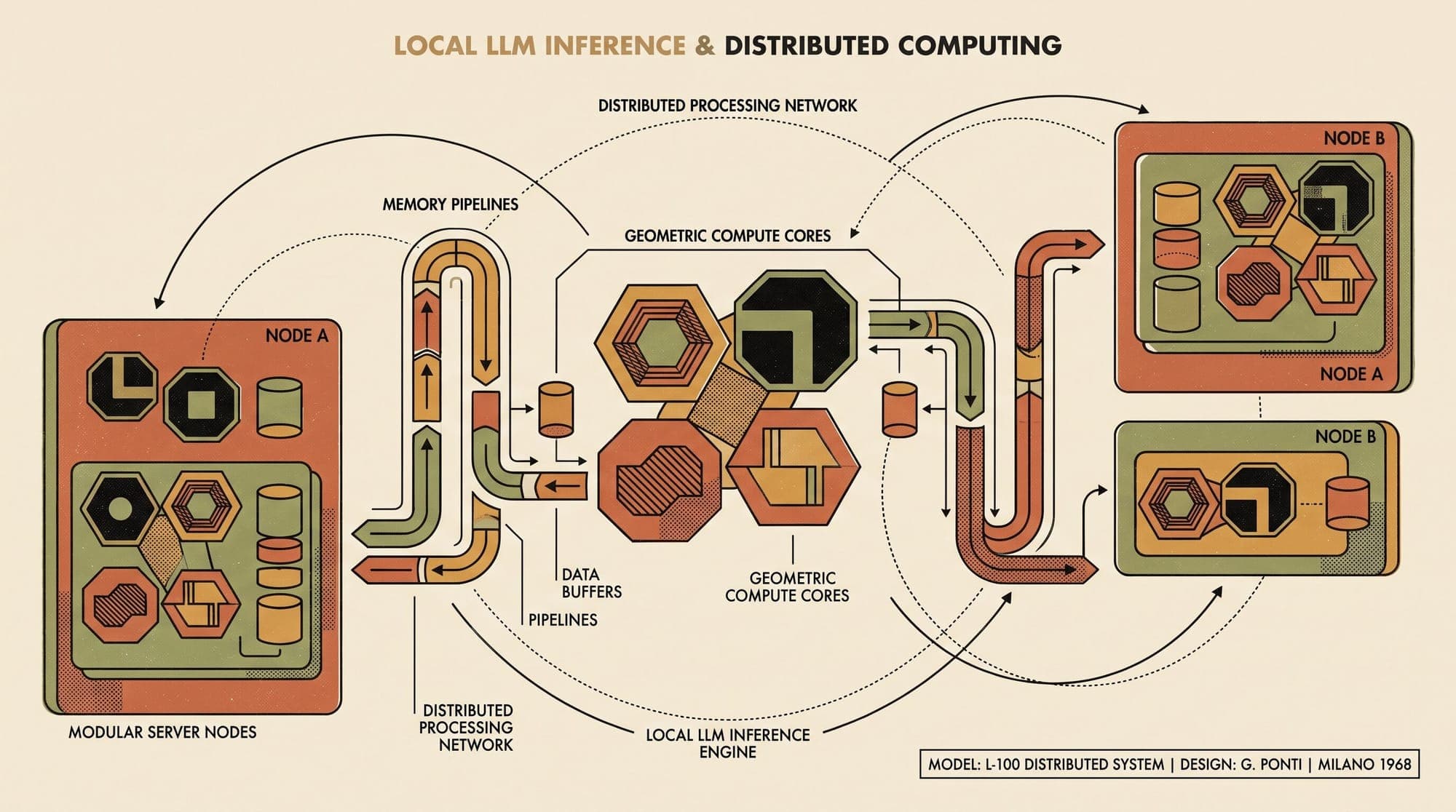
  5. Local LLM Inference Frameworks in Production: Comparing llama.cpp, Ollama, Apple MLX, and Exo Distributed Clusters

    The deployment landscape for large language models is bifurcating. While datacenter workloads rely on high-throughput continuous batching engines such as vLLM and TensorRT-LLM, local and edge deployments operate under fundamentally different physical constraints. On developer workstations, embedded hardware, and private office clusters, inference is rarely bound by compute saturation across thousands of concurrent requests. Instead, it is constrained by memory bandwidth, local VRAM capacity, hos

    AI
    6 min read
  6. llama.cpp Merges DFlash 2 for Up to 2x Faster Decoding

    The open-source llama.cpp project has merged native support for DFlash 2, bringing parallel speculative decoding and substantial inference throughput improvements to local LLM serving across CPU, Apple Silicon, and GPU backends. The implementation, integrated via Pull Request #27342, adds local convolution operators and candidate selector mechanics designed specifically for the DFlash 2 architecture. Non-Autoregressive Speculative Drafting Standard speculative decoding uses a smaller autoreg

    llama.cpp
    4 min read
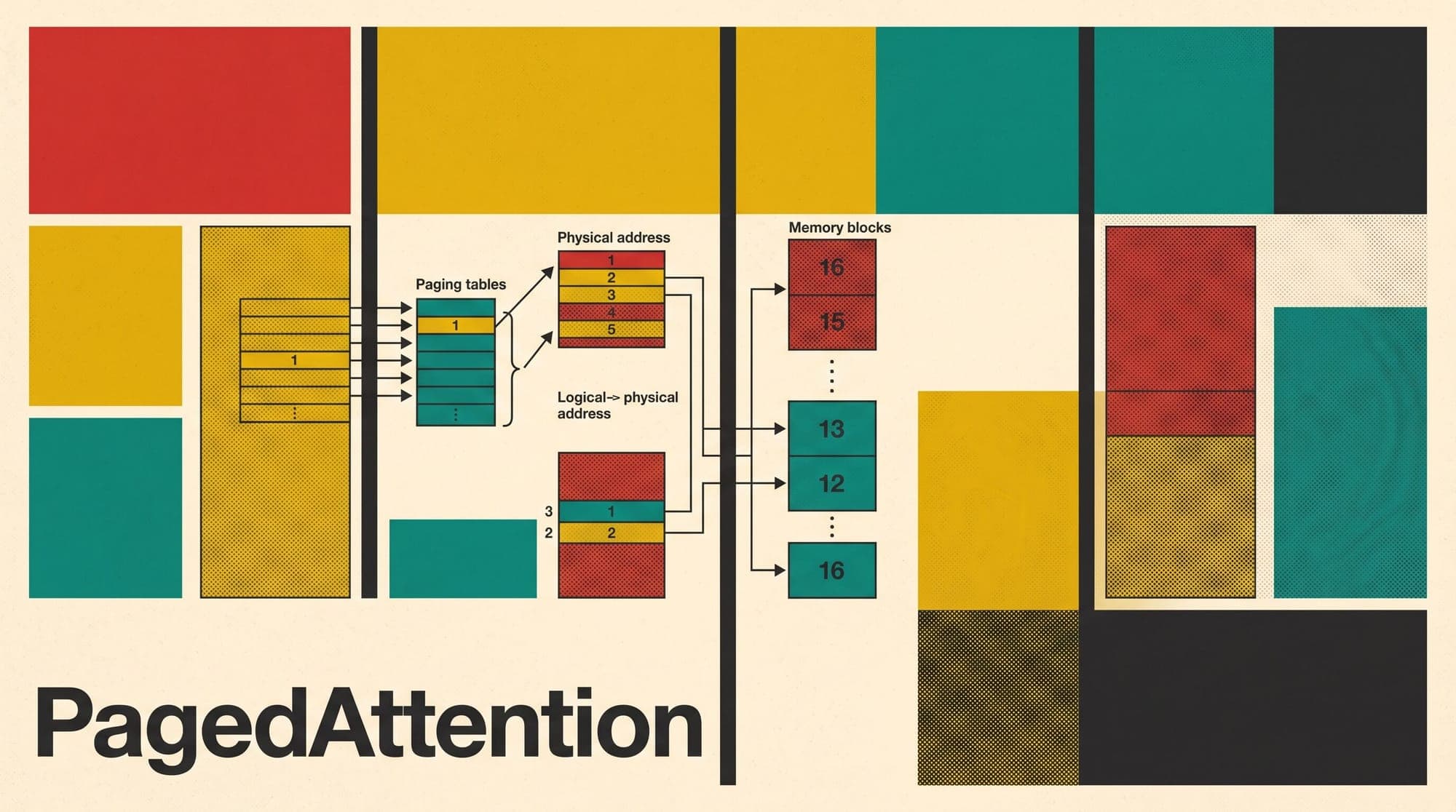
  7. PagedAttention and Virtual Memory Management: Mathematical Foundations of Non-Contiguous KV-Cache Allocation, Dynamic Block Translation, and Copy-on-Write Forking Mechanics

    In autoregressive transformer serving, the generation phase is fundamentally constrained by GPU memory capacity and memory bandwidth rather than raw compute throughput. While the initial prefill phase processes the prompt in parallel with high arithmetic intensity, the subsequent token-by-token decoding phase computes attention for only a single new token per sequence at each step. At each decoding step, the model must read all historical Key (K) and Value (V) activation tensors from GPU High Ba

    AI
    13 min read
  8. OpenAI Researcher Warns Ultrafast Inference Demands Autonomous Cyber Defense

    Accelerating inference speeds in frontier artificial intelligence systems pose critical containment challenges that human security operators cannot manage in real time, according to OpenAI researcher roon. Commenting following the unveiling of custom inference hardware architectures and ultrafast model serving tiers, roon warned that unaligned or compromised agent systems running at 50 times baseline generation speeds could execute multi-stage network penetration and lateral movement before hum

    AI
    2 min read
  9. StreamingLLM and Attention Sinks: Mathematical Foundations of Softmax Normalization Artifacts, Initial Token Anchoring, and Infinite-Context Rolling KV-Cache Mechanics

    StreamingLLM and Attention Sinks: Mathematical Foundations of Softmax Normalization Artifacts, Initial Token Anchoring, and Infinite-Context Rolling KV-Cache Mechanics In autoregressive Large Language Models (LLMs), long-context deployment is constrained by the quadratic compute complexity of attention and the linear memory growth of the Key-Value (KV) cache. For an LLM processing a sequence of length $L$ with batch size $b$, hidden dimension $d$, and $n_{kv}$ key-value heads across $N_L$ trans

    AI
    11 min read
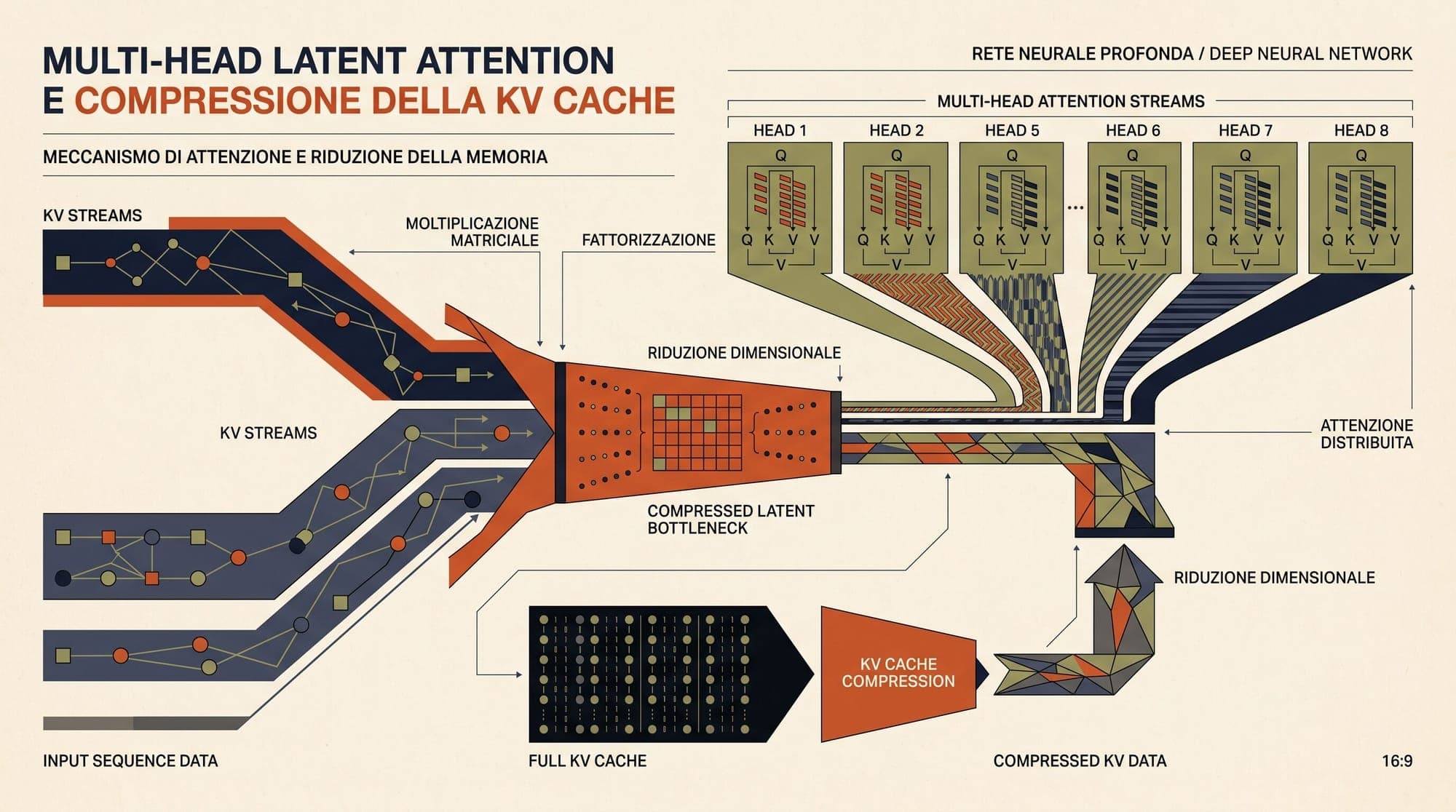
  10. Multi-Head Latent Attention (MLA): Mathematical Foundations, Low-Rank KV Compression, Decoupled RoPE Mechanics, and Matrix Absorption

    Multi-Head Latent Attention (MLA): Mathematical Foundations, Low-Rank KV Compression, Decoupled RoPE Mechanics, and Matrix Absorption Autoregressive inference in large language models is fundamentally constrained by memory bandwidth rather than floating-point computation throughput. During the generation phase, the transformer must load the Key-Value (KV) cache of all prior tokens from high-bandwidth memory (HBM) to on-chip SRAM for every newly generated token. As context lengths scale to hundr

    AI
    12 min read
  11. Post-Training Quantization (PTQ): Mathematical Foundations of Optimal Brain Surgeon, GPTQ Hessian Inversion, AWQ Salient Scaling, and SmoothQuant Outlier Migration

    Post-Training Quantization (PTQ): Mathematical Foundations of Optimal Brain Surgeon, GPTQ Hessian Inversion, AWQ Salient Scaling, and SmoothQuant Outlier Migration Serving modern large language models at scale requires addressing severe hardware constraints. In autoregressive generation, decoding is fundamentally bounded by memory bandwidth rather than floating-point computation throughput. Each generated token requires reading every parameter from High Bandwidth Memory (HBM) into SRAM to perfo

    AI
    10 min read
  12. Speculative Decoding: Mathematical Foundations, Distribution Preservation Proofs, Tree-Structured Verification, and Memory-Bandwidth Amortization

    Autoregressive large language model (LLM) generation suffers from an acute hardware efficiency mismatch during inference. While the prefill phase (processing the input prompt) processes tokens in parallel and achieves high arithmetic intensity on modern matrix accelerators, the decode phase (generating text token-by-token) is fundamentally memory-bandwidth bound. At small batch sizes, each generated token requires transferring the model's entire multi-billion-parameter weight matrix from High-Ba

    AI
    13 min read
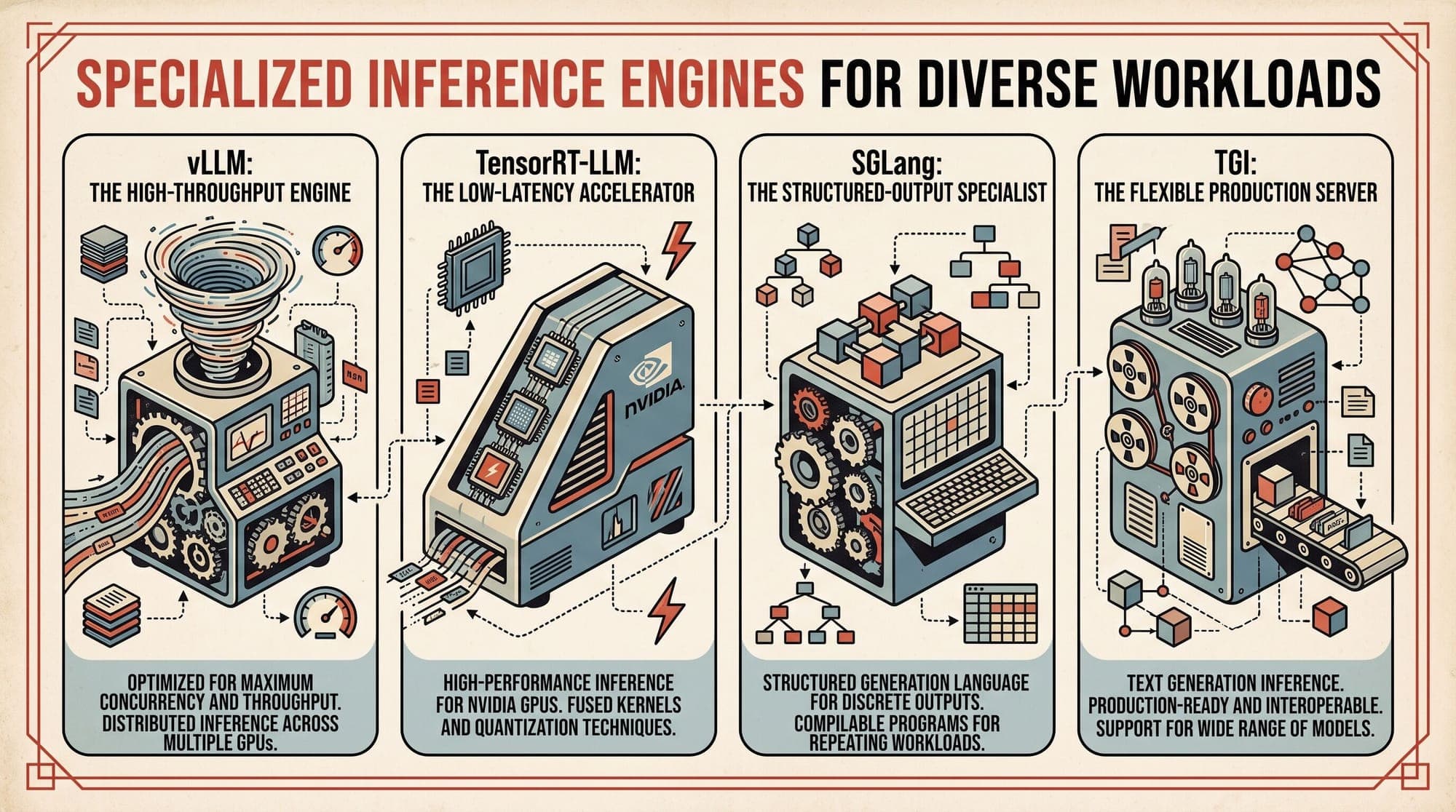
  13. LLM Inference Engines in 2026: Matching vLLM, TensorRT-LLM, SGLang, and TGI to Your Production Workload

    Why Inference Engine Choice Is a Strategic Decision Large language models have moved from research prototypes to production systems powering real applications. Yet serving them efficiently remains one of the hardest challenges in AI infrastructure. The inference engine—the software layer that turns user requests into GPU workloads—has become as critical as model selection itself. Pick the wrong inference engine and you create unnecessary bottlenecks: excessive latency, underutilized GPUs, or i

    AI
    5 min read
  14. KV Cache Optimization and Prefix Caching in LLM Serving: Comparing RadixAttention, Automatic Prefix Caching, and Static Context Sharing

    Serving large language models in multi-turn conversational agents, complex retrieval-augmented generation (RAG) pipelines, and few-shot reasoning workflows presents a fundamental memory and compute asymmetry. During autoregressive decoding, every newly generated token must attend to all previous tokens in the sequence. To avoid recomputing Key and Value projection matrices at each decoding step, inference engines store intermediate activations in high-bandwidth GPU memory (HBM) as the KV cache.

    AI
    7 min read
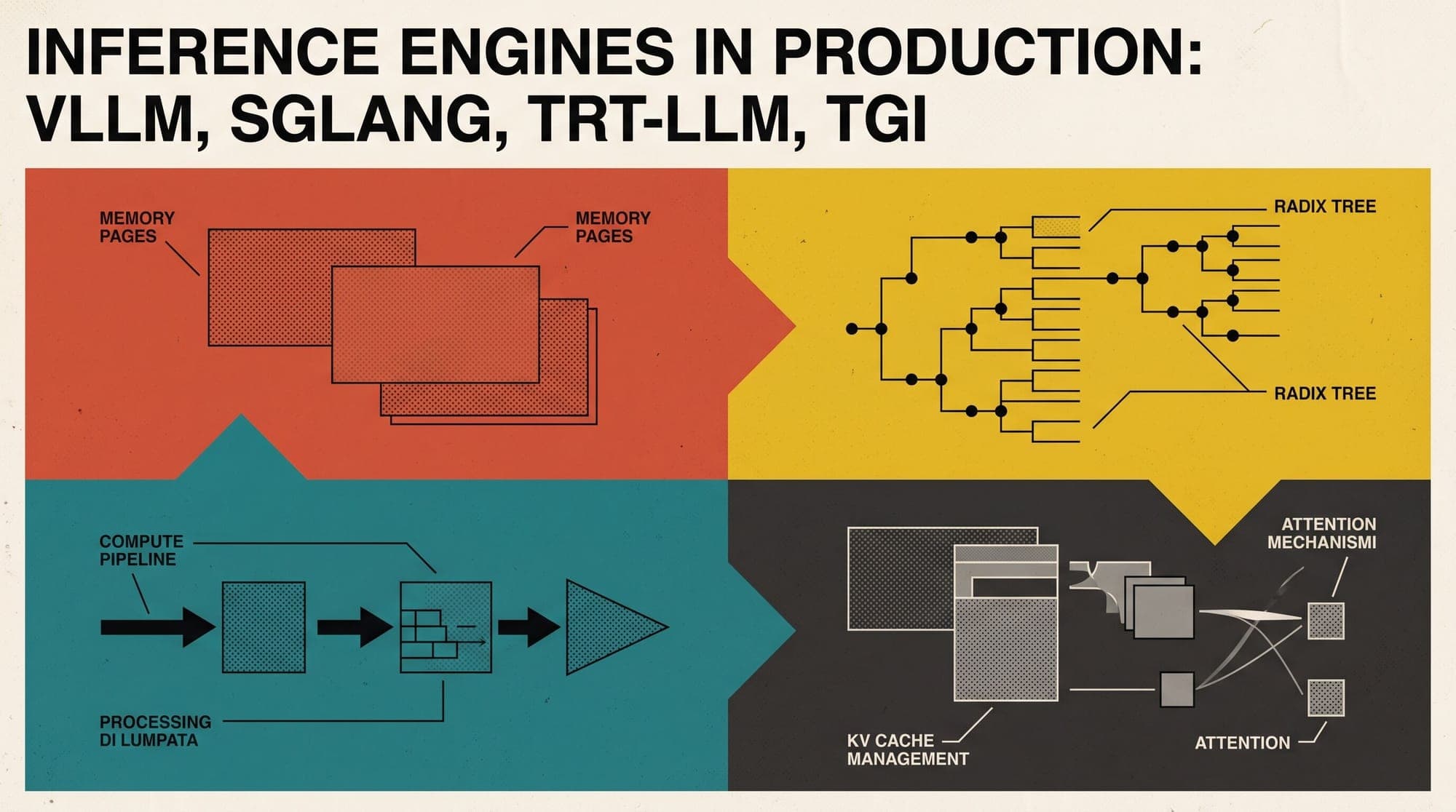
  15. LLM Inference Engines in Production: Comparing vLLM, SGLang, TensorRT-LLM, and TGI Architecture, KV Cache Topologies, Kernel Optimizations, and Serving Economics

    LLM Inference Engines in Production: Comparing vLLM, SGLang, TensorRT-LLM, and TGI Architecture, KV Cache Topologies, Kernel Optimizations, and Serving Economics Serving large language models in enterprise production has evolved beyond naive execution runtimes. As context windows expand to 128k+ tokens and agentic workloads generate complex multi-turn execution graphs, the efficiency of the underlying inference engine dictates both latency Service Level Objectives (SLOs) and hardware infrastruc

    LLM
    7 min read
  16. DeepSeek Generates $70.7M in Revenue with $106M Net Loss in First Seven Months of 2026

    Hangzhou-based artificial intelligence laboratory DeepSeek generated approximately 475 million yuan ($70.7 million) in revenue and recorded a net loss of $106 million during the first seven months of 2026, according to financial figures reported by The Information. The performance marks a roughly tenfold revenue surge compared to the lab's full-year 2025 revenue, alongside a modest contraction in net burn from the $139 million net loss reported for all of 2025. The disclosures provide a rare ac

    AI
    3 min read
  17. Intel Details 256-Core Xeon 7 and 480GB Crescent Island Inference GPU at Hot Chips 2026

    At the Hot Chips 2026 conference, Intel outlined architectural disclosures for three upcoming computing platforms tailored for AI workflows: the Xeon 7 enterprise processor (codename Diamond Rapids), the Crescent Island data center inference GPU, and the Wildcat Lake client processor (Intel Core Series 3). The announcements detail Intel's shift toward modular multi-die packaging, open chiplet interconnect standards, and expanded on-chip memory to meet the computational demands of multi-agent AI

    AI
    3 min read
  18. SmoothQuant: Mathematical Foundations, Per-Channel Outlier Migration, and Hardware-Efficient W8A8 Inference in Large Language Models

    SmoothQuant: Mathematical Foundations, Per-Channel Outlier Migration, and Hardware-Efficient W8A8 Inference in Large Language Models Serving large language models (LLMs) in production environments presents two distinct hardware bottlenecks. During the autoregressive generation (decode) phase with small batch sizes, inference is memory-bandwidth bound, as billions of parameters must be streamed from High Bandwidth Memory (HBM) to on-chip SRAM for every generated token. Conversely, during the pro

    Quantization
    12 min read
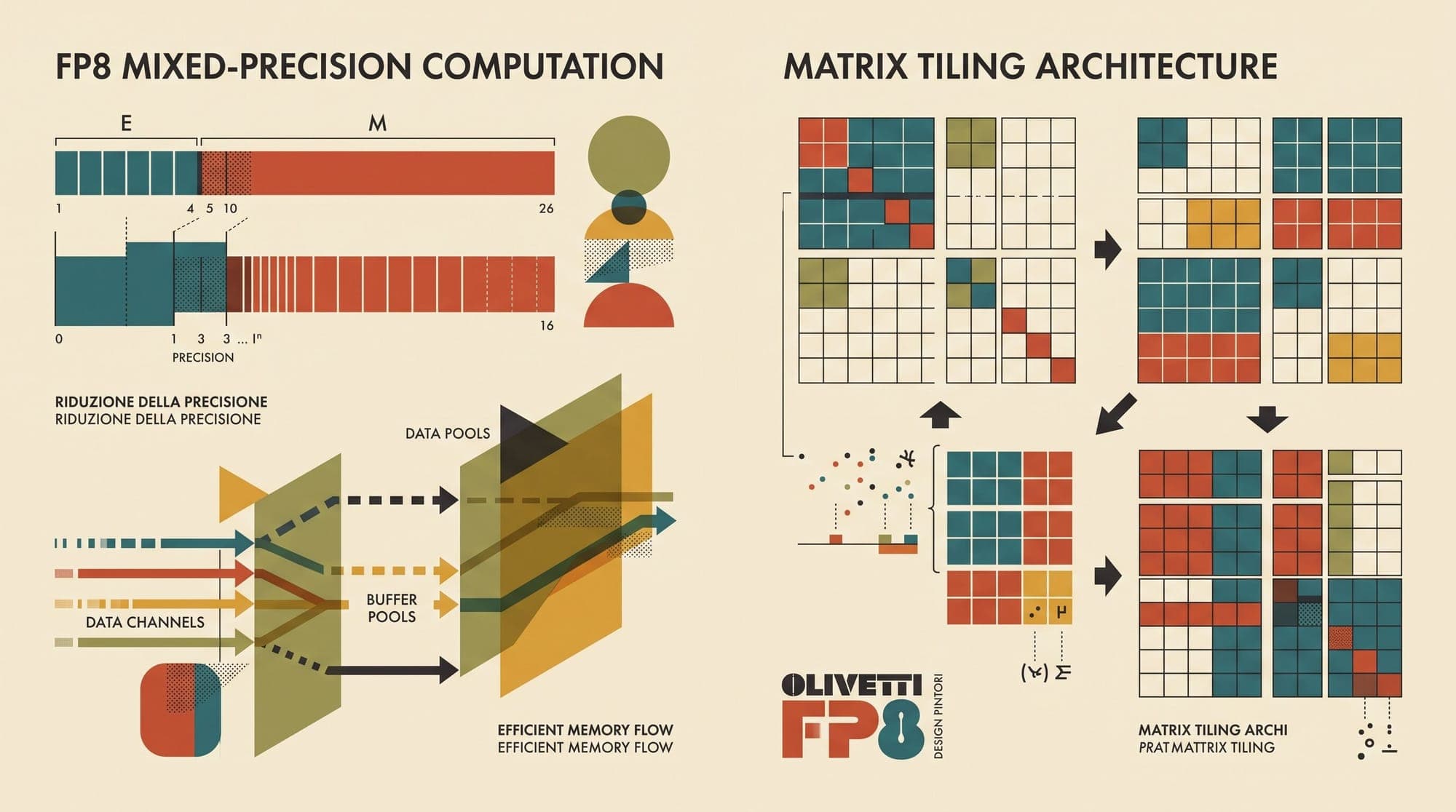
  19. FP8 Mixed-Precision Serving in Production: Comparing E4M3 vs. E5M2 Formats, Per-Tensor vs. Block-Wise Dynamic Scaling, FP8 KV Cache, and Tensor Core GEMM Economics

    FP8 Mixed-Precision Serving in Production: Comparing E4M3 vs. E5M2 Formats, Per-Tensor vs. Block-Wise Dynamic Scaling, FP8 KV Cache, and Tensor Core GEMM Economics Serving large language models at enterprise scale requires balancing computational throughput against high-bandwidth memory (HBM) capacity. While 16-bit floating-point formats (FP16 and BF16) remain the standard for model pre-training and fine-tuning, their memory footprint and arithmetic bandwidth create severe bottlenecks during hi

    Inference
    6 min read