
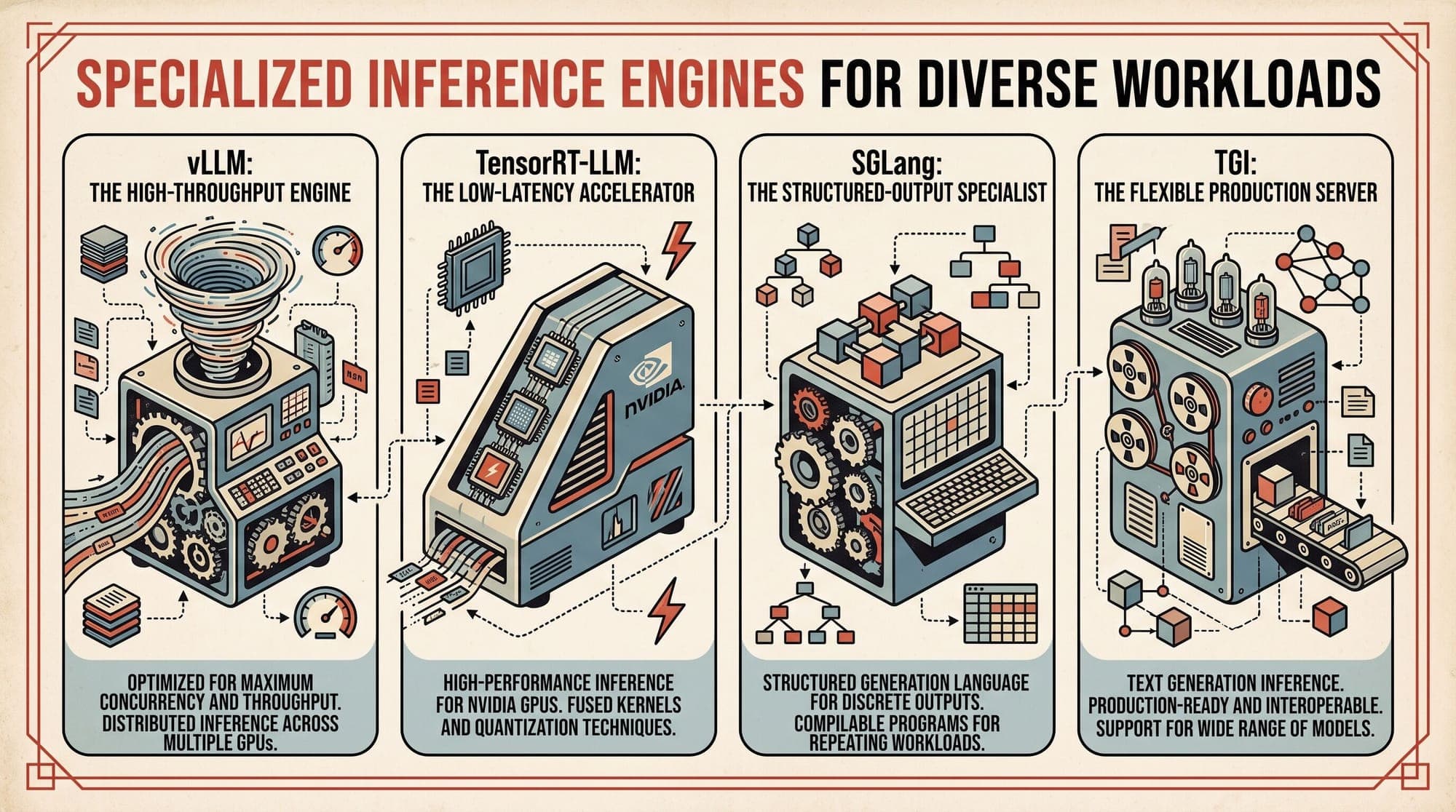
title: LLM Inference Engines in 2026: Matching vLLM, TensorRT-LLM, SGLang, and TGI to Your Production Workload feature_image: https://cms.llms.blog/content/images/2026/08/llm-inference-cover.png
LLM Inference Engines in 2026: Matching vLLM, TensorRT-LLM, SGLang, and TGI to Your Production Workload
Why Inference Engine Choice Is a Strategic Decision
Large language models have moved from research prototypes to production systems powering real applications. Yet serving them efficiently remains one of the hardest challenges in AI infrastructure. The inference engine—the software layer that turns user requests into GPU workloads—has become as critical as model selection itself.
Pick the wrong inference engine and you create unnecessary bottlenecks: excessive latency, underutilized GPUs, or inflated infrastructure costs. The choice isn't about raw benchmark numbers; it's about matching the engine's optimization philosophy to your specific traffic patterns, hardware constraints, and operational capabilities.

The Three-Way Tradeoff: Throughput, Latency, and Memory
Every LLM serving engine optimizes for different points in the throughput-latency-memory triangle:
- Throughput: Tokens served per second across all concurrent requests
- Latency: Time for a single user to receive a response (time-to-first-token and end-to-end)
- Memory Efficiency: How many concurrent sessions fit in available VRAM
These metrics pull against each other. Increasing throughput through larger batches raises per-request latency. Aggressive memory optimization can limit maximum sequence length. No engine maximizes all three simultaneously—the choice reveals which two you prioritize and which one you accept tradeoffs on.
Engine-by-Engine Breakdown
vLLM: The Throughput and Memory Efficiency Leader
Core Innovation: PagedAttention + Continuous Batching vLLM's PagedAttention manages KV cache memory like an operating system manages virtual memory—allocating fixed-size blocks on demand instead of reserving contiguous chunks per request. Combined with continuous in-flight batching (adding/removing requests each iteration), this eliminates memory fragmentation and sustains high GPU utilization on bursty, unpredictable traffic.
Strengths:
- Highest sustainable throughput on bursty workloads (3,500 tokens/sec for Llama 3 70B on A100)
- Best memory efficiency via PagedAttention (handles more concurrent sessions per GPU)
- Multi-vendor hardware support (NVIDIA, AMD, Intel GPUs, Google TPU, Intel Gaudi, Huawei Ascend)
- Zero-compile deployment (Docker run, no model-specific preprocessing)
- Broadest model support (hundreds of architectures including multimodal and MoE)
Weaknesses:
- Higher time-to-first-token vs SGLang (150ms vs 80ms for single requests)
- Less latency optimization than SGLang or TensorRT-LLM for ultra-low-latency needs
Ideal For:
- High-concurrency chat platforms and LLM APIs
- Environments with mixed or evolving hardware
- Teams prioritizing operational simplicity and model breadth
- Workloads with variable arrival patterns and diverse request lengths
TensorRT-LLM: NVIDIA-Specific Performance Maximization
Core Innovation: Ahead-of-Time Compilation and Kernel Fusion TensorRT-LLM builds hardware-specific execution graphs before serving begins—fusing kernels, optimizing tensor memory layouts, and compiling to native FP8 precision on target NVIDIA GPUs. This trades a one-time compilation cost (30-60 minutes) for lower per-token overhead at runtime.
Strengths:
- Highest peak throughput on standardized NVIDIA hardware (4,500 tokens/sec for Llama 3 70B on H100)
- Most efficient GPU utilization via low-level optimizations (kernel fusion, tensor core utilization)
- Tight integration with NVIDIA inference stack (Triton, NeMo)
- Best for latency-sensitive applications when hardware is homogeneous
Weaknesses:
- Compilation complexity and deployment friction (recompile for model/GPU/CUDA changes)
- NVIDIA-only hardware support
- Fixed batch sizes at compile time (poor handling of dynamic traffic)
- Requires specialized ML ops expertise
Ideal For:
- Standardized NVIDIA GPU clusters where every millisecond matters
- Organizations with dedicated ML infrastructure teams
- Latency-sensitive applications (trading, real-time voice) on homogeneous hardware
- Environments willing to trade deployment agility for peak performance
SGLang: The Latency and Structured Generation Specialist
Core Innovation: Radix Attention + Stateful Computation SGLang builds on PagedAttention with Radix Attention—storing computations in trie structures so requests sharing prefixes (system prompts, context) reuse cached attention. Its stateful computation model chains multi-stage inference in single API calls instead of multiple hops.
Strengths:
- Lowest time-to-first-token (80-120ms for single requests)
- Excellent for workloads with heavy prompt reuse (multi-turn conversations, agent workflows)
- Structured generation pipelines (RAG, multi-step reasoning, tool use) in consolidated calls
- Good balance of throughput and latency characteristics
Weaknesses:
- Smaller ecosystem and production footprint vs vLLM
- Less mature tooling and integrations
- Throughput slightly lower than vLLM on bursty mixed workloads
Ideal For:
- Interactive chat and coding assistants where latency matters
- Agent-based systems with multi-step reasoning
- Workloads with high prompt/template reuse (shared system contexts)
- Teams prioritizing user-facing responsiveness over absolute peak throughput
Hugging Face TGI: The Ecosystem Integration Choice
Core Innovation: Zero-Config Production Readiness TGI prioritizes ease of deployment and Hugging Face ecosystem integration over raw performance. It handles tensor parallelism, model loading, and production features (safety checks, logging) with minimal configuration.
Strengths:
- Simplest deployment and operation (container or standalone service)
- Seamless Hugging Face Transformers integration
- Built-in production features (custom stop sequences, logit biasing, detailed logging)
- Proven stability from Hugging Face's internal use
Weaknesses:
- Middle-of-the-road performance (2,500 tokens/sec throughput, 200-300ms TTFT)
- Less optimization innovation than purpose-built engines
- Limited hardware specificity vs TensorRT-LLM
- Less memory efficiency than vLLM/SGLang
Ideal For:
- Teams already invested in the Hugging Face ecosystem
- Rapid prototyping and internal tooling
- Organizations prioritizing operational simplicity over performance extremes
- Workloads where development speed matters more than inference cost
Decision Framework: Matching Engine to Workload
Choose based on your operational reality, not benchmark leaderboards:
If Your Traffic Is...
- Bursty and diverse (variable arrival times, mixed request lengths): vLLM
- PagedAttention and continuous batching handle unpredictability best
- Multi-vendor support accommodates evolving infrastructure
- Repetitive with shared context (multi-turn chats, agent workflows): SGLang
- Radix Attention caches attention for shared prefixes
- Stateful computation reduces API hops in multi-step workflows
- Running unchanged for months (stable models, stable hardware): TensorRT-LLM
- Compilation cost amortized over long uptime
- Peak performance justifies operational complexity
If Your Priorities Are...
- Maximum throughput on mixed hardware: vLLM
- Best sustained tokens/sec across diverse workloads
- Hardware flexibility prevents vendor lock-in
- Lowest latency for interactive users: SGLang
- Superior time-to-first-token for responsive applications
- Structured generation reduces perceived latency in complex workflows
- Peak performance on standardized NVIDIA: TensorRT-LLM
- Highest absolute throughput on homogeneous GPU clusters
- Hardware-specific optimizations extract maximum performance
- Fastest deployment and ecosystem integration: TGI
- Zero-config production serving
- Seamless Hugging Face workflow integration
Production Deployment Considerations
Cost Implications
Engine choice compounds at scale. Better throughput on the same hardware means fewer GPU hours:
- vLLM/TensorRT-LLM: ~3,500-4,500 tokens/sec on A100/H100
- SGLang: ~2,800 tokens/sec with latency advantages
- TGI: ~2,500 tokens/sec with operational simplicity
At 100M tokens/month, the difference between 2,500 and 4,000 tokens/sec represents ~167 GPU hours—a significant cost delta at scale.
Infrastructure Patterns
- High Availability: Multi-region deployments with load balancing (primary/secondary split)
- Multi-Model Serving: Route simple queries to smaller instances, complex ones to larger
- Cost Optimization: Schedule batch workloads for off-peak hours using spot instances
- Hybrid Approaches: Some teams run multiple engines for different workload types
Operational Complexity
- Lowest: TGI (zero config, Hugging Face native)
- Medium: vLLM/SGLang (standard container deployment)
- Highest: TensorRT-LLM (compilation step, specialized expertise required)
Conclusion: It's About Fit, Not Speed Rankings
The "best" LLM inference engine in 2026 depends entirely on your specific constraints:
- Hardware homogeneity (standardized NVIDIA vs mixed)
- Traffic patterns (bursty vs repetitive vs stable)
- Latency sensitivity (interactive chat vs batch processing)
- Operational capacity (specialized ML ops team vs generalist engineers)
Instead of asking "Which is fastest?", ask "Which tradeoffs match my reality?" The answer determines whether you gain value from vLLM's memory efficiency, TensorRT-LLM's peak performance, SGLang's latency advantages, or TGI's operational simplicity.
Sources
- Spheron Network: "LLM Inference Optimization: vLLM vs TensorRT-LLM vs SGLang Decision Framework (2026)"
- Yotta Labs: "Best LLM Inference Engines (2026): vLLM, SGLang & TensorRT-LLM Compared"
- DeployBase: "Best LLM Inference Engines 2026: vLLM vs SGLang vs TGI vs llama.cpp"



