Alibaba Qwen Office 2.0 Puts AI Agents in Team Chats
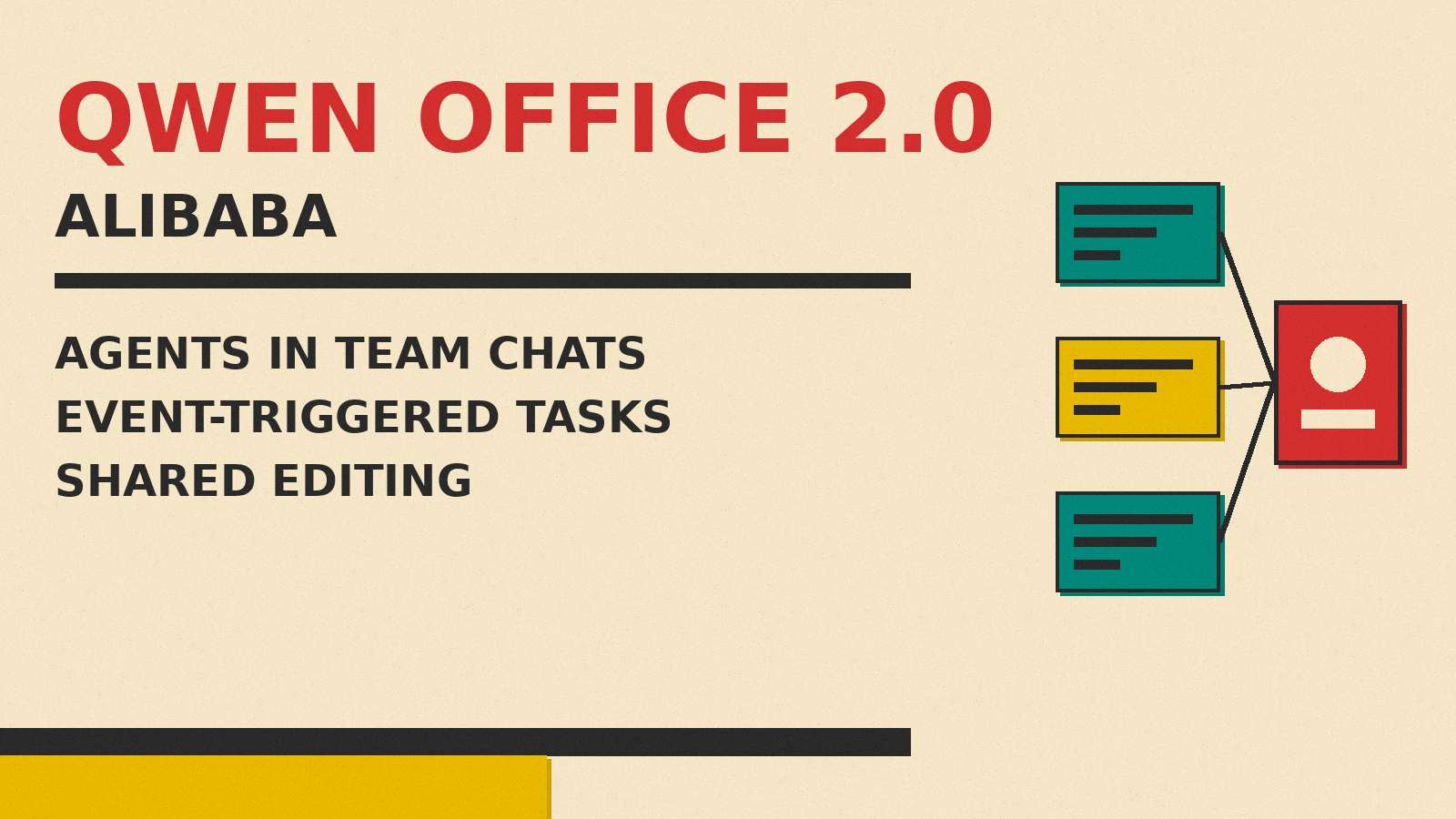
Alibaba's Qwen Office 2.0 adds team spaces with a digital employee, event-triggered tasks, shared editing and a materials space, per its release notes.
News on Alibaba's AI models, chips and business. Recent stories cover Qwen 3.8 27B and Qwen3.8-Flash-Next, the Wan 3.0 video model, Qwen running on a XuanTie RISC-V CPU, and Alibaba's help with Apple's AI model for China.
Alibaba's Qwen Office 2.0 adds team spaces with a digital employee, event-triggered tasks, shared editing and a materials space, per its release notes.
Alibaba has released the open weights for Qwen3.8-Flash-Next, a 125B-parameter multimodal Mixture-of-Experts (MoE) model that acts as an early architectural preview for the upcoming Qwen4 family. Operating with only 6B active parameters per token alongside a 51B N-gram embedding layer, the model targets cost efficiency across long-context reasoning, agentic coding, and multimodal workloads. For how it fits with Qwen3.8-Max, the open 2.4T weights and the Omni models, see our Qwen3.8 explainer. U
Alibaba Tongyi Lab has launched a public beta of Wan 3.0, the latest iteration of its video generation model family. Available on Alibaba Cloud Model Studio and Qwen Cloud under the model identifier wan3.0-video, the model produces up to 30 seconds of continuous video in a single pass at resolutions up to 1080p. Unlike predecessor models such as Wan 2.7, which capped single-pass output at 15 seconds, Wan 3.0 consolidates video synthesis into a unified architecture and expands supported input mo

Alibaba Group Holding announced a proposed equity placement in Hong Kong to raise HK$80 billion ($10.2 billion), allocating 100% of net proceeds to expand its full-stack artificial intelligence capabilities across custom silicon, cloud compute infrastructure, and foundation model development. Transaction Structure and Market Scale According to terms reviewed by Reuters, Alibaba is offering 710 million ordinary shares at HK$112.70 per share, representing a 3.6% discount to its latest closing p

Alibaba's semiconductor division, T-Head, announced day-zero native inference support for its latest open-weight model, Qwen 3.8 27B, running directly on the XuanTie C950 RISC-V server processor. Operating without discrete graphics processing units, the 64-core RISC-V chip delivered sustained decode throughput of 30 tokens per second alongside a time-to-first-token latency of 1.9 seconds. Update, October 29, 2026: a developer has since gone the other way and compiled a 32-bit RISC-V CPU into th

Alibaba's Qwen research lab released Qwen 3.8 27B, a 27-billion-parameter Apache 2.0 licensed AI model available in 17GB GGUF format that can run on high-end consumer laptops. The model supports vision, long contexts, and tool calling. Our Qwen3.8 explainer shows where the 27B sits in the rest of the family. The over-thinking problem Qwen's documentation describes the model as defaulting to xhigh for reasoning effort, a setting designed for complex tasks demanding thorough analysis. In practi
Apple has developed a custom large language model for the Chinese market with support from Alibaba, a rare US-China AI partnership that would give Apple more control over its AI features in a market where buyers have been turning to domestic phone makers, The Verge reported. According to Reuters, citing three people familiar with the matter, Apple trained the China-specific model with Alibaba's support. This departs from Apple's previous strategy of relying on domestic Chinese models to power A

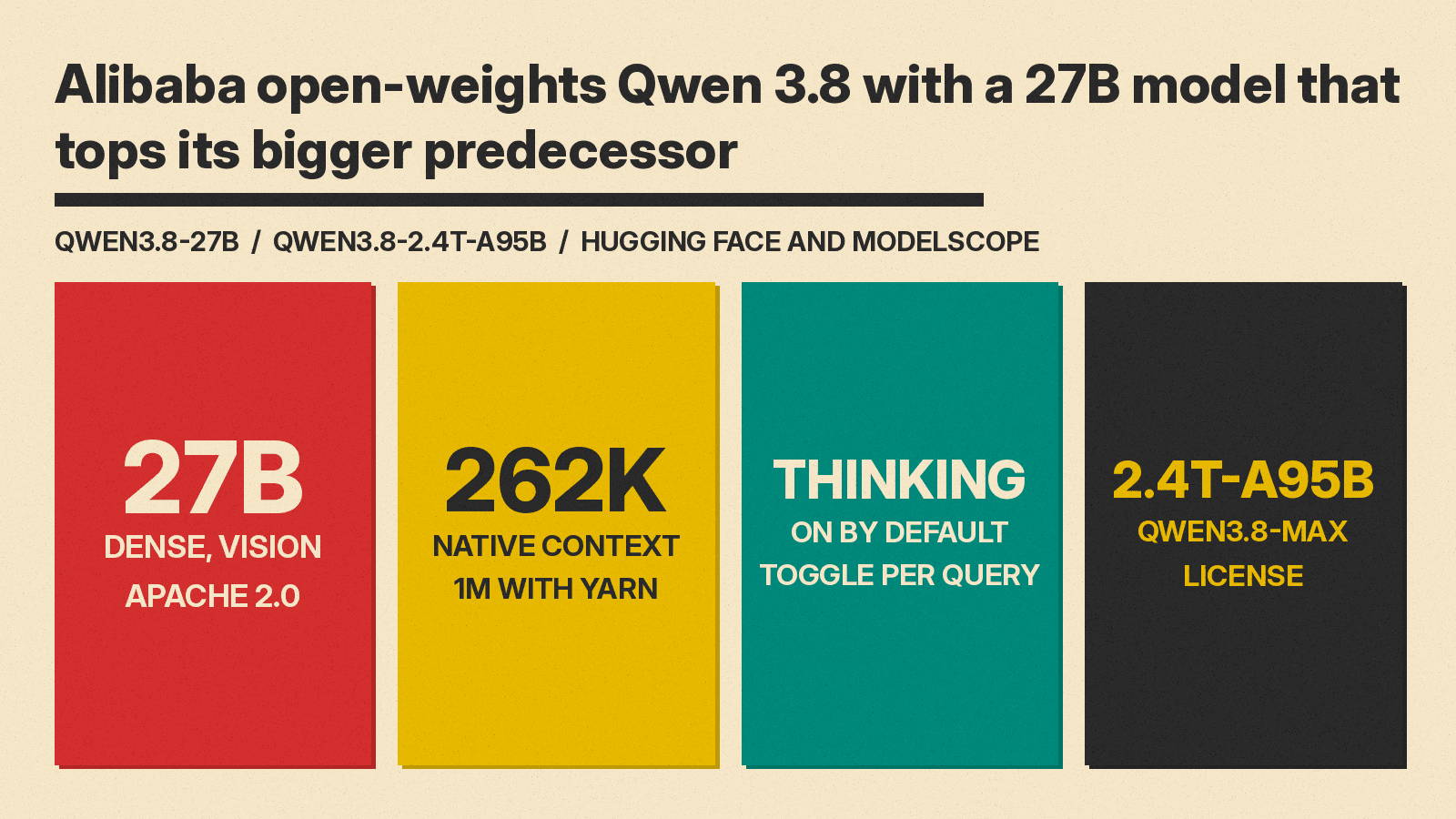
Alibaba's Qwen team announced the open weights for Qwen3.8 on August 14. The Qwen3.8-27B model card lists the Apache 2.0 license, and Hugging Face shows its weight files uploaded on August 13 (UTC). The move puts a capable new open model directly into the hands of researchers and companies that want to fine-tune and self-host it. The centerpiece is Qwen3.8-27B, a 27 billion parameter multimodal dense model. Qwen says it outperforms the larger Qwen3.7-Plus on coding and office tasks. The team al
Alibaba officially launched Qwen 3.8-Max on August 3, calling it the most powerful model in the Qwen family to date. The 2.4 trillion-parameter model supports a one-million-token context window and is multimodal, capable of processing text, images, video, and documents in a single prompt. The company priced Qwen 3.8-Max at $2 per million input tokens and $6 per million output tokens, with implicit caching at $0.25 per million tokens. That positions it well below the pricing of frontier models f
