
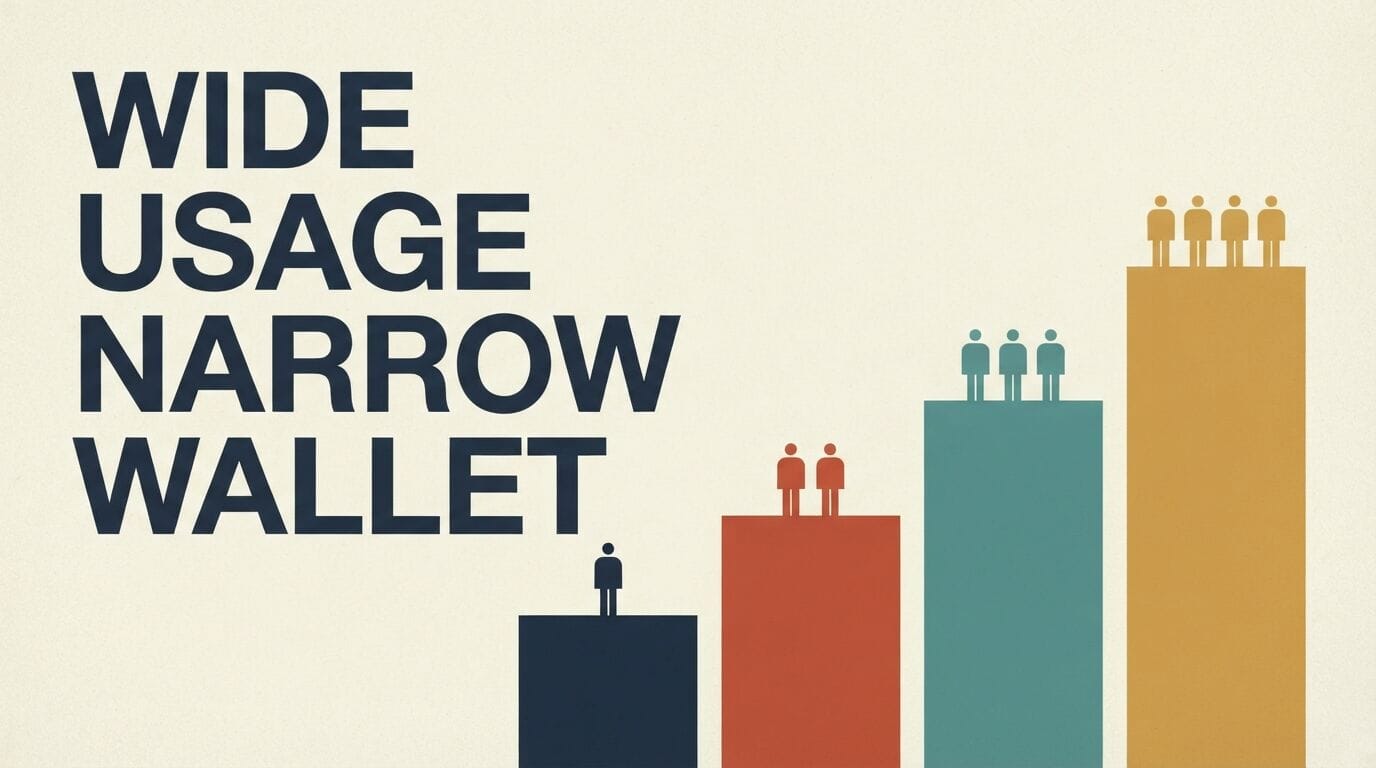
Two reports published a few weeks apart this autumn describe the same market and print numbers that appear to contradict each other. Andreessen Horowitz's Top 100 Gen AI Consumer Apps, in its seventh edition on October 5, reported that just 4.5% of U.S. consumers had an active paid personal subscription to ChatGPT, Gemini or Claude as of August, up from 2.1% a year earlier. Menlo Ventures, in its 2026 State of Consumer AI report on September 16, found that 55% of AI users now pay for at least one AI product. Both figures are accurate. They are read from different meters, and the gap between them is the most useful picture of consumer AI available in late 2026.
Three scoreboards, three questions
The a16z ranking, produced with partner Olivia Moore, lists the top 50 web products by monthly visits (Similarweb) and the top 50 mobile apps by monthly active users (Sensor Tower), both as of August 2026. This edition adds a third list: observed spending on U.S. consumer cards, supplied by panel data firm YipitData. Menlo's report rests on a survey of 5,067 U.S. adults fielded in July 2026, with estimates of global spend built on top.
Each scoreboard answers a different question. The web and mobile lists measure attention. The card panel measures how much money actually leaves American wallets for subscriptions, and it only sees what runs through consumer cards: desktop apps and agents buried inside messaging platforms are invisible to it, which is a16z's stated reason for adding the list. The survey measures the looser question of whether people feel they pay for AI, across every product category, with the usual self-report inflation.
Traffic and revenue rank different companies
On attention, the leaderboard has settled. ChatGPT still leads, with roughly twice Gemini's August web visits and about six times Claude's, and a 2.5x mobile lead over Gemini. Only 11 products make their first appearance in this edition, the smallest number of debuts across all seven lists.
On money, the ranking reorganizes. A striking 29 of the top 50 vendors by consumer spend appear nowhere on the web or mobile traffic lists. Only seven products rank in the top group on all three lists: ChatGPT, Claude, Suno, Perplexity, Photoroom, Canva and Notion. Suno, the music model company, ranks 19th on web traffic but 7th on spending; ElevenLabs ranks 25th and 10th. Plaud, which sells a physical meeting recorder plus a subscription, debuted at 16th on the spend list. Claude is the clearest case of monetization outrunning reach: it now sits second in U.S. consumer spending while ranking third in web traffic, and it passed Gemini in U.S. paid subscribers this year even after Google migrated legacy paid users onto its AI plan, which inorganically inflated the Google count.
The spending data also shows how differently the assistants convert. Of Claude's consumer payers, 7.3% are on Max, the subscription that starts at $100 a month. The share is 1.3% for Google and 1.1% for ChatGPT on their corresponding $100 tiers. Claude's run, a16z notes, came on the back of prosumer launches (Cowork in January, Claude Design in April, the Fable 5 model in June) and a burst of public attention during Anthropic's late-February dispute with the Pentagon, which briefly put the app at number one among free U.S. mobile apps. By mid-summer the winds had shifted: YipitData recorded declines in Claude's average daily sessions in July and August while ChatGPT re-accelerated after the July launch of the GPT-5.6 family and ChatGPT Work.
The $903 tail
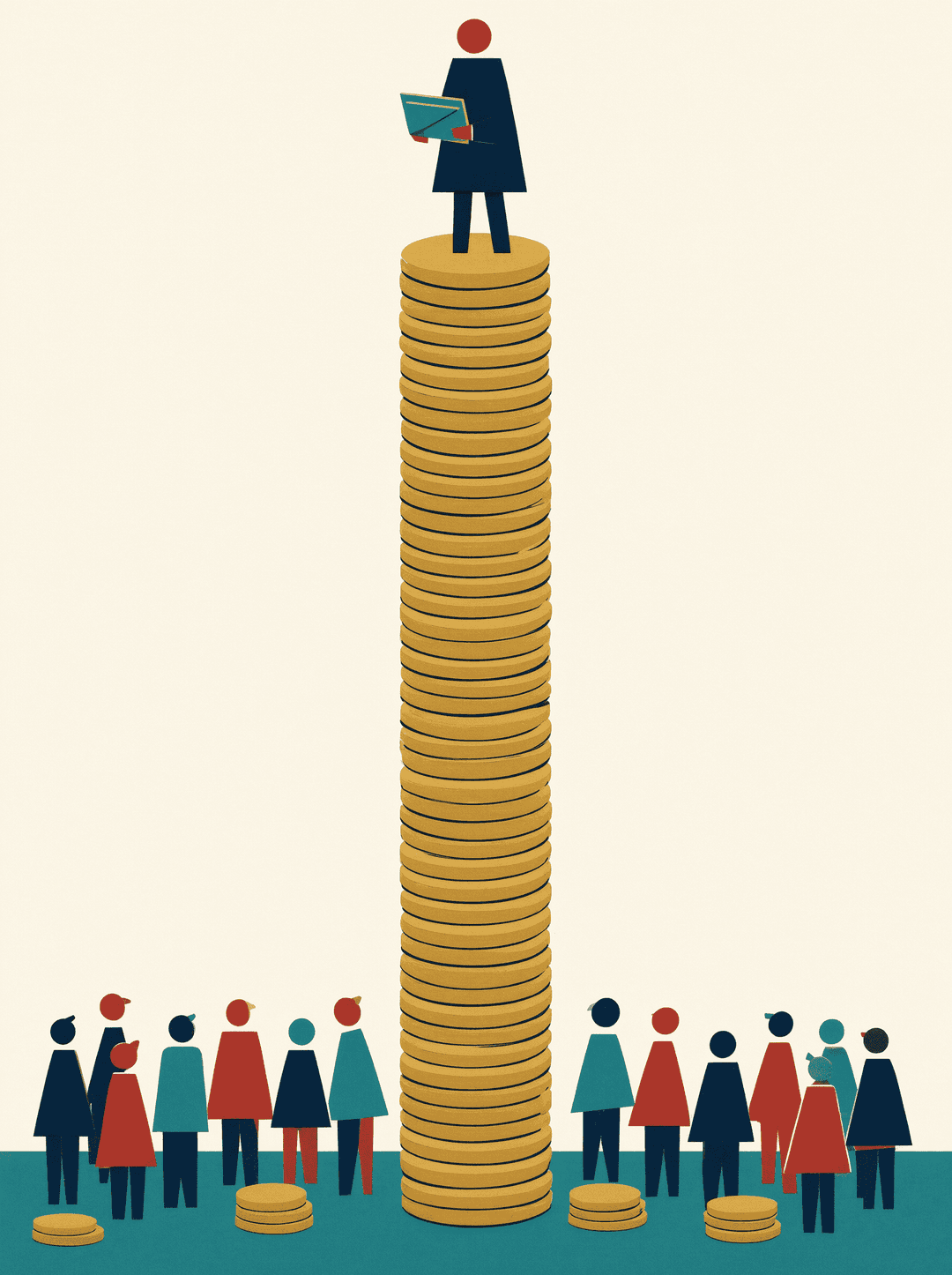
Both reports find that consumer AI revenue is a power law. In the YipitData panel, the top 1% of AI payers accounted for 19.5% of all observed consumer AI spend as of August, more than the bottom 50% of spenders combined (16.6%). That top 1% pays an average of $903 a month on consumer cards, up 80% in 18 months, while the median AI payer spends $25 a month and has barely grown that. The top 10% of spenders account for roughly half of all observed spend.
Menlo reaches a similar shape with different instruments: the typical payer spends $20 to $49 a month, but the 14% who spend $100 or more account for 60% of U.S. consumer AI spend. Its profile of a power payer is a millennial parent with a post-graduate degree working in technology or financial services, someone with more money than time.
Loyalty, however, is thin. Only 13% of users who pay for one AI product pay for a second. And paying is not broad: 4.5% penetration means one American in 22 funds a frontier assistant with a card. Pew Research, cited by a16z, finds roughly half of U.S. consumers use AI but only 25% do so daily. Menlo's numbers point the same way: U.S. adult adoption moved from 61% to 64% in a year, and the global user base grew 11%, from 1.8 billion to 2.0 billion, while global consumer spend more than tripled, from $12 billion to $40 billion. Growth in 2026 was depth, not breadth.
A subscription economy inside an ad economy
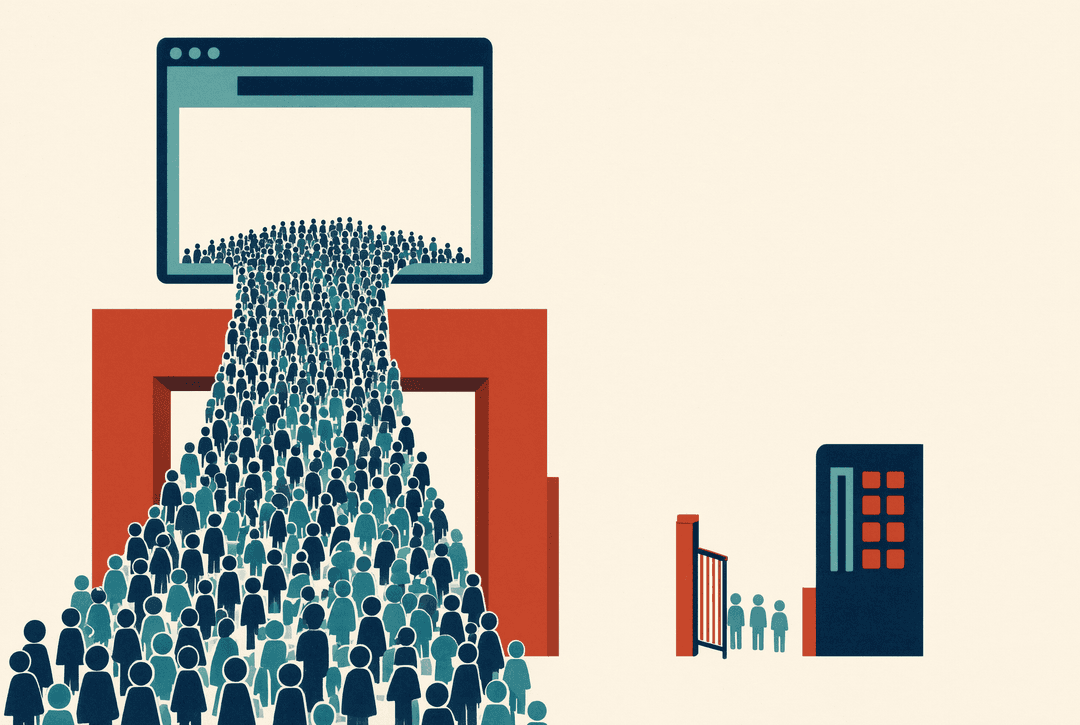
The monetization mix is an inversion of everything that came before it. Of the 44 AI-native products on a16z's top web list, all have some revenue model live: 84% sell subscriptions, 64% add usage charges or credits, only 14% show ads, and 2% take transaction or platform fees. For contrast, advertising generated 97.6% of Meta's revenue and 73.2% of Alphabet's in 2025. The consumer internet historically refused to charge ordinary users; consumer AI has done little else.
That refusal has likely capped how deep the market goes, and the reports can see the ceiling. Menlo found that 48% of payers cover their AI costs themselves, 34% have a family member or friend paying, and roughly 20% have an employer or school pick up the tab; employer-funded users spend a blended $95 a month against $55 for fully self-funded ones. Menlo also notes the speed of the spend curve: app stores took eight years to reach this level of consumer spend and U.S. streaming more than a decade. Consumer AI did it in three and a half years, mostly by billing people directly.
Two cracks in the subscription-only model are visible. OpenAI said in its own reporting that ChatGPT advertising reached a $1 billion annualized revenue run rate in August, and OpenEvidence, used by an estimated 50-60% of U.S. physicians per NBC News, now monetizes partly through ads. And a16z argues the next real business model may be transactional: personal agents that take a fee on purchases could monetize users who will never buy a subscription.
The agent lane is the newest scoreboard
Menlo finds 41% of AI users have tried an agent, 24% use one regularly, and 32% have let an AI act on their behalf without a final approval step. Among agent users, 92% already pay for AI. a16z tracks the product race behind that: startups like Instinct, Tomo, Poke, Lindy and Town report hundreds of thousands of users, while Meta, OpenAI and xAI answer with Muse, Dots and Grok Bot.
The early numbers look less like a consumer app launch than a payment pipe. Instinct reportedly passed 100,000 users in three weeks while invite-only; founder Noah Shinn says 40% of users connect a personal credit card within three weeks and spend an average of $1,300 a month through the agent, with more than $1 billion in annualized transaction volume, half of it travel. Meta's Muse hit 250,000 daily actives in its first week and 5 million downloads in under a month, faster at launch than ChatGPT or Claude, though a16z is careful to note Threads collected 15 million downloads in 22 days. The platforms are already choosing sides: Amazon shut Muse's access in under two weeks while Shopify, Instacart, OpenTable, Expedia, Ticketmaster and Plaid signed official integrations.
What the disagreement means
There is no single scoreboard for consumer AI in late 2026, and quoting one is a choice of meter. Visits measure attention, which is wide and increasingly settled among three assistants. Card panels measure a narrow paying tail with an extraordinary top end: $903 a month from the 1% versus $25 from the median. Surveys measure perceived participation, which makes the market look broader than any receipt shows. The one claim all three support: adoption has plateaued while revenue compounds, and the industry's growth plan now rests on converting casual users into the kind of person who treats an AI bill as a business expense. Expect 2027's leaderboard arguments to be about which of those meters matters most.
Sources
- The Top 100 Gen AI Consumer Apps — 7th Edition, a16z, October 5, 2026
- 2026: The State of Consumer AI, Menlo Ventures, September 16, 2026
- Americans and AI 2026: Chatbots, Smart Devices, and Views on Impact, Pew Research Center, June 17, 2026
- Expanding access to AI with ChatGPT ads, OpenAI, cited by a16z
- NBC News on OpenEvidence physician usage
