
The word "sovereign" has attached itself to the biggest line items in AI infrastructure, and the money is real. Nvidia's chief financial officer told investors in February that the company's sovereign AI business more than tripled year over year in fiscal 2026, to over $30 billion, roughly 14 percent of its $215.9 billion in total revenue, with the growth driven by customers in Canada, France, the Netherlands, Singapore and the UK. Gartner forecasts worldwide sovereign cloud IaaS spending of $80 billion in 2026, up 35.6 percent from 2025.
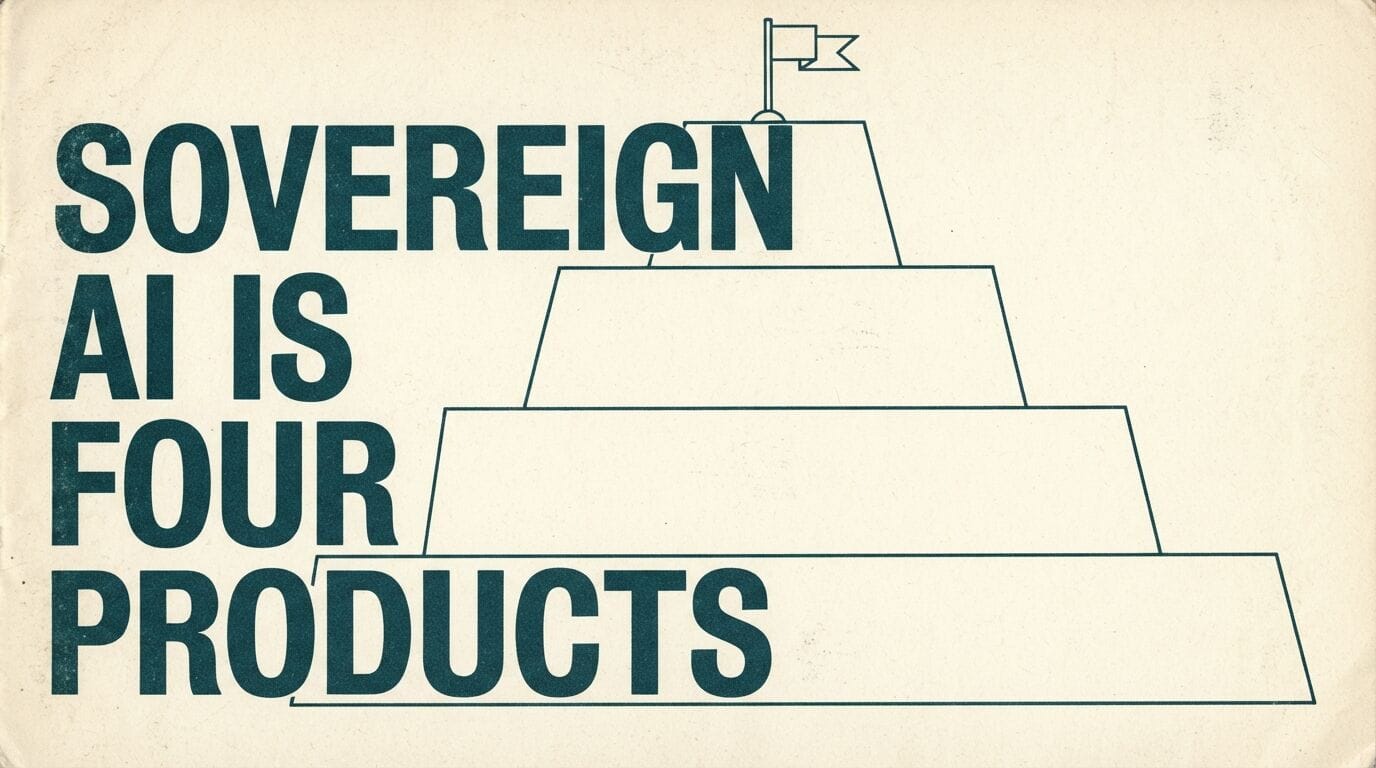
But "sovereign AI" is not one purchase. Four different things get sold under the label, they cost wildly different amounts, and almost nobody buys all four. Knowing which one a vendor, a ministry or a press release is actually describing is most of the analysis.
The term comes from the person selling the chips
Credit where credit is due: Nvidia's Jensen Huang has been the loudest voice for the concept since late 2023, and the company's stockpile of sovereign deals is one reason the segment exists as a reported number. Huang's formulation, delivered at the World Governments Summit in February 2024, is that every country needs to "own the production of their own intelligence," adapted to its languages, data and regulations. Nvidia defines sovereign AI as a nation's ability to produce AI using domestic infrastructure, data, talent and business networks.
The skepticism is also on the record. Nate Fick, then the State Department's first ambassador for cyberspace and digital policy, testified to the Senate in November 2023 that "there is no room for digital sovereignty." Whether the category reflects strategic necessity or a very effective sales motion depends on which layer you examine.

Layer one: metal
The most literal purchase is compute hardware inside your borders. This is where the headline projects live:
- Saudi Arabia's HUMAIN, a Public Investment Fund subsidiary announced in May 2025, began with a first deployment of 18,000 Nvidia GB300 servers toward a projected 500 megawatts of AI capacity, and expanded the Nvidia partnership in November 2025 to a plan for up to 600,000 GPUs, with a stated ambition of 6.6 gigawatts by 2034.
- Stargate UAE, announced alongside it in May 2025, is G42's one-gigawatt campus with OpenAI, Oracle, Nvidia, Cisco and SoftBank, with the first 200 megawatts scheduled for 2026.
- France's Mistral AI raised $830 million in its first-ever debt financing in March 2026, from a seven-bank consortium led by state investment bank Bpifrance, to buy 13,800 GB300 GPUs for a 44-megawatt data center at Bruyeres-le-Chatel south of Paris, and says it wants 200 megawatts of capacity across Europe by the end of 2027.
- Deutsche Telekom and Nvidia opened a one-billion-euro "Industrial AI Cloud" in Munich in early 2026, marketed as infrastructure for a sovereign Germany and Europe, and already hosting SOOFI, a project to train a European language model on it.
- India took a different shape: the government did not build data centers. Under the IndiaAI Mission, approved in 2024 with over 10,300 crore rupees (about $1.2 billion) over five years, it empanelled private operators such as Yotta, Tata Communications, Jio and E2E Networks and now points to 38,000 GPUs onboarded against an original 10,000 target, rented to startups and researchers at subsidized rates the government cites at 65 rupees an hour.
- The European Commission is running the largest public program of all: an InvestAI facility of 20 billion euros for up to seven AI gigafactories, each with over 100,000 advanced chips. An informal call drew 77 proposals across 60 sites in 16 member states, with reported investment values above 230 billion euros; the formal tender opened in July 2026, pairing up to 10 billion euros of public money with at least 20 billion euros of private capital. The first deadlines arrive in December 2026, with the largest lot slipping to February 2027.
Buying metal is the layer countries are most willing to pay for, because it shows up as construction, jobs and a ribbon-cutting. Industry groups have quietly pointed out the missing piece: there is no agreed plan for what the gigafactories will be used for or how they stay funded once the subsidy ends.
Layer two: a cloud with a jurisdiction attached
The second product is an operations model. Amazon launched the general availability of its European Sovereign Cloud on January 15, 2026, after a 7.8 billion euro investment pledge: a partition of AWS physically and logically separate from other regions, with all customer content and metadata staying in the EU, an in-EU copy of the source code, no critical dependencies on non-EU infrastructure, and operations restricted to EU residents. Amazon staged an exercise in October 2026 to demonstrate the cloud can run even if cut off from the rest of the world. Microsoft and Google sell weaker versions of the same idea through data boundary commitments.
This is the layer where sovereignty is a property of the operator, not of the silicon. The chips underneath are the same ones from layer one, and the parent companies remain subject to their home-country laws, which is the objection regulated buyers either accept or spend three years litigating in a risk assessment.

Layer three: a dropdown menu
The cheapest product is a setting. OpenAI introduced European data residency for ChatGPT Enterprise, Edu and its API in mid-2025; eligible customers now get storage at rest in ten regions, with in-region GPU inference available in the US and Europe, on Europe projects that must be new (existing projects cannot switch), with plan-dependent approval and a retention amendment attached. Azure OpenAI makes the choice explicit in deployment type: a "Global" deployment routes inference wherever capacity is, a "Data Zone" confines processing to a boundary, and "Regional" pins to one region. Storage location is not the same promise as inference location, and consultants now make a living reading which one a contract actually commits to.
Anthropic is the instructive case. Its first-party API offers no EU or UK region at all: the inference geography parameter accepts "us" or "global", US-pinned inference costs 1.1 times standard pricing, and workspace storage is US-only. European teams either treat every prompt as a GDPR Chapter V transfer papered over with standard contractual clauses, or reach Claude through Amazon Bedrock or Google Cloud, at partner prices with partner feature gaps. On November 5, 2026, Microsoft announced that Claude models inside Copilot will move into the EU Data Boundary by the end of the year. The residency answer to "who can compel access to this inference" is now, in that corner of the market, "whoever hosts the boundary."
Gartner's forecast captures why buyers keep shopping: it expects sovereign cloud spending to shift 20 percent of current workloads from global providers to local ones, with growth fastest in the Middle East and Africa (89 percent) and Europe (83 percent).
Layer four: the weights
The rarest product is model ownership. Only a handful of countries fund frontier-scale pretraining, and most sovereign programs quietly assume a US or Chinese open-weights model or a hosted API at the top of the stack. The EU gigafactory pitch explicitly ties its 100,000-chip facilities to training "very large AI models," which is the only layer where European or Gulf or Indian law would actually reach the artifact. Mistral and a few national projects (SOOFI in Germany, India's language-model efforts) are the exceptions that prove the rule: the compute layer is being bought at hundreds-of-billions scale, the weights layer at single-project scale.
The fine print runs through every layer
Here is the joke in the room. All four layers of "sovereign" AI, in Saudi Arabia, the UAE, France, Germany, India and the UK alike, sit on chips made by one American company, whose export requires a license from one American agency. Washington signed off on the Saudi GB300 allocation through the Commerce Department's Bureau of Industry and Security in late 2025 and cleared G42's purchase in November 2025. A country can own the data center, the operator, the weights and the statute, and still be one export-control revision away from an unfilled rack, as the November 2026 curbs episode showed.
So when a vendor or a government says sovereign AI, ask which layer is for sale. Metal is a purchase order. Operations is a contract with jurisdictional asterisks. Residency is a configuration setting with a pricing multiplier. Weights are a research program. Most "sovereign AI strategies" announced in 2026 are the first one priced like the fourth. None of that makes the spend irrational, the way a national airline is not irrational. It just means the flag on the press release is not the same object as the flag on the building.
Sources
- Nvidia Q4 FY2026 earnings call coverage, sovereign AI revenue over $30B (Yahoo Finance / Motley Fool): https://finance.yahoo.com/news/nvidia-earnings-call-nvidias-ai-112000659.html
- Nvidia, "NVIDIA CEO: Every Country Needs AI" (World Governments Summit, Feb 2024): https://blogs.nvidia.com/blog/world-governments-summit
- Gartner press release, sovereign cloud IaaS $80B in 2026 (Feb 9, 2026): https://www.gartner.com/en/newsroom/press-releases/2026-02-09-gartner-says-worldwide-sovereign-cloud-iaas-spending-will-total-us-dollars-80-billion-in-2026
- Bloomsbury Intelligence and Security Institute, "Sovereign Artificial Intelligence" (Fick testimony, Huang term history): https://bisi.org.uk/reports/sovereign-artificial-intelligence
- AWS, European Sovereign Cloud general availability (Jan 15, 2026): https://press.aboutamazon.com/aws/2026/1/aws-launches-aws-european-sovereign-cloud-and-announces-expansion-across-europe
- AWS Security Blog, ESC independent operation exercise (Oct 2026): https://aws.amazon.com/blogs/security/aws-european-sovereign-cloud-demonstrating-an-independent-operation
- VDF, "Sovereign AI in Europe" (ESC launch facts, four-kinds framing): https://vdf.ai/blog/sovereign-ai-europe
- Nvidia newsroom, Saudi Arabia and NVIDIA AI factories / HUMAIN 18,000 GB300 (May 2025): https://nvidianews.nvidia.com/news/saudi-arabia-and-nvidia-to-build-ai-factories-to-power-next-wave-of-intelligence-for-the-age-of-reasoning
- Colin Powers, "Nvidia in the Gulf" (BIS licenses, 600,000-GPU plan, Stargate UAE): https://phenomenalworld.org/analysis/nvidia-in-the-gulf
- Datacenter Dynamics, HUMAIN buys 18,000 GB300 chips: https://www.datacenterdynamics.com/en/news/saudi-arabian-ai-venture-humain-buys-18000-nvidia-gb300-chips-several-hundred-thousand-more-on-the-way
- CNBC, Mistral $830M debt financing for 13,800 GB300 data center (Mar 30, 2026): https://www.cnbc.com/2026-03-30/mistral-ai-paris-data-center-cluster-debt-financing.html
- Deutsche Telekom, Industrial AI Cloud launch with Nvidia: https://www.telekom.com/en/newsroom/latest-updates/media-information/2025/11/for-a-sovereign-germany and https://www.telekom.com/en/newsroom/latest-updates/media-information/2026/2/germany-s-first-ai-factory-for-industry
- Government of India PIB, IndiaAI Mission 38,000 GPUs at 65 rupees/hour: https://www.pib.gov.in/PressNoteDetails.aspx?ModuleId=3&NoteId=156786&lang=1®=3
- European Commission, AI Factories and AI Gigafactories pages: https://digital-strategy.ec.europa.eu/en/policies/ai-factories and https://commission.europa.eu/topics/competitiveness/competitiveness-coordination-tool-projects/ai-gigafactories_en
- Wikipedia, AI Gigafactory (call structure, deadlines, 77 proposals): https://en.wikipedia.org/wiki/AI_Gigafactory
- Lightreading, EU defers gigafactory call to early 2026 / InvestAI: https://www.lightreading.com/ai-machine-learning/eu-defers-formal-call-for-ai-gigafactories-to-early-2026
- Science|Business, industry criticism of the gigafactory business case: https://sciencebusiness.net/news/ai/eus-ai-gigafactories-need-rethink-says-industry
- OpenAI, "Introducing data residency in Europe": https://openai.com/index/introducing-data-residency-in-europe
- Sentra, AI data residency 2026 compliance table (OpenAI ten regions, Anthropic US-only inference): https://www.sentra.app/articles/ai-data-residency
- Wavect, EU data residency for AI APIs (eu.api.openai.com conditions, Mistral api.eu endpoint): https://wavect.io/blog/eu-data-residency-ai-apps-2026
- Sondero, Azure OpenAI EU Data Zones review (Global vs Data Zone vs Regional): https://www.sondero.ai/blog/azure-openai-eu-review
- AWS documentation, Claude Platform on AWS data residency (inference_geo us/global, 1.1x): https://docs.aws.amazon.com/claude-platform/latest/userguide/data-residency.html
- The AI Consultancy, Claude data residency UK/EU: https://theaiconsultancy.ai/blog/claude-data-residency-uk-2026
- Schneider IT Management, Microsoft moving Claude models into the EU Data Boundary (Nov 5, 2026): https://www.schneider.im/microsoft-365-copilot-anthropic-models-and-compliance-impact-in-the-eu
- Onyx, "Sovereign AI: Definition, Why It Matters" (McKinsey four dimensions, Nvidia definition): https://onyx.app/insights/sovereign-ai
