

On November 10, 2025, the investor Michael Burry posted a short accusation on X. Hyperscalers, he wrote, were "understating depreciation by extending useful life of assets [to] artificially boost earnings - one of the more common frauds of the modern era." His number: $176 billion of understated depreciation across 2026 to 2028, with Oracle's earnings overstated by 26.9% and Meta's by 20.8% by 2028 (Burry on X, CNBC).
A year of arguments later, nobody has proved a fraud, and almost nobody has proved the accounting is fine. The dispute looks technical because it is. But there is a simple way to read it: a GPU runs on three different clocks, and the depreciation schedule only shows you one of them.
What the books actually say
Every company that owns datacenter hardware has to pick a "useful life" for it: the number of years over which the cost is spread as an expense. For AI servers, the picks as of the filings reviewed in October 2026 look like this (American Compute, with SEC citations):
- Microsoft, Alphabet, Oracle and CoreWeave: six years
- Meta: 5.5 years
- Nebius, IREN and (for a subset of servers) Amazon: five years
- Amazon overall: five to six years
Two of those lines moved recently, in opposite directions. On January 1, 2025, Amazon shortened the assumed life of a subset of its servers from six years to five, explicitly citing the "increased pace of technology development, particularly in the area of artificial intelligence and machine learning" (Amazon 2024 10-K). In January 2026, Nebius lengthened its servers from four years to five, citing "usage patterns and current utilization commitments" (Nebius interim financials). Same silicon, opposite conclusions, both disclosed.
Why one number moves earnings so much
Straight-line depreciation divides cost by years. A $1 billion fleet expensed over four years costs $250 million a year; over six years, $167 million. The longer schedule adds about $83 million a year to pre-tax income, and the cash balance does not move at all, because depreciation is a book entry, not a payment.
The disclosed effects are not hypothetical:
- Microsoft said its move from four to six years added $3.7 billion to fiscal 2023 operating income (Microsoft FY2023 10-K).
- Meta said its 2025 extension to 5.5 years cut that year's depreciation by $2.92 billion and raised net income by $2.59 billion, about $1.00 per diluted share (Meta 2025 10-K).
- Amazon's shortening of a subset back to five years worked the other way, adding roughly $1.4 billion of depreciation in 2025 (Amazon 2025 10-K).
The drift is a decade old. Amazon set the pattern in January 2020, taking servers from three years to four (it later went to five in 2022 and six in early 2024), and Microsoft, Alphabet and Meta followed with their own extensions (MBI Deep Dives, Flossbach von Storch Research Institute). The original CPU-era logic was Moore's Law slowing down, meaning old servers kept handling workloads longer. The question Burry raised is whether that logic survived the handoff to AI accelerators.
The case that six years is too long
Burry's argument is a product-cycle argument. Nvidia ships a new flagship generation every one to two years, and a chip that loses a training race is not worth what the balance sheet says it is. By his estimate, the big buyers will understate depreciation by $176 billion across 2026 to 2028 (Investing.com summary).
The sensitivities computed from that premise are meaningful. JPMorgan Asset Management, according to Data Gravity's November 2026 analysis, restated all GPU and networking capex since 2023 on a three-year life and got 2025 EPS falling about 7% at Amazon, Meta and Microsoft, 6% at Alphabet, and 17% at Oracle. On the 2026 server cohort alone, roughly $425 billion of hardware, a three-year life charges about $142 billion a year against $71 billion at six.
Two quotes from the industry itself carry water for this side. Nvidia's chief executive Jensen Huang said at GTC that when Blackwell ships in volume, "you couldn't give Hoppers away" (Burry, Cassandra Unchained, July 8, 2026). And Microsoft's own Satya Nadella said on the Dwarkesh Patel podcast in November 2025 that he "didn't want to get stuck with four or five years of depreciation on one generation" (transcript). The companies that buy the most Nvidia hardware talk like companies that worry their chips will be economically stale well before the books say so.
The case that the chips just keep working
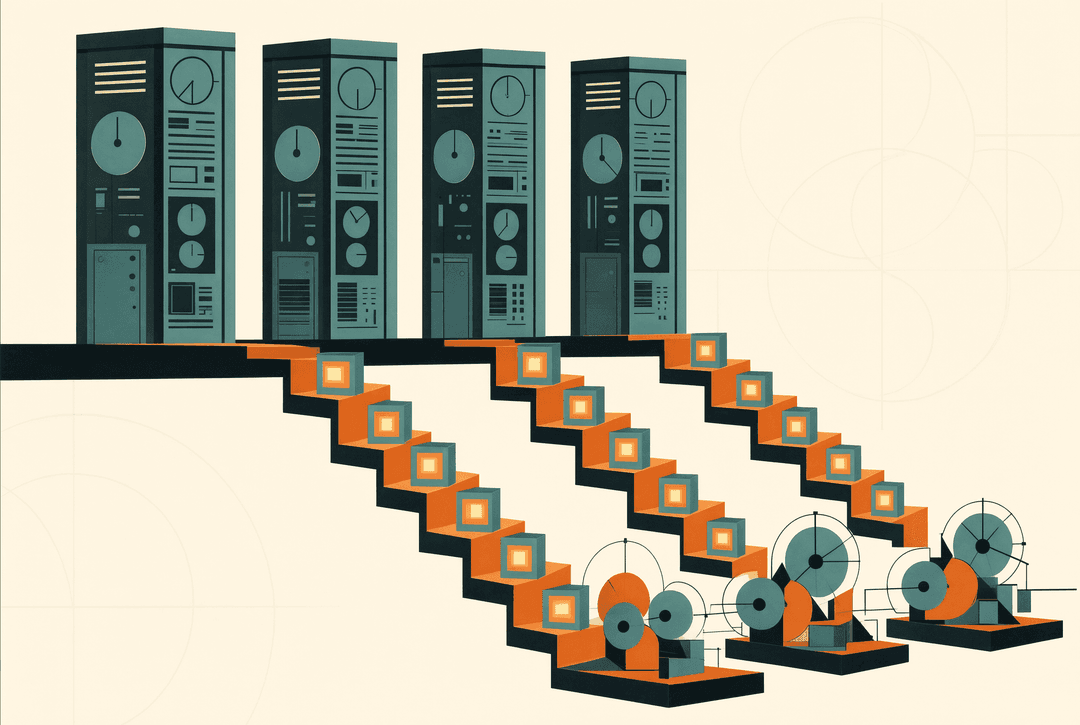
The operator evidence points the other way, and it is stronger than the product-cycle argument gives credit for.
Physical retirement dates are long. Google Cloud only shut down its last P100 instances in 2026, nine years after the chip launched; Azure retired V100 instances at eight; CUDA 13.0 dropped Volta support eight years in. Failure data, read correctly, agrees: Meta's widely quoted Llama 3 paper counted 419 unplanned job interruptions in 54 days on 16,384 H100s, but those are restarts, not dead cards. Actual replacement rates from the NCSA Delta cluster run 0.36% a year for A100s and 0.82% for H100s, and Oak Ridge ran 27,756 V100s for five and a half years at over 80% utilization with 0.4% ever throwing a double-bit error. The "one to three years" figure circulating in bear posts traces to a single 2024 quote from an unnamed source, repeated since (Princeton CITP, Data Gravity).
The market data also disagrees with planned obsolescence. An A100 launched in 2020 at a $4.10/hour cloud price still rents for $1.02 to $1.58, and A100 hardware still sold for thousands of dollars per card in August 2026, when every depreciation schedule has it at zero (American Compute Rack Report). H100 rental prices did collapse, from over $8/hour in 2023 to a $1.70 one-year contract floor in October 2025, then reversed: $2.35 by March 2026, $2.75 spot by September, with CoreWeave reporting rising prices across A100, H100 and H200 in the same quarter (Data Gravity, citing SemiAnalysis composites). Nvidia told analysts in a November 2025 memo that its customers depreciate GPUs over four to six years based on real-world longevity (CNBC).
Even the resale market's own bookkeeping is ambiguous. American Compute's June 2026 residual-value study found a six-year straight-line schedule tracks its "moderate" resale band in 12 of 20 sampled GPU-years and never books a card above what buyers actually pay. Five years tracks the conservative band. Four years writes GPUs below market (American Compute). A lender's view: on the same fleet, a 65% advance rate is fully covered for three years on a new B300 and uncovered for two years on a new H200, because the H200 is already two years into its technology life the day it is bought.
The part both sides keep missing
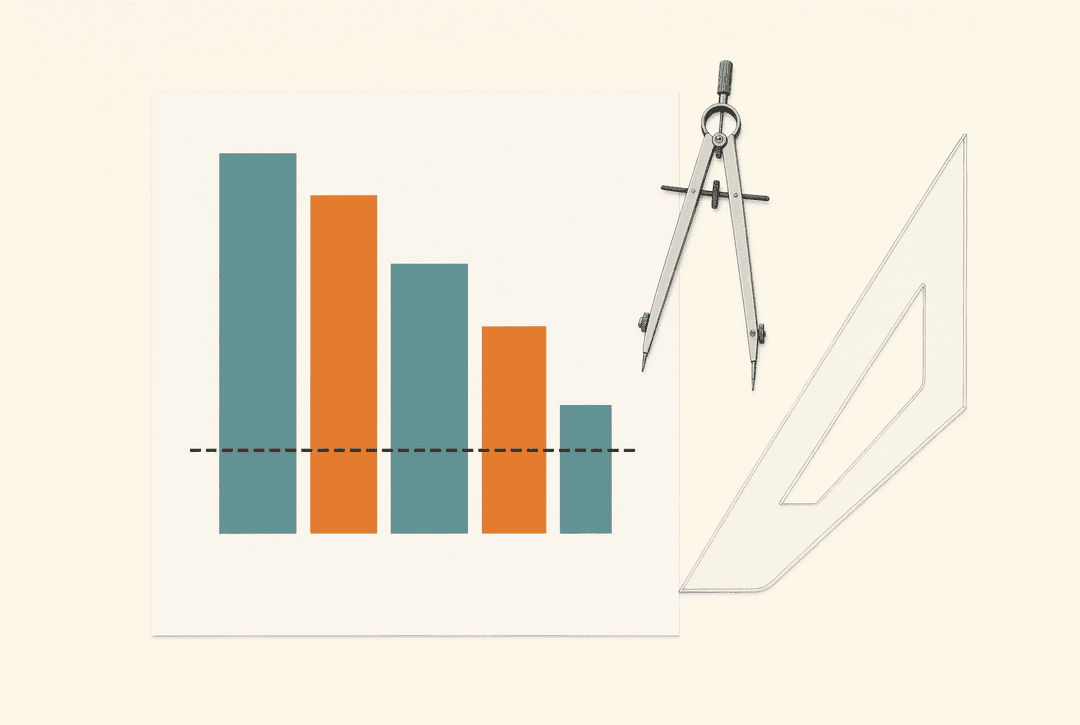
Here is the synthesis that Data Gravity's Chris Zeoli makes and neither the accusation nor the defense does: the length is defensible; the shape is not.
A GPU's earning power is front-loaded. Model an H100 bought in late 2023 at $40,000 all-in, rented at the rates that actually prevailed: it nets about $32,500 of cash in year one, $17,800 in year two, $14,700 in year three, and around $12,000 in each later year at then-current contract rates. Half the lifetime cash arrives in the first two years. Straight-line depreciation charges that asset exactly $6,667 a year, every year, as if it earned uniformly. In year one the charge covers 21% of the cash the card generated; in year six, 56%.
An accounting method for exactly this problem exists: accelerated depreciation. Sum-of-years-digits would charge $11,400 in year one and $1,900 in year six and track the cash within a few points. No hyperscaler uses it. Industries that rent out depreciating hardware do manage the schedule actively: rental-car firms set depreciation from used-vehicle markets and revise quarterly, and Hertz took a $245 million charge in late 2023 when EV resale values fell. The neocloud lenders are closer to the truth than the borrowers' accountants: GPU-backed loans amortize over three to five years, inside the customer contract (Data Gravity).
Why does shape matter if the six-year total charge is the same? Because the fleet is not in steady state. The four largest buyers guided roughly $670 billion of 2026 capex against about $380 billion in 2025, and when the installed base grows around 50% a year, 61% of deployed cards are two years old or younger. In a young, fast-growing fleet, straight-line books less depreciation than the cash profile in every quarter. Distillate Capital measured the fingerprint: hyperscaler depreciation ran around 80% of capex for most of the last decade and is now under 40%, a gap that looks like aggressive accounting but is mostly a young fleet (Data Gravity).
The arithmetic flips when growth slows. The same policy that flatters margins while the base doubles starts overstating the charge on aging cards, and margins compress without any chip failing and any schedule changing. About ten points of the current margin picture, on this reading, is a function of the capex growth rate, not of hardware longevity.
What to watch instead of the timeline fight
Three things are worth more than another useful-life opinion:
- Impairment charges, not policy changes. No large buyer is likely to shorten schedules voluntarily; Amazon's 2025 partial cut is the only one on record. Forced write-downs, the way Hertz ate the EV resale collapse, are the mechanism that actually corrects book values (Dave Friedman, Substack).
- The depreciation-to-capex ratio. It is below 40% now versus near 80% a few years ago. As it rises back toward the growth rate, reported margins will drift down even with zero new accounting decisions.
- Free cash flow per share, not EPS. Depreciation is added back to cash flow, so the entire fight happens inside a line investors can bypass in one click. Microsoft's FY2026 annual report shows depreciation jumping from $15.2 billion (FY2024) to $22.0 billion (FY2025) to $34.3 billion (FY2026) even under six-year lives (Microsoft 2026 Annual Report). The bill arrives on schedule either way.
The GPUs are not dying after two years, and the six-year life is not obviously a fiction. What is true is narrower and more interesting: the hardware earns early, the books charge evenly, and a fleet growing 50% a year turns that mismatch into tens of billions of dollars of present-day profit that belongs, economically, to a future that has not shown up yet.
Sources
- Michael Burry, X post, November 10, 2025: https://x.com/michaeljburry/status/1987918650104283372
- CNBC, "Big Short investor Michael Burry accuses AI hyperscalers of artificially boosting earnings," November 11, 2025: https://www.cnbc.com/2025-11-11/big-short-investor-michael-burry-accuses-ai-hyperscalers-of-artificially-boosting-earnings.html
- CNBC, "Nvidia pushes back on charges that AI investment is a bubble," November 25, 2025: https://www.cnbc.com/2025-11-25/nvidia-pushes-back-on-charges-that-ai-investment-is-a-bubble.html
- American Compute, "GPU Depreciation Schedules vs Resale Value," October 2026: https://www.amcompute.com/blog/gpu-useful-life-depreciation-schedules
- Chris Zeoli, "How Long Does a GPU Last?" Data Gravity, November 2026: https://www.datagravity.dev/p/how-long-does-a-gpu-last
- Michael Burry, "Short Thoughts," Cassandra Unchained, July 8, 2026: https://michaeljburry.substack.com/p/short-thoughts-july-8-2026-nvda-neos
- Dwarkesh Patel interview with Satya Nadella, November 2025: https://www.dwarkesh.com/p/satya-nadella-2
- Mihir Kshirsagar, "Lifespan of AI chips: the $300 billion question," Princeton CITP, October 15, 2025: https://blog.citp.princeton.edu/2025-10-15/lifespan-of-ai-chips-the-300-billion-question/
- Microsoft FY2026 Annual Report: https://www.microsoft.com/investor/reports/ar26/index.html
- Amazon 2024 10-K: https://www.sec.gov/Archives/edgar/data/1018724/000101872425000004/amzn-20241231.htm
- Amazon 2025 10-K: https://www.sec.gov/Archives/edgar/data/1018724/000101872426000004/amzn-20251231.htm
- Meta 2025 10-K: https://www.sec.gov/Archives/edgar/data/1326801/000162828026003942/meta-20251231.htm
- Nebius interim financials, August 2026: https://www.sec.gov/Archives/edgar/data/1513845/000110465926094844/nbis-20260812xex99d2.htm
- MBI Deep Dives, "Big Tech's Deteriorating Earnings Quality": https://www.mbi-deepdives.com/big-tech-earnings-quality
- Flossbach von Storch Research Institute, "Hyperscalers: The New Heavy Industry": https://www.flossbachvonstorch-researchinstitute.com/en/studies/detail/hyperscalers-the-new-heavy-industry
- Dave Friedman, "The $176 Billion Accounting Question at the Heart of the AI Boom": https://davefriedman.substack.com/p/the-176-billion-accounting-question
