
Standard retrieval-augmented generation (RAG) architectures operate on a naive assumption: that the raw user query is suitable for direct retrieval against a vector database or lexical search index. In production, this assumption fails across significant query distributions. Raw user queries are frequently short (averaging 4 to 8 words), structurally underspecified, conversational, or laden with unresolved pronoun bindings. Conversely, indexed document chunks typically contain 256 to 1024 tokens of dense, domain-specific text with complex technical phrasing.
This structural mismatch introduces severe retrieval degradation in dense bi-encoder architectures. Bi-encoders map queries and passages into a shared vector space, but cosine similarity between a brief, high-level query vector and a comprehensive document passage often captures stylistic proximity rather than true informational relevance.
To bridge this semantic asymmetry, production RAG systems deploy pre-retrieval query transformation layers. By rewriting, expanding, abstracting, or synthesizing pseudo-documents from the initial prompt before executing vector and keyword searches, systems can dramatically increase retrieval recall. However, these techniques introduce non-trivial latency overheads, vector database query amplification, and specific hallucination failure modes.

Core Query Transformation Topologies
Query transformation is not a monolithic technique. Production systems leverage four primary transformation archetypes, each targeting distinct retrieval failure modes.
1. Hypothetical Document Embeddings (HyDE)
Introduced by Gao et al. (2022), Hypothetical Document Embeddings (HyDE) bypass the query-document asymmetry by pivoting entirely into document space.
Given an input query, HyDE instructs an instruction-tuned language model to generate a hypothetical passage that answers the query, without access to external knowledge. The synthetic passage is then passed to an embedding encoder (such as Contriever or standard dense embedding models) to compute the retrieval vector. The vector database retrieves real corpus documents closest to the synthetic document vector in embedding space.
Why it works: Even if the hypothetical document contains factual inaccuracies, its linguistic register, vocabulary, domain terminology, and semantic structure closely mirror the distribution of real documents in the target corpus. The embedding model acts as a lossy filter, capturing the topical neighborhood while discarding granular factual hallucinations.
Failure modes: HyDE degrades when the query pertains to obscure, private, or newly minted entities unknown to the generator model. If the language model hallucinates a plausible but incorrect conceptual framework (for example, inventing a fictional API endpoint or proprietary algorithm), the resulting vector pulls retrieval into irrelevance.
2. Query Expansion and Query2doc
Query expansion enriches the lexical and semantic footprint of the query. In traditional information retrieval, this was accomplished using pseudo-relevance feedback (PRF) or synonym ontologies. Modern LLM-based query expansion, formalized by Wang et al. (2023) in Query2doc, prompts a model to generate few-shot pseudo-documents that are concatenated directly with the original query string.
For sparse retrieval (such as BM25), the expanded query string injects crucial domain keywords, synonyms, and related acronyms that the user omitted. For dense retrieval, concatenating the pseudo-document expands the token context, stabilizing the embedding vector against out-of-vocabulary terms.
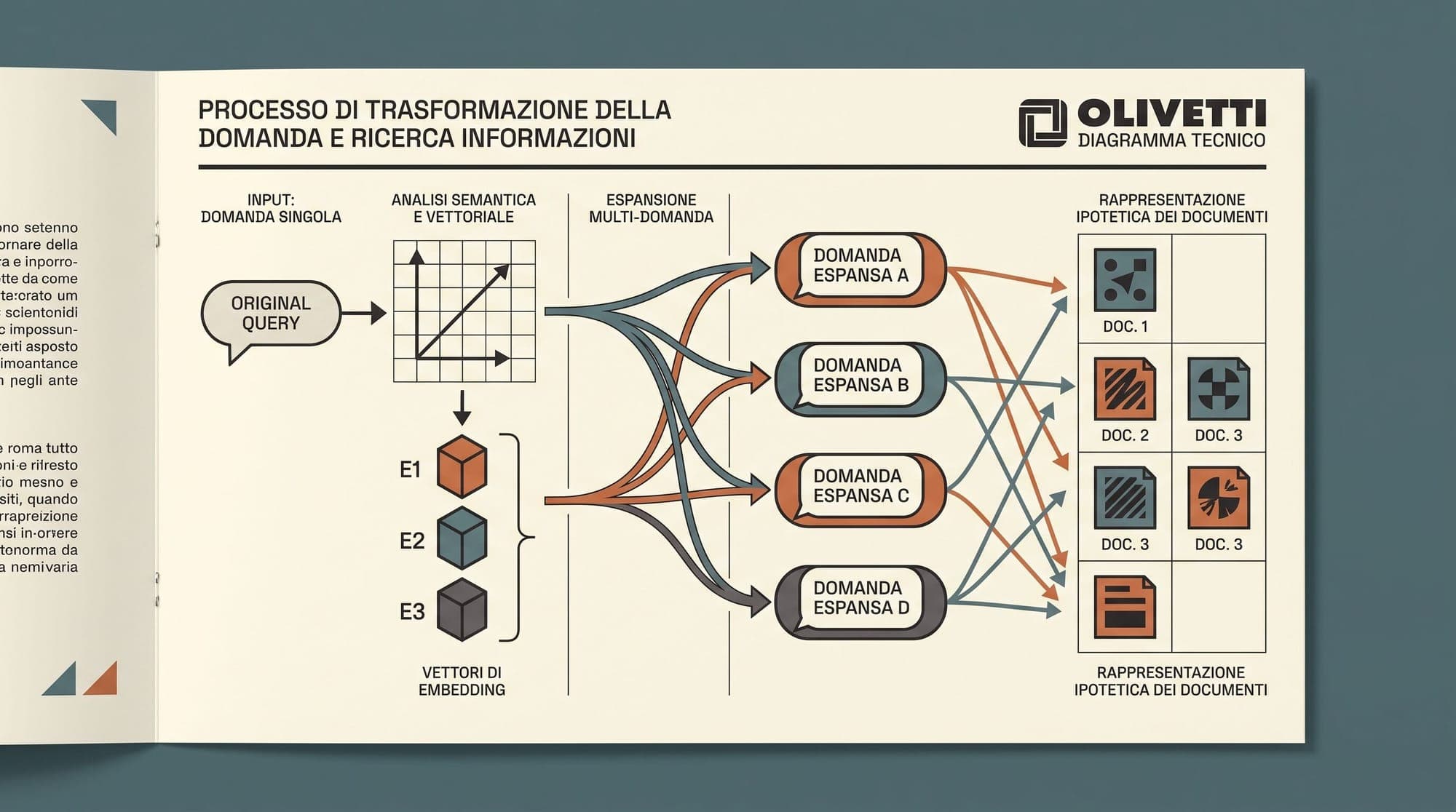
3. Multi-Query Expansion and Sub-Query Decomposition
Multi-query expansion generates multiple distinct query reformulations from different semantic perspectives. For example, an ambiguous user query like "Kubernetes pod eviction reasons" can be expanded into:
- Resource pressure and NodePressure thresholds causing Kubernetes pod eviction
- Preemption and priority class eviction mechanisms in Kubernetes
- Taints and tolerations resulting in pod eviction on Kubernetes nodes
Each reformulated query is executed independently against the retrieval index in parallel. The resulting candidate sets are deduplicated and merged using Reciprocal Rank Fusion (RRF), where the score for document d is the sum of 1 / (60 + rank) across all result lists.
Sub-query decomposition is applied to multi-hop analytical queries. The transformation engine decomposes the prompt into discrete single-hop lookups, retrieving targeted context for each component before downstream generation.
4. Step-Back Prompting
Formalized by Zheng et al. (2023), Step-Back Prompting instructs the model to derive high-level concepts and first-principles abstractions from an instance-level query.
When presented with a specific problem, the step-back transformation generates an abstract inquiry regarding underlying principles. Retrieving both the high-level principles and the instance-specific facts equips the downstream generation model with the theoretical framing needed to avoid reasoning missteps.
Production Latency Economics and Model Tiering
The primary barrier to deploying query transformation in latency-critical production environments is the pre-retrieval latency tax.
In a baseline RAG pipeline, the retrieval stage incurs only embedding inference latency (10 to 30ms on GPU) and vector index search (5 to 20ms). Introducing an LLM query transformation step inserts a generative model invocation before retrieval can begin, adding 150 to 500ms of Time-to-First-Token (TTFT) and generation delay.
Latency and Fan-Out Profiles by Transformation Strategy
- Direct Retrieval (Baseline): 0 additional LLM calls, 1x retrieval multiplier, 0ms latency overhead. Best for high-precision, exact-match queries.
- Conversational Rewrite: 1 fast SLM call, 1x retrieval multiplier, 40 to 90ms latency overhead. Resolves multi-turn chat and pronoun bindings into standalone search terms.
- HyDE: 1 fast SLM call, 1x retrieval multiplier, 80 to 180ms latency overhead. Best for short, conceptual, zero-shot queries.
- Multi-Query Expansion: 1 fast SLM call, 3x to 5x retrieval multiplier, 60 to 140ms latency overhead. Best for ambiguous, broad, or exploratory searches.
- Step-Back Prompting: 1 fast SLM call, 2x retrieval multiplier, 60 to 120ms latency overhead. Best for multi-step reasoning and STEM problems.
- Query Decomposition: 1 fast SLM call, 2x to 4x retrieval multiplier, 80 to 160ms latency overhead. Best for complex comparative questions.
Mitigating Latency with Small Language Models
Using frontier models for query transformation is an anti-pattern that inflates serving costs and pushes end-to-end P95 latency beyond acceptable SLAs.
Production systems deploy dedicated Small Language Models (1B to 3B parameters), such as Llama-3.2-1B/3B or Qwen-2.5-3B, hosted on local inference backends (such as vLLM or SGLang) with FP8 or INT4 quantization. These compact models execute transformation prompts with sub-50ms TTFT and generation times under 100ms.
Speculative Pre-Retrieval
To eliminate perceived latency, systems can execute speculative dual-path retrieval:
- Upon receiving the user query, immediately fire a baseline vector search on the raw query in parallel with the transformation generation.
- If the baseline retrieval returns high-confidence scores (such as cosine similarity exceeding 0.88 on dense vectors or high BM25 scores), begin streaming the initial generation tokens.
- If the transformation completes and identifies distinct high-relevance documents, dynamically splice the expanded context into the generation stream or trigger a re-ranking pass.
Vector Database Load and Reranking Architecture
Deploying multi-query expansion multiplies the Queries Per Second (QPS) received by downstream vector databases. Expanding every incoming request into 4 sub-queries increases database load by 400%, potentially exhausting HNSW graph traversal compute and memory bandwidth on dense vector clusters.
To maintain throughput and stability:
- Cap Fan-Out: Limit multi-query expansion to 3 to 4 variants maximum.
- Batch Vector Lookups: Group the generated embeddings into a single batched k-NN search query rather than issuing sequential network requests.
- Mandatory Cross-Encoder Reranking: Query expansion inevitably increases retrieval noise alongside recall. A lightweight cross-encoder reranker (such as BGE-Reranker-v2-m3 or Cohere Rerank) must be placed after the Reciprocal Rank Fusion stage to prune spurious matches down to top-K candidates before context assembly.
Production Decision Matrix
Query transformation should not be applied uniformly to every request. A production gateway routes incoming queries dynamically based on deterministic heuristics and lightweight classification:
- Multi-turn conversations with unresolved pronouns: Route to conversational contextualization rewriter.
- Queries under 6 words with abstract concepts: Route to HyDE synthetic document generator.
- Multi-hop comparative inquiries: Route to query decomposition engine.
- Domain-specific terminology with missing synonyms: Route to Query2doc BM25 expansion.
- Exact identifiers, code symbols, or product UUIDs: Bypass transformation and route to direct hybrid search.
Implementation: Async Transformation and Fusion Engine
Below is a production-ready asynchronous Python implementation demonstrating query classification, parallel multi-query transformation, concurrent vector retrieval, and Reciprocal Rank Fusion.
import asyncio
from typing import List, Dict, Any
from dataclasses import dataclass
import httpx

@dataclass
class SearchResult:
    doc_id: str
    content: str
    score: float

class QueryTransformationPipeline:
    def __init__(
        self,
        slm_endpoint: str,
        vector_db_client: Any,
        embedding_client: Any,
        rrf_k: int = 60
    ):
        self.slm_endpoint = slm_endpoint
        self.vdb = vector_db_client
        self.embedder = embedding_client
        self.rrf_k = rrf_k

    async def generate_transformations(self, query: str) -> List[str]:
        """Generate 3 diverse search queries using a low-latency SLM."""
        prompt = (
            f"You are an expert search retrieval optimizer. Given the user query, "
            f"output exactly 3 diverse search queries that capture different perspectives, "
            f"synonyms, and technical phrasing. Output one per line without numbering.\n\n"
            f"Query: {query}"
        )

        async with httpx.AsyncClient(timeout=1.5) as client:
            response = await client.post(
                f"{self.slm_endpoint}/v1/completions",
                json={
                    "prompt": prompt,
                    "max_tokens": 80,
                    "temperature": 0.3,
                    "stop": ["\n\n"]
                }
            )
            raw_text = response.json()["choices"][0]["text"].strip()
            variants = [line.strip("- ").strip() for line in raw_text.split("\n") if line.strip()]

            # Ensure original query is always retained
            return list(set([query] + variants[:3]))

    async def execute_retrieval(self, query: str, top_k: int = 20) -> List[SearchResult]:
        """Embed a single query variant and query the vector database."""
        vector = await self.embedder.embed_query(query)
        results = await self.vdb.search(vector=vector, limit=top_k)
        return [SearchResult(doc_id=r["id"], content=r["text"], score=r["score"]) for r in results]

    def reciprocal_rank_fusion(
        self,
        result_lists: List[List[SearchResult]],
        final_top_k: int = 10
    ) -> List[SearchResult]:
        """Fuse multiple ranked result lists using Reciprocal Rank Fusion."""
        rrf_scores: Dict[str, float] = {}
        doc_map: Dict[str, SearchResult] = {}

        for results in result_lists:
            for rank, item in enumerate(results):
                doc_id = item.doc_id
                doc_map[doc_id] = item
                if doc_id not in rrf_scores:
                    rrf_scores[doc_id] = 0.0
                rrf_scores[doc_id] += 1.0 / (self.rrf_k + rank + 1)

        sorted_docs = sorted(
            rrf_scores.keys(),
            key=lambda x: rrf_scores[x],
            reverse=True
        )

        fused_results = []
        for doc_id in sorted_docs[:final_top_k]:
            original_item = doc_map[doc_id]
            fused_results.append(
                SearchResult(
                    doc_id=doc_id,
                    content=original_item.content,
                    score=rrf_scores[doc_id]
                )
            )
        return fused_results

    async def search(self, query: str, top_k: int = 10) -> List[SearchResult]:
        """Execute full transformation, parallel retrieval, and fusion."""
        # Step 1: Expand queries via SLM
        query_variants = await self.generate_transformations(query)

        # Step 2: Parallel retrieval across all variants
        tasks = [self.execute_retrieval(q, top_k=25) for q in query_variants]
        retrieval_batches = await asyncio.gather(*tasks)

        # Step 3: Reciprocal Rank Fusion
        fused_candidates = self.reciprocal_rank_fusion(retrieval_batches, final_top_k=top_k)
        return fused_candidates
Architectural Guidelines for Production Deployment
- Gate Transformations Dynamically: Never apply HyDE or multi-query expansion to high-specificity entity searches (such as error codes, product serial numbers, or UUIDs). Direct keyword and hybrid dense-sparse search outperforms generative rewriting on exact-match lookups.
- Keep Transformation Temperature Low: Set generation temperature between 0.1 and 0.3. High temperature encourages lexical diversity at the cost of semantic drift and fictitious hallucinations.
- Bound Generation Length: Cap pseudo-document and expansion token generation at 60 to 120 tokens. Longer generations linearly increase TTFT latency without yielding proportional recall improvements.
- Enforce Downstream Reranking: Always pair multi-query expansion with a cross-encoder reranker to discard off-topic passages before they contaminate the context window of the generator model.
Sources
- Gao, L., Ma, X., Lin, J., & Callan, J. (2022). Precise Zero-Shot Dense Retrieval without Relevance Labels. arXiv:2212.10496.
- Wang, L., Yang, N., & Wei, F. (2023). Query2doc: Query Expansion with Large Language Models. arXiv:2303.07678.
- Zheng, H. S., Mishra, S., Chen, X., Cheng, H.-T., Chi, E. H., Le, Q. V., & Zhou, D. (2023). Take a Step Back: Evoking Reasoning via Abstraction in Large Language Models. arXiv:2310.06117.
- Cormack, G. V., Clarke, C. L., & Büttcher, S. (2009). Reciprocal Rank Fusion Outperforms Condorcet and Individual Rank Learning Methods. In Proceedings of the 32nd International ACM SIGIR Conference on Research and Development in Information Retrieval (SIGIR '09).



