
When a coding agent fails to edit a file, the error is usually a version of the same sentence: the text you searched for does not match the current contents. Not close. Not similar. Exactly. One mistyped space inside a forty-line block, and the edit is refused.
How far "close" is from "exactly" has a formal answer. It comes from a 1966 paper on communication codes, predates spell-check, and now sits underneath most of the machinery that keeps language models from corrupting your data and your files. Here is what edit distance is, and where it runs inside modern AI systems.
The number of edits between two strings
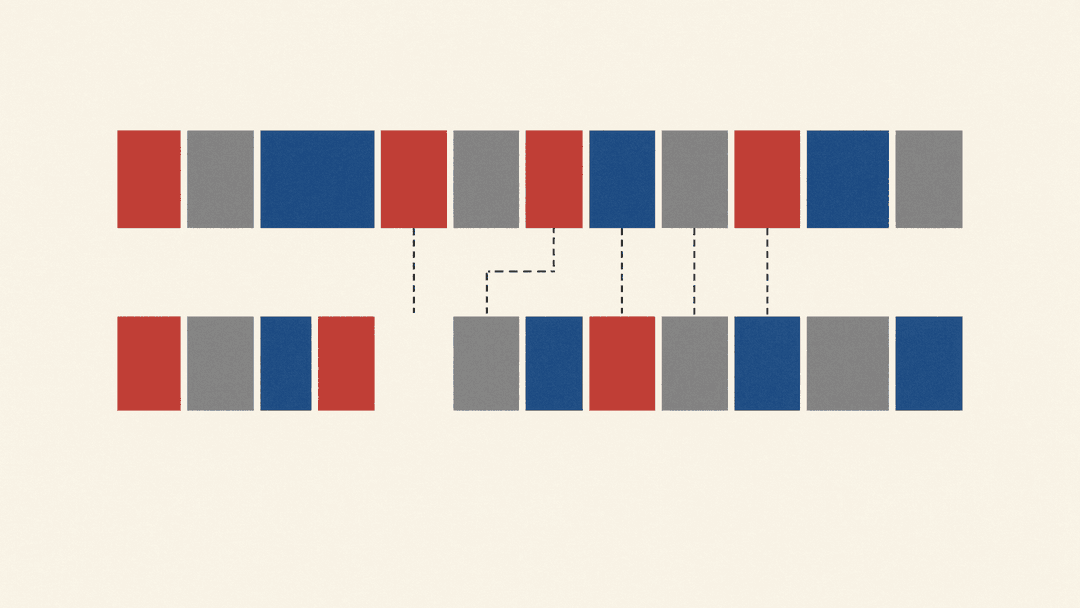
Edit distance counts the fewest single operations that turn one string into another. The classic version, Levenshtein distance, allows three: insert a character, delete one, or substitute one. Turning "kitten" into "sitting" costs three: swap k for s, swap e for i, add a g at the end. A closely related variant, the Damerau-Levenshtein distance, also counts swapping two adjacent characters, so typing "recieve" for "receive" costs 1 instead of 2.
The origin is less text-friendly than the application suggests. Vladimir Levenshtein's 1966 paper "Binary codes capable of correcting deletions, insertions, and reversals" studied communication channels that drop digits, repeat digits, or flip their order, and asked how much redundancy a code needs to survive that damage. Text processing borrowed the counting rule later.
The grid, and why typos are cheap
The standard algorithm fills a table with dynamic programming. Lay one string across the top and one down the side, and each cell holds the distance between the two prefixes that end at that row and column. The update rule is three cheap local choices: take the value from the left, above, or diagonal, and add one if the two characters disagree. Comparing two strings of length 1,000 means roughly a million cells. The same recurrence family also underlies sequence alignment in computational biology, where the "strings" are DNA and proteins.
The reason this is tractable in practice is a statistic, not an algorithm. In 1964, Fred Damerau studied real spelling errors logged by an information-retrieval system and reported that more than 80 percent were a single error of one of four types: a substituted letter, a transposition of adjacent letters, an insertion, or a deletion. Human typos are local. The correct word is usually one or two edits away, so you only ever need to search a tiny neighborhood.
Peter Norvig turned that observation into twenty lines of Python in his 2006 essay "How to Write a Spelling Corrector": generate dictionary words at edit distance 1 from a misspelling, fall back to distance 2, and rank candidates by word frequency. In his development set, 267 of 270 misspellings sat within distance 2 of the intended word (23 of 400 in the harder test set). Spell-check feels clairvoyant because the neighborhood it searches is nearly always where the answer lives.
The training-data janitor
The same metric became a quality-control tool for the corpora models learn from. In work published at ACL 2022, Katherine Lee, Daphne Ippolito and colleagues found that web-scraped datasets are full of near-duplicates: a single 61-word English sentence appears more than 60,000 times in C4, a standard training corpus. Models trained on such data recite training text verbatim in over 1 percent of unprompted completions.
Their cleanup pipeline uses edit distance twice. Cheap MinHash signatures over five-word shingles propose candidate duplicate pairs, and a pair is kept as a duplicate only if its edit similarity, the edit distance normalized by string length, clears 0.8. Deduplicating the datasets cut memorized regurgitation roughly tenfold and let models reach the same or better accuracy with fewer training steps. Fuzzy by design, because near-duplicates, not exact copies, are what crawlers collect.
The patch that has to match exactly

The last stop is the file-edit step in coding agents. Claude Code, Codex and Aider all have the model emit edits as search-and-replace blocks or anchored diffs, which forces the model to reproduce existing file contents before anything is written. The applying tool then checks whether the anchor text matches the file.
And here the industry made a counterintuitive choice. Aider shipped Levenshtein-style fuzzy matching of search blocks early on, so a model's anchor text within a few edits of the file would still apply. Then it disabled the feature. The maintainer's reasoning: models often leave semantically significant lines out of both the search block and the replacement, and a forgiving matcher converts that omission into a silent deletion of important code. A near-match applied is a bug shipped. Exact-match plus a failure message sent back to the model, prompting a retry, proved safer than the distance metric itself.
The metric did not disappear from the loop. It moved into the scoreboard. Aider's benchmarks of edit formats found that asking GPT models to return a full rewritten file was the most reliable way to land edits, at the cost of latency and tokens; diff formats only won as models got better at exact reproduction. OpenAI said it specifically trained GPT-4.1 to follow diff formats more reliably, and reported more than double GPT-4o's score on Aider's polyglot diff benchmark. Model quality is now partly measured by how well a model quotes strings back exactly.
So a counting trick from Soviet coding theory runs three layers of the modern stack: it finds the word you meant to type, it decides which web documents the lab actually trains on, and it decides whether your agent's patch lands or bounces. The engineering lesson is the mild one: a near-match metric is often most valuable as a failure detector. Measure the distance, and when it is not zero, make the model try again.
Sources
- V. I. Levenshtein, "Binary codes capable of correcting deletions, insertions, and reversals," Soviet Physics Doklady 10(8), 1966: http://ui.adsabs.harvard.edu/abs/1966SPhD...10..707L/abstract
- Levenshtein distance (definition and dynamic-programming computation): https://en.wikipedia.org/wiki/Levenshtein_distance
- Damerau-Levenshtein distance, including Damerau's 1964 spelling-error findings (Communications of the ACM 7(3)): https://en.wikipedia.org/wiki/Damerau%E2%80%93Levenshtein_distance
- Peter Norvig, "How to Write a Spelling Corrector," 2006: https://www.norvig.com/spell-correct.html
- Katherine Lee et al., "Deduplicating Training Data Makes Language Models Better," ACL 2022: https://arxiv.org/abs/2107.06499
- Aider, "GPT code editing benchmarks": https://aider.chat/docs/benchmarks.html
- Aider issue 306 on disabling Levenshtein fuzzy matching of search blocks: https://github.com/paul-gauthier/aider/issues/306
- OpenAI, "Introducing GPT-4.1 in the API" (diff-format training and Aider polyglot scores): https://openai.com/index/gpt-4-1
- Gabriel Anhaia, "Exact-Match Edits vs Patches: How Claude Code, Codex and Aider Write to Your Files": https://dev.to/gabrielanhaia/exact-match-edits-vs-patches-how-claude-code-codex-and-aider-write-to-your-files-45d1
