

Production retrieval-augmented generation (RAG) systems frequently fail at the first retrieval boundary. When pipelines rely exclusively on dense bi-encoder embeddings, they struggle with exact keyword matching, out-of-vocabulary product codes, compliance identifiers, and rare acronyms. Conversely, when systems rely solely on lexical search like BM25, they fail on vocabulary mismatch, paraphrased queries, and semantic abstraction.
Hybrid search architectures resolve this tension by executing dual-path retrieval across lexical and semantic indexes, aggregating candidate sets through rank and score fusion algorithms, and refining final context windows using deep cross-encoder rerankers.

The Fundamental Failure Modes of Single-Retriever Pipelines
Single-paradigm retrieval architectures impose structural limitations on generative pipelines:
- Dense Bi-Encoder Failures: Dense embedding models map text into low-dimensional continuous vector spaces (typically 768 to 3072 dimensions). While effective at capturing broad conceptual intent, dense embeddings compress the entire sequence into a single fixed-width representation. This bottleneck causes catastrophic loss of exact token details. In technical documentation, legal contracts, or customer support datasets, queries targeting specific SKUs (such as
AX-9021-v3), hexadecimal error codes, or legal clauses (Section 12.4.1) return irrelevant candidates because the embedding model treats these distinct tokens as out-of-distribution noise or averages them into generic token neighborhoods. - Sparse BM25 Failures: Standard lexical search indexes documents using inverted term tables weighted by term frequency and inverse document frequency. BM25 assumes orthogonality between vocabulary terms. If a user asks "how to eliminate GPU memory fragmentation" and a document discusses "mitigating VRAM allocation overhead", BM25 assigns a relevance score of zero because there is no lexical term overlap.
Hybrid search resolves these trade-offs by pairing high-recall sparse retrieval with high-precision semantic dense retrieval.
Sparse Retrieval Paradigms: BM25 vs. SPLADE
Modern hybrid architectures implement sparse retrieval through two primary mechanisms: classic statistical bag-of-words scoring or learned neural sparse expansion.
1. Classical BM25 (Best Matching 25)
The Okapi BM25 ranking function computes document relevance relative to a query with terms using the following formulation:
Where:
- represents the term frequency of token within document .
- and represent document length and average collection document length, respectively.
- (typically calibrated between and ) controls term frequency saturation limits.
- (typically set to ) governs document length penalization.
- , where is total documents and is document frequency of term .
BM25 requires zero neural inference at query time, executes in sub-millisecond CPU latency on inverted indexes (such as Lucene, Tantivy, or inverted tables in vector databases), and provides deterministic keyword matching.
2. Learned Sparse Encoders: SPLADE v2
SPLADE (Sparse Lexical and Expansion Model) replaces heuristic term counts with neural vocabulary predictions. Rather than embedding text into a dense vector, SPLADE uses a BERT-based transformer encoder to project input tokens onto the full vocabulary space ( dimensions for bert-base-uncased).
For a document with token sequence , the model computes a sparse weight for every token in vocabulary :
Where is the transformer output representation at token position , and is the masked language modeling prediction head.
SPLADE introduces two distinct architectural capabilities:
- Neural Term Weighting: Assigns contextual importance to words based on semantic relevance rather than simple inverse document frequency.
- Implicit Term Expansion: Activates related vocabulary tokens not explicitly present in the original document text. For example, a passage containing "cardiovascular health" automatically activates weights for "heart", "artery", and "cardiology".
- Regularized Sparsity: Training utilizes FLOPS and L1 regularization objectives to force the majority of vocabulary activations to zero, allowing the resulting sparse vectors to be indexed directly in standard inverted indexes.
While SPLADE matches or exceeds dense retriever recall on zero-shot benchmarks (such as BEIR), it incurs transformer inference costs during both document ingestion and query processing.
Dense Bi-Encoder Retrieval Mechanics
Dense retrieval architectures employ dual Siamese transformer towers ( and ) to project queries and documents into a shared metric embedding space :
Modern production models (such as BGE-M3, NV-Embed-v2, and text-embedding-3-large) optimize parameters using multi-stage contrastive training with hard negatives and InfoNCE loss objectives.
Dense vectors are indexed in memory-optimized graph structures, predominantly Hierarchical Navigable Small World (HNSW) or Inverted File with Product Quantization (IVF-PQ). Dense search excels at cross-lingual alignment, conceptual semantic matching, and handling syntax variability, but remains fundamentally vulnerable to precision degradation on literal key phrases.
Fusion Algorithms: Aggregating Multi-List Candidate Sets
When sparse and dense retrievers execute queries in parallel, each produces a separate ranked candidate list with incompatible score scales. BM25 yields unbounded positive scores , dense cosine similarity yields values in , and inner product metrics depend on vector norm magnitudes.
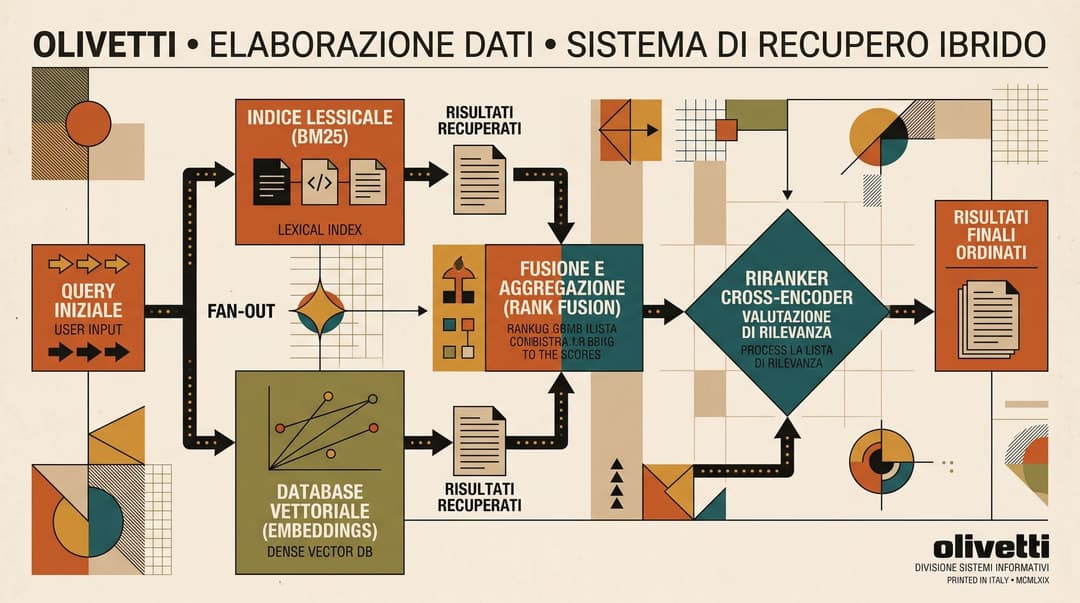
Production systems rely on two primary fusion strategies to combine these disparate result sets.
1. Reciprocal Rank Fusion (RRF)
Introduced by Cormack, Clarke, and Buettcher (SIGIR 2009), Reciprocal Rank Fusion is a score-free, rank-based aggregation algorithm. For a set of candidate documents retrieved across distinct retrieval methods (e.g., ), the RRF score is computed as:
Where:
- is the 1-indexed rank position of document in the result list of retrieval system . If document was not retrieved by system , (evaluating to ).
- is a constant smoothing parameter, empirically established at .
Key architectural properties of RRF:
- Scale Invariance: RRF ignores raw score distributions entirely, preventing high-variance score anomalies from skewing results.
- Top-Rank Preference: The reciprocal function heavily rewards documents appearing in the top 5 positions of either list while gracefully decaying contributions from lower ranks. For instance, with , a rank 1 result contributes , while rank 50 contributes .
- Zero Calibration Overhead: Requires no hyperparameter tuning or labeled relevance training sets to operate effectively across diverse document collections.
2. Relative Score Fusion (RSF) and Convex Linear Combination
When score distributions can be reliably normalized, score-based linear fusion allows explicit weighting between lexical and semantic components:
Where represents the semantic weight bias.
While linear combination enables domain-specific tuning (for example, setting on code repositories where exact syntax matching dominates, or on unstructured customer feedback), min-max normalization remains sensitive to outlier scores in sparse retrieval. If a single document achieves an extreme BM25 score due to repeated rare keywords, standard min-max scaling compresses all other lexical candidates toward zero.
Infrastructure Implementations: Dual-Engine vs. Native Vector Databases
Production engineering teams deploy hybrid search using two primary infrastructure patterns:
Pattern A: Disaggregated Dual-Engine Topology
- Lexical Layer: Elasticsearch, OpenSearch, or Tantivy managing an inverted index.
- Dense Layer: Dedicated vector databases (such as Qdrant, Milvus, or Pinecone) managing dense HNSW indexes.
- Orchestration: The application gateway fans out queries asynchronously to both engines, waits for top- candidate sets (e.g., ), executes in-memory RRF fusion, and passes the merged pool to downstream rerankers.
- Trade-offs: Highest operational flexibility and independent scaling of CPU-bound lexical search vs. RAM/GPU-bound vector search, but requires managing two distributed stateful clusters and cross-network network round-trips.
Pattern B: Unified Native Hybrid Vector Databases
Modern vector databases (including Qdrant, Milvus 2.4+, Weaviate, and Vespa) provide native multi-vector and hybrid indexing within a single cluster node:
- Qdrant: Stores dense vectors alongside sparse vector payloads in a single segment structure, supporting native sparse inverted indexes and built-in RRF fusion queries in a single network round-trip.
- Milvus 2.4+: Implements multi-vector search protocols combining sparse BM25/SPLADE embeddings and dense vectors with built-in RRF and ranker operators.
- Trade-offs: Simplified infrastructure footprint, single write path, and reduced latency jitter, at the cost of unified cluster resource sizing.
The Two-Stage Production Standard: Hybrid Retrieval + Cross-Encoder Reranking
In high-accuracy production RAG, first-stage hybrid retrieval is rarely the final step. First-stage retrieval must evaluate millions of documents in sub-10ms windows, necessitating independent representation encoding (bi-encoders and inverted indexes).
Second-stage retrieval applies a full cross-encoder model (such as BGE-Reranker-v2, Cohere Rerank 3.5, or ColBERTv2 late-interaction architectures) over the top 50 to 100 fused hybrid candidates:
- Query Fan-Out: The incoming user query is dispatched to sparse (BM25/SPLADE) and dense vector indexes.
- First-Stage Fusion: Top 50 candidates from each path are merged using RRF () into a deduplicated candidate pool of 60-80 unique passages.
- Cross-Encoder Scoring: The cross-encoder takes raw
(query, document_passage)text pairs as joint input into a deep bidirectional transformer, computing all-to-all cross-attention across all query and passage tokens. - Context Injection: The top 5 to 10 reranked passages are packed into the LLM system prompt context window.
This two-stage hierarchy eliminates the retrieval blind spots of bi-encoders while bounding computationally intensive cross-attention inference to under 50 input candidate pairs.
Empirical Benchmark Comparisons
Evaluations across standard information retrieval suites demonstrate the consistent performance advantage of hybrid pipelines:
- BEIR Zero-Shot Benchmark: On the 13-dataset aggregate BEIR evaluation suite (Thakur et al., NeurIPS 2021), hybrid retrieval combining BM25 and dense bi-encoders with RRF yields a 26% to 31% improvement in NDCG@10 over pure keyword baselines, and lifts Mean Reciprocal Rank (MRR) from 0.410 to 0.486 (+18.5%).
- Elasticsearch Labs Evaluations: Benchmarking BM25, learned sparse representations, and RRF across BEIR datasets showed that RRF consistently outperforms or matches the best individual retriever on every single test set without requiring dataset-specific tuning.
- MTEB Retrieval Suite: Denser Retriever benchmarks recorded an NDCG@10 of 56.47 for combined hybrid search with reranking versus 54.24 for pure dense vector baselines.
- E-Commerce Search (WANDS Benchmark): On product search datasets characterized by heavy exact-match requirements, basic RRF achieves 0.7068 mean NDCG, outperforming standalone BM25 (0.6983) and standalone KNN dense vector search (0.6953).
Production Recommendations
- Default to RRF for First-Stage Fusion: Unless dedicated labeled query-document datasets are available to continuously optimize linear combination weights (), use Reciprocal Rank Fusion with . RRF eliminates scale normalization bugs and ensures stable retrieval across diverse content domains.
- Cap First-Stage Retrieval Depth: Fetch 50 candidates from the sparse index and 50 candidates from the dense index. Deeper candidate retrieval yields diminishing returns in recall while increasing latency at the reranking stage.
- Always Pair Hybrid Retrieval with a Cross-Encoder Reranker: Hybrid retrieval solves recall by capturing all relevant documents; cross-encoder reranking solves precision by eliminating false positives generated by term overlap or loose semantic associations.
- Evaluate Domain-Specific Sparsity Costs: For standard enterprise text and knowledge bases, BM25 provides near-zero latency overhead and excellent keyword fidelity. For domains with extreme synonym variation and vocabulary mismatch, evaluate SPLADE v2 or hybrid multi-vector architectures.
Update (Oct 19, 2026)
- Cross-encoder reranking on top of first-stage retrieval goes back to monoBERT (Nogueira and Cho, 2019).
Sources
- BEIR: A Heterogeneous Benchmark for Zero-shot Evaluation of Information Retrieval Models (Thakur et al., NeurIPS 2021)
- Reciprocal Rank Fusion Outperforms Condorcet and Individual Rank Learning Methods (Cormack, Clarke, & Buettcher, SIGIR 2009)
- SPLADE: Sparse Lexical and Expansion Model for First Stage Ranking (Formal, Piwowarski, & Clinchant, SIGIR 2021)
- SPLADE v2: Sparse Lexical and Expansion Model for Information Retrieval (Formal, Lassance, Piwowarski, & Clinchant, arXiv 2021)
- Okapi at TREC-3 (Robertson, Walker, Jones, Hancock-Beaulieu, & Gatford, NIST SP 500-225, 1994)
- Improving Information Retrieval in the Elastic Stack: Hybrid Retrieval (Elasticsearch Labs)
- Introducing Reciprocal Rank Fusion for Hybrid Search (OpenSearch Documentation)
- Hybrid Search for RAG: Combining BM25 and Dense Vector Search (Denser AI)
- Sparse Vectors and Hybrid Search in Qdrant (Qdrant Documentation)
- Passage Re-ranking with BERT
