
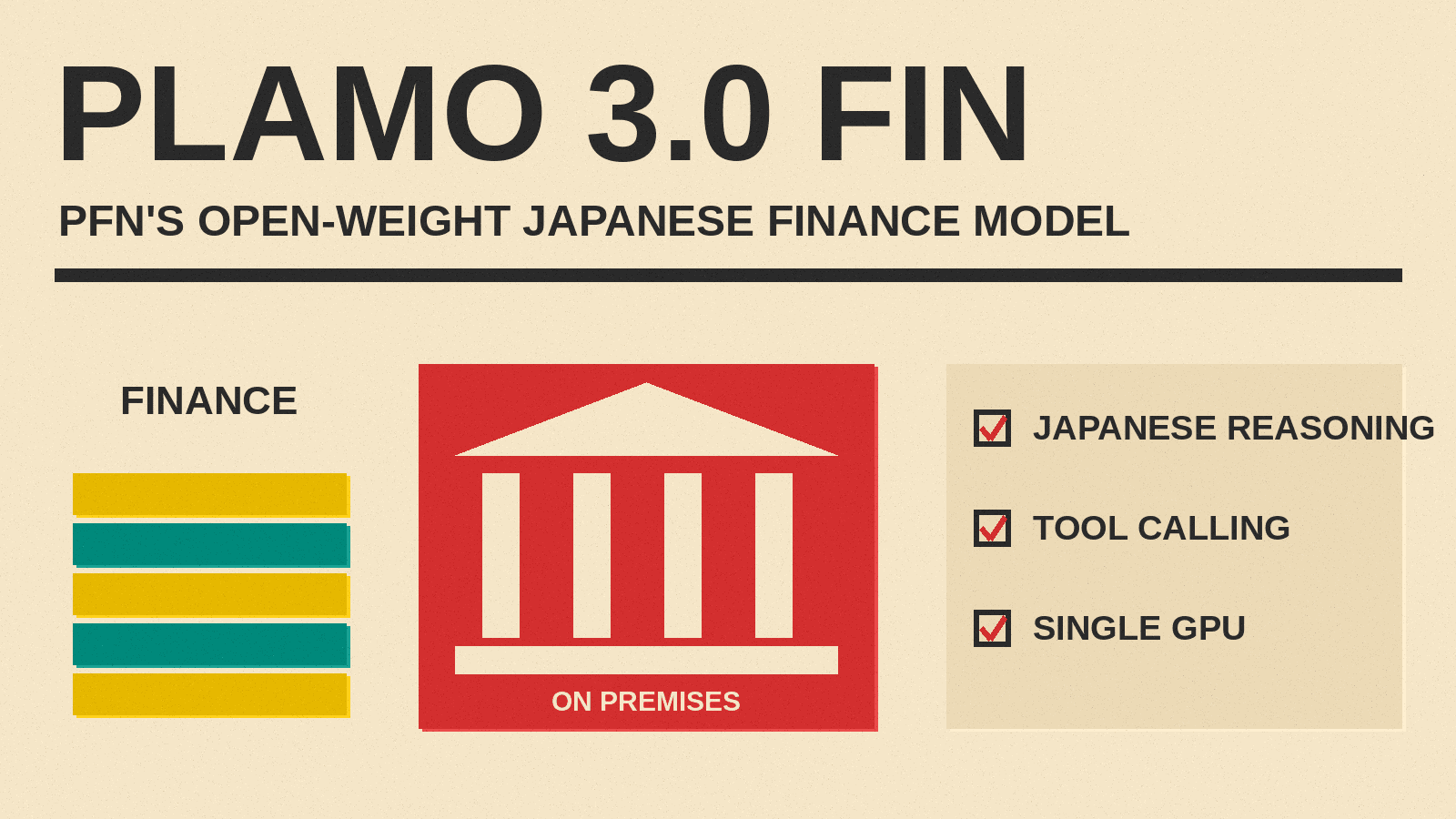
Tokyo-based Preferred Networks (PFN) has released PLaMo 3.0 Fin, a small Japanese language model built for financial work, as open weights on Hugging Face. The press release is dated November 9, 2026. The weights are listed as pfnet/plamo-3-8b-fin-instruct under the PLaMo Community License.
The model card says it "is not a general-purpose assistant." PFN aims it at financial institutions with strict security needs, including closed cloud and on-premises setups.
What PFN released
According to PFN's press release and its technical blog post (both in Japanese), PLaMo 3.0 Fin:
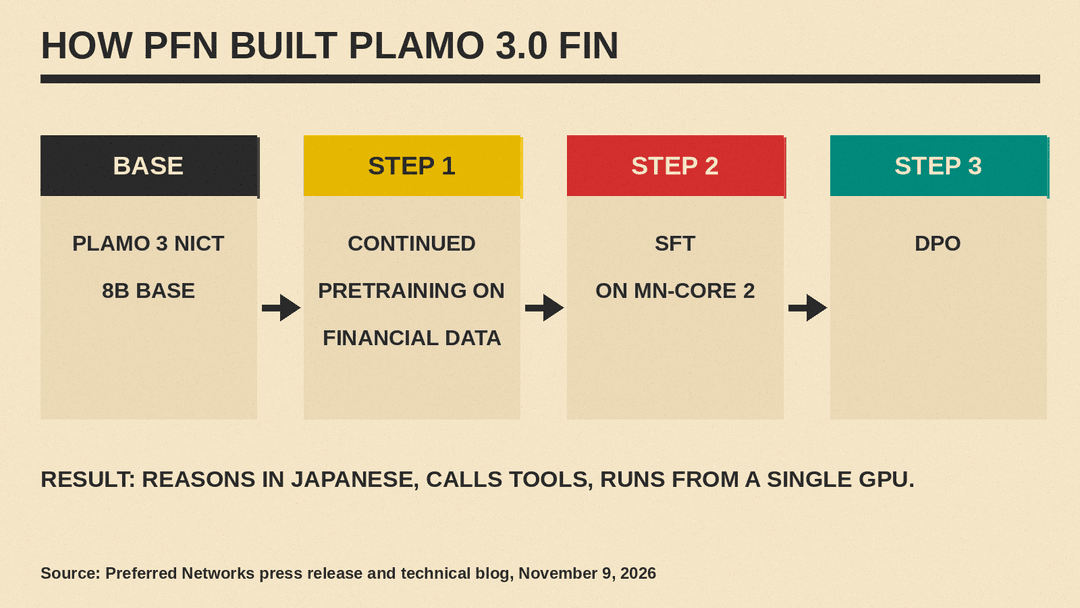
- Starts from PLaMo 3 NICT 8B Base, a pretrained model from PFN's joint research with Japan's National Institute of Information and Communications Technology (NICT).
- Adds continued pretraining on financial data centered on Japan, then supervised fine-tuning (SFT) and direct preference optimization (DPO).
- Reasons step by step before it answers, like other reasoning models, and writes that reasoning in Japanese. PFN says this makes it easier to check the basis for an answer.
- Can call outside tools, such as web search for current information, a calculator, or an internal database.
- Can run from a single GPU, in a closed cloud environment or on premises, according to the press release.
The model card lists a context length of 262,144 tokens, "the base model's maximum," and notes that financial pretraining "used sequences of up to 32,768 tokens." Japanese is the only listed language.
On size, PFN's blog and the model card describe it as an 8B model. The Hugging Face Hub metadata for the repository counts about 8.5 billion parameters in the weight files, as checked on November 9, 2026.
Trained in part on PFN's own chip
PFN ran the instruction-following training step (SFT) on MN-Core 2, an AI chip it designed itself, on its Preferred Computing Platform (PFCP). PFN says a porting method built around a coding agent let developers without deep MN-Core 2 knowledge port the SFT code, including multi-board distributed training, within a week, and that training then ran at practical speeds on par with a GPU setup. These are PFN's own claims, with no third-party measurement. The blog says continued pretraining and DPO ran on NVIDIA H100 GPUs.
Benchmark claims
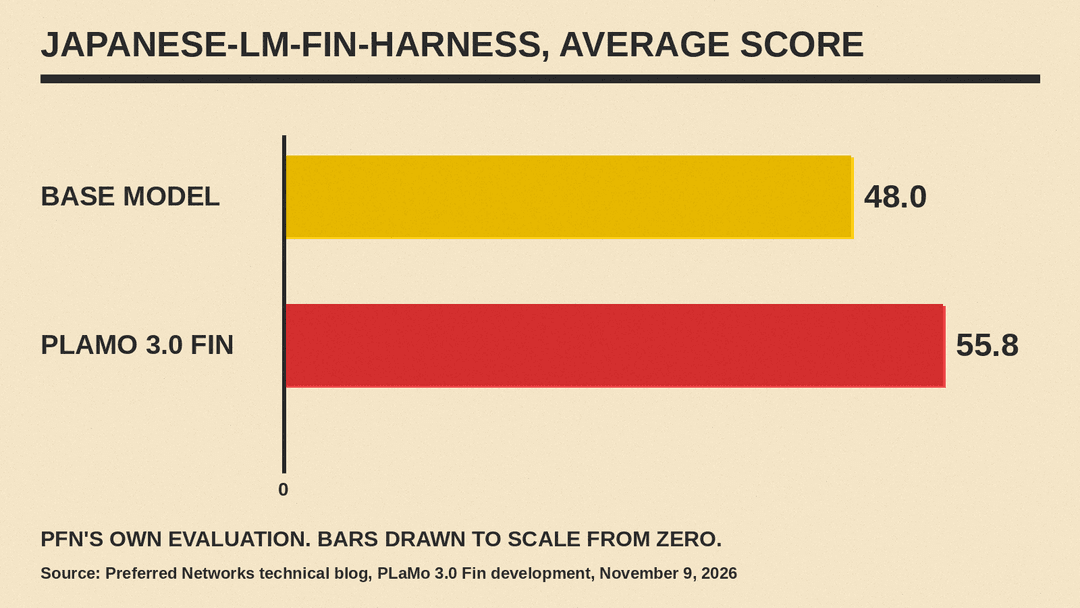
PFN's blog reports one headline figure. On japanese-lm-fin-harness, a benchmark of Japanese financial knowledge, the average score rose from 48.0 for the base model to 55.8 for PLaMo 3.0 Fin. The blog also says the model placed mid-tier or higher among comparison models of the same size or larger on several Japanese finance benchmarks. Both results come from PFN's own evaluation.
Intended uses and stated limits
The press release lists example tasks: routing customer inquiries, extracting and checking data from application forms (for example in know-your-customer checks), analyzing fraud alerts, and analyzing borrowers' business conditions.
PFN's blog also lists weak points. With many tools available, the model often reasons at length without settling on a tool and fails to reach an answer. On a tool-use benchmark, 5 to 10 of 540 samples hit the context limit without an answer. PFN recommends giving the model only a small set of tools at a time. The blog also warns that, as an 8B model, it can give plausible but wrong answers, and it recommends checking facts and numbers with tools and human review.
The model card goes further. It says outputs "do not constitute legal, financial, tax, or investment advice," and that apps built on it "should not be used to make investment decisions on a user's behalf." It also asks for human confirmation "before any action with real-world effects, such as placing orders or transferring funds."
The license
The weights use the PLaMo Community License, not a standard open source license. The license page says it was established on February 25, 2025 and revised on November 9, 2026, the same day as this release. Key terms in the English text:
- Commercial use requires prior registration with PFN, and the user's or its affiliated company's annual revenue or sales "must not exceed 1 billion yen." Above that, a separate commercial license from PFN is needed. The Japanese press release words the threshold as less than 1 billion yen in the most recent fiscal year.
- Anyone who shares the model or a derived model must show "Built with PLaMo" and include "PLaMo" in the derived model's name.
- Models trained on PLaMo outputs count as derived models under the same terms.
- The agreement runs until termination. It has no renewal clause, but PFN may modify it after notifying users, and may end it at once if a user breaks its terms.
Our guide on how to read an AI model card covers terms like these, and open-weight vs closed AI models explains the wider difference.
How to try it
The model card shows loading through Hugging Face Transformers with trust_remote_code=True, and PFN's blog adds that vLLM has a PLaMo 3 parser for reasoning and tool calls. PFN also offers the model in beta as plamo-3.0-fin-beta through PLaMo API and PLaMo Chat, with a free plan that has usage limits.
Why it matters
PLaMo 3.0 Fin is a small, Japanese-only, finance-only model, trained partly on PFN's own chip and built for closed cloud or on-premises use. PFN's case, in the press release, is that running a large model on every high-volume finance task can cost more than it returns, and that sensitive customer data calls for secure closed environments. The license cap means larger institutions need a separate commercial deal with PFN.
