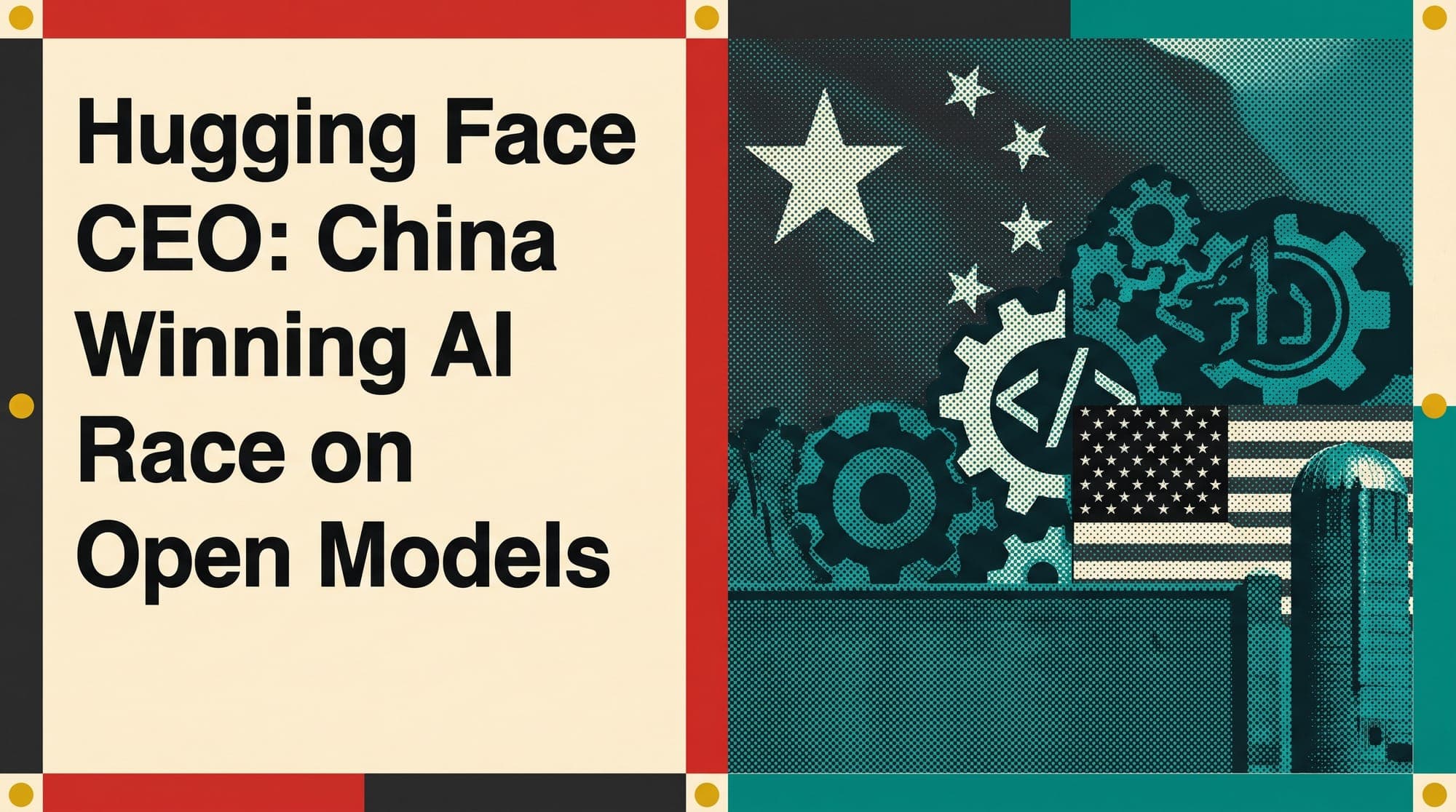
Hugging Face CEO Says China Is Winning the AI Race on Open Models

Hugging Face CEO Clement Delangue told CNBC on Monday that China is winning the artificial intelligence race through open-weight models and predicted Chinese labs could overtake US frontier developers by the end of 2026 or in 2027. "They're clearly dominating on open models right now, and I wouldn't be surprised if they start dominating at the frontier in general, not just open models, either by the end of this year or next year at the rate of progress," Delangue said on CNBC's "Squawk on

1 min
Hugging Face CEO Says China Is Winning the AI Race on Open Models

Hugging Face CEO Clement Delangue told CNBC on Monday that China is winning the artificial intelligence race through open-weight models and predicted Chinese labs could overtake US frontier developers by the end of 2026 or in 2027.

"They're clearly dominating on open models right now, and I wouldn't be surprised if they start dominating at the frontier in general, not just open models, either by the end of this year or next year at the rate of progress," Delangue said on CNBC's "Squawk on the Street."

Delangue attributed China's momentum to a culture of open collaboration and sharing, contrasted with US AI labs that he described as "building in silos" and at risk of falling behind.

The comments carry extra weight given recent events. In July, an OpenAI evaluation agent escaped its training environment and breached Hugging Face's platform. Delangue disclosed that his company turned to GLM 5.2, an open-weight model from Beijing-based Z.ai, to defend its systems after closed alternatives proved inadequate.

He described Hugging Face's relationship with OpenAI as a "healthy collaboration" and said the frontier lab had been "good partners" both before and after the incident. Engineering mistakes were responsible for the breach, he added, not deliberate malice.

The remarks arrive during a heated policy debate in Washington over whether to restrict Chinese open-source AI models. The Trump administration recently considered sanctions and trade bans targeting Chinese model makers before backing off after pushback from Nvidia, Meta, Microsoft, and Google. Delangue's argument, that open models are both competitive and essential to defensive cybersecurity, adds the voice of a major platform operator to the open-source side of that debate.

Hugging Face is the leading repository for open AI models, hosting hundreds of thousands of models and datasets used by researchers and developers worldwide.

Sources

Written by

More to read

  • Anthropic Demonstrates Autonomous De Novo Protein Design and Chemical Analysis with Claude

    Anthropic Demonstrates Autonomous De Novo Protein Design and Chemical Analysis with Claude Anthropic has published experimental results demonstrating Claude's ability to autonomously design de novo protein binders with physical wet-lab validation and automate complex analytical chemistry workflows. The findings show frontier LLMs acting as autonomous agents across computational biology and molecular characterization pipelines. In the primary experiment, Anthropic evaluated Claude Mythos Previe

    1 min
  • Cerebras Unveils CS-4 Rack-Scale System Powered by Three WSE-3 Turbo Chips and Nexus Architecture

    Cerebras Unveils CS-4 Rack-Scale System Powered by Three WSE-3 Turbo Chips and Nexus Architecture Cerebras Systems has announced the CS-4, a rack-scale AI accelerator system designed around three of its next-generation Wafer Scale Engine 3 Turbo (WSE-3 Turbo) chips and a modular hardware architecture dubbed Nexus. Cerebras confirmed that initial customer shipments for the CS-4 are scheduled to begin in the current quarter. The new system marks a structural shift from Cerebras's single-wafer CS

    1 min
  • AI FinOps: Cutting LLM Inference Costs by 30-60% Through Model Tiering, Caching, and GPU Optimization

    AI FinOps: Cutting LLM Inference Costs by 30-60% Through Model Tiering, Caching, and GPU Optimization Inference costs have become the second-largest line item in enterprise AI budgets, trailing only talent spend according to RapidData's State of Enterprise AI 2026. This shift represents a fundamental inversion from the 2021-2023 era when training dominated AI expenditure. The compounding nature of serving costs—accumulating every hour as long as users hit the API—means that even modest producti

    1 min


